Flood misery in Philippines after typhoon kills 22
Huge rain band ensured more downpours while flooding swept within 40 kilometres of Manila
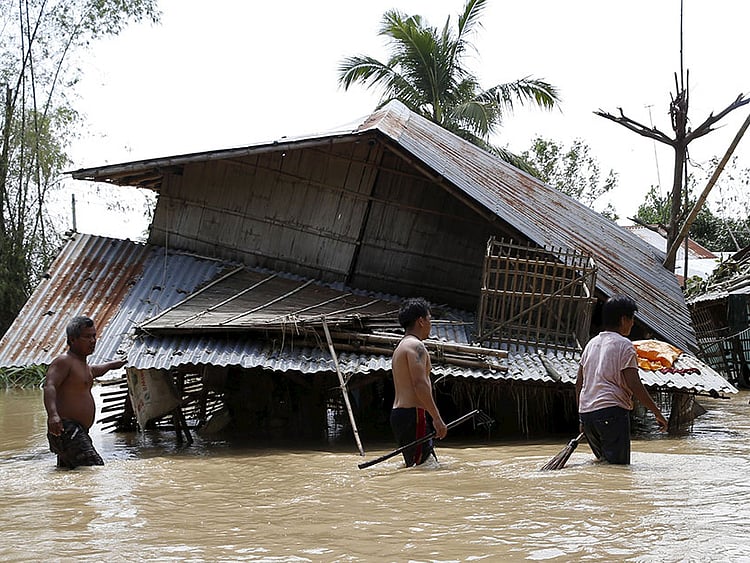
La Paz, Philippines: Head-high floodwaters churned across vast farming regions of the northern Philippines on Tuesday as heavy rain compounded the misery of a typhoon that killed at least 22 people and displaced thousands.
Koppu weakened into a tropical storm and moved into the South China Sea by Tuesday morning, but its huge rain band ensured more downpours while flooding swept within 40 kilometres (25 miles) of Manila, the capital.
Rice farmer Jeffrey de la Torre, 32, woke up to water flowing through his shanty for a second day, dangerously close to the top of a dining table used by the family of five as an emergency bed.
“We’re miserable. I hardly get any sleep. I’m scared the water might rise,” said de la Torre, a father of three young children from the small farming town of La Paz, 95 kilometres (59 miles) north of Manila.
“I just hope our rice stock is enough. Our farm was wiped out so, for now I’m out of work.”
De la Torre spoke to AFP as he waded across a flooded road to beg a friend for fish to feed his wife and children, aged between three and eight.
Koppu, the second strongest storm to hit the Philippines this year, forced 70,000 people from their homes and impacted about 230,000 others across the main island of Luzon, the government’s disaster management agency said.
Twenty-two people were killed in floods, landslides and boat accidents, as well as by flying debris, according to an AFP tally based on confirmed figures from national and local authorities.
Floods as high as rooftops covered some of the nation’s most important rice and corn farming regions in the flat plains north of Manila that are either side of three giant mountain ranges.
While the water had subsided on Tuesday in many areas closer to the ranges, the flooding moved downstream.
With the heavy rain continuing over the Cordillera ranges in the north and dams almost at capacity, more water was expected to flow down throughout the week.
More than 200 villages in the farming regions were submerged on Tuesday, with some areas more than 1.5 metres (five feet) under water, according to the local Civil Defence office and regional officials.
In the large coastal town of Lingayen, 170 kilometres north of Manila, residents were taken by surprise on Monday night after the Agno river broke its bank and led to neck-deep floods.
“We thought the danger had already passed,” municipal disaster officer Sharon Sison told AFP, referring to Koppu slashing through the town of 100,000 people late on Saturday.
Sison said local rescue workers and volunteers on boats picked up more than 2,000 people who were stranded in their homes or on the roofs.
The Philippines endures about 20 major storms a year, many of them deadly.
The islands of the Southeast Asian archipelago are often the first major land mass that the storms hit after emerging over the Pacific Ocean.
Scientists have warned climate change will mean more frequent and intense storms.
The most powerful storm ever recorded on land, Super Typhoon Haiyan, hit the Philippines in 2013, leaving at least 7,350 people dead or missing.
While the latest storm has not been one of the deadliest, it will condemn many thousands of already financially struggling farmers to deeper poverty.
On the outskirts of Cabanatuan, a regional trading centre about three hours’ drive north of Manila, receded floodwaters on Monday revealed vast swathes of rice crops destroyed, their green blades turned brown, flattened and withered.
Farmers and other residents, their legs and arms caked in mud, wrung mattresses and blankets by the roadside to squeeze out brown water.
“If we don’t clean this up fast, we’ll get sick,” tricycle driver Dennis Punzalan told AFP, his feet buried in thick, slimy mud, as he threw his five-year-old daughter’s teddy bears on to a pile of rubbish.
Sign up for the Daily Briefing
Get the latest news and updates straight to your inbox
Network Links
GN StoreDownload our app
© Al Nisr Publishing LLC 2026. All rights reserved.