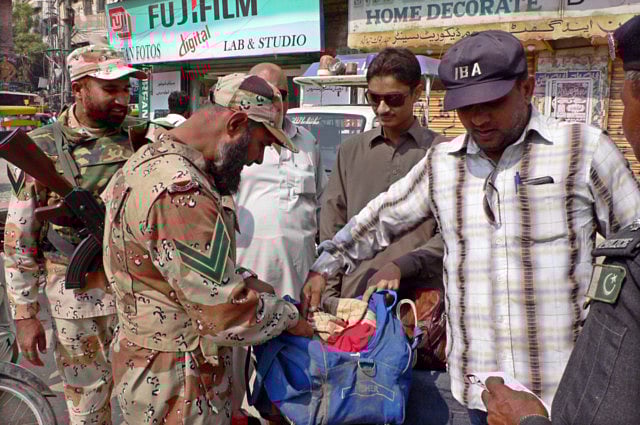
Islamabad: After a decade of terrorist attacks, Pakistan is implementing a new legal framework to deal with its growing militant threat — what some are calling a local version of the USA Patriot Act.
The government says the measure will improve an anti-terrorism effort plagued by inefficiency and abuses. At times, security forces have swept up thousands of suspected Islamist militants without charge, outraging human rights activists. When terrorism suspects do go before a judge, however, they are often freed, dismaying Western officials.
“This law is war, declared war, against those who challenge the state,” said Khawaja Zaheer, the senior justice adviser to Prime Minister Nawaz Sharif. “This law is intended to do what should have been done in 2001 or 2002,” in the aftermath of the attacks on the World Trade Centre and the Pentagon.
But in a debate that mirrors the controversy over the USA Patriot Act, activists argue that the new measure will lead to widespread abuses.
“People are already being detained, people are already being kept in internment camps, people are already involuntarily disappeared,” said I.A. Rehman, secretary general of Pakistan’s Human Rights Commission, an independent Lahore-based body. “The only thing they want to do with this is give even more special powers to security forces to detain.”
For years, Pakistan’s leaders have lurched between tough talk on terrorism and sympathetic outreach to some militant groups. This week Sharif condemned a US drone strike that killed the leader of the Pakistani Taliban, Hakimullah Mehsud, days before planned talks between the group and the Pakistani government.
Still, with Sharif facing pressure from Western governments to act, he has been quietly building a legal framework that could underpin a potential military offensive against the Taliban should talks fail.
“The organised mafia is roaming free due to [a] legal vacuum,” Sharif wrote in a letter asking lawmakers to support the plan.
Last year, there were more than 1,577 terrorist attacks in Pakistan, resulting in 2,050 deaths, according to the Pak Institute for Peace Studies. Another group, the South Asia Terrorism Portal, reported 3,007 civilian deaths in Pakistan last year linked to terrorism, and 2,745 through October of this year.
Currently, Pakistan tries all terrorism cases in overburdened local courts, and it can take years to complete such a trial. During a recent meeting at the White House, President Barack Obama asked Sharif why seven Pakistanis suspected in the 2008 Mumbai attacks still haven’t been tried, the prime minister told local reporters.
Sharif didn’t reveal his response to Obama.
In 2010, a US State Department report said 75 per cent of terrorism suspects in Pakistani provincial courts were eventually freed last year, a local court acquitted four men accused of being part of a 2010 plot to detonate a car bomb in New York’s Times Square. The verdict caused outrage in Washington.
Pakistan is now seeking to establish a federal court system to try some terrorism suspects.
Zafarullah Khan, Pakistan’s justice secretary, said the new ordinance will lead to a “quick disposal of justice” while also abiding by Pakistan’s constitution.
“As a citizen of Pakistan, I would have preferred this was done 10 years ago when everyone else around the world responded, but we were not that serious,” Khan said.
But activists are deeply sceptical. They point to a 2009 military campaign in the northwestern Swat Valley that temporarily displaced more than two million residents.
The Human Rights Commission said in October that there were still 2,000 men missing in Khyber Pakhtunkhwa province, many of whom it suspects were detained during the military operations in the Swat Valley. Earlier this year, Pakistan’s attorney general said only 700 people were being held in internment centres.
Those detained, and their relatives, say it’s often unclear why people are jailed or where they are held.
Lubna Khan, a homemaker, said she’s been looking for her husband for four years, since he was picked up by authorities as he drove from their farm near Peshawar to Islamabad.
“If he is in the custody of the security agencies, let them admit that so I can relax,” she said. “But no one is saying where he is.”
One 30-year-old man, who asked that he be identified only by his last name of Khan (a common Pakistani surname), said in an interview that he was picked up by officers in plainclothes while riding his motorbike in northwest Pakistan in June. He said he was blindfolded and detained for 25 days without being told why.
“They did not torture me, just kept me alone,” he said.
Activists criticise the new ordinance as having many harsh and ill-defined passages. They note, for example, that it allows security forces to open fire on individuals who are even suspected of preparing to destroy property.
The measure also states that enemy aliens “may be detained by the government for such period as may be determined by it from time to time.”
The 1.5 million to three million Afghan refugees in Pakistan could be especially vulnerable to that provision, activists say, noting that many do not have proper documentation and that the ordinance considers “crossing national boundaries” as “waging war against Pakistan.”
Sign up for the Daily Briefing
Get the latest news and updates straight to your inbox
Network Links
GN StoreDownload our app
© Al Nisr Publishing LLC 2026. All rights reserved.