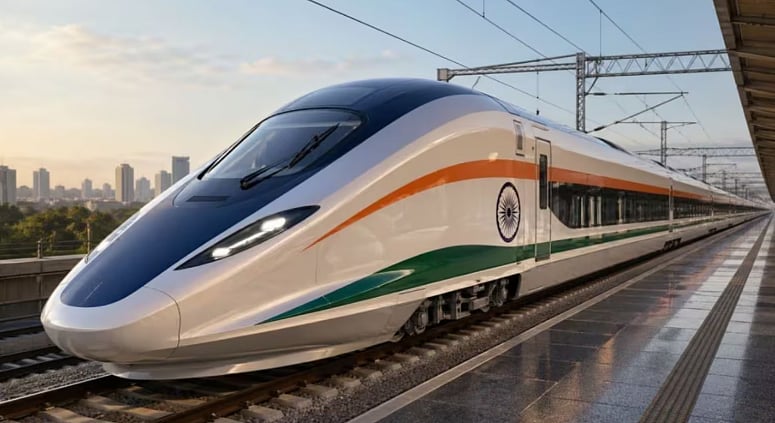
A proposed high-speed rail corridor between Delhi and Ahmedabad could eventually become part of a wider bullet train network connecting India's national capital with Mumbai. If the two routes are developed and integrated, a journey of nearly 1,400km could potentially take around six hours.
According to NDTV, the proposed Delhi-Ahmedabad corridor is envisaged as an extension of the under-construction Mumbai-Ahmedabad High-Speed Rail project. Together, the routes could link Delhi, Rajasthan, Gujarat and Mumbai through high-speed rail.
Get updated faster and for FREE: Download the Gulf News app now - simply click here.
Meanwhile, India's homegrown B28 bullet train is taking shape at Bharat Earth Movers Limited's (BEML) facility in Bengaluru. The train is being developed as part of the country's efforts to build its own high-speed rail technology.
However, the developments are at different stages. Construction is under way on the Mumbai-Ahmedabad corridor, while the Delhi-Ahmedabad route remains at the planning stage. Here is what has been proposed, which cities could benefit and how India's bullet train programme is progressing.
Delhi to Ahmedabad in under four hours?
The proposed Delhi-Ahmedabad corridor would cover approximately 886km and is expected to reduce the journey between the two cities to less than four hours.
At present, a conventional train journey between Delhi and Ahmedabad takes around 14 hours, according to project details reported by The Times of India.
If the proposed route is eventually connected to the Mumbai-Ahmedabad corridor, the Delhi-Mumbai journey could take around six hours or less. This is a long-term possibility, however, and not an officially announced travel-time target.
For comparison, the fastest regular train currently connecting Delhi and Mumbai takes around 15 hours and 40 minutes.
Which cities could the bullet train connect?
The proposed route would begin at Dwarka Sector 21 in Delhi before passing through Haryana, Rajasthan and Gujarat.
According to the detailed project report prepared by the National High Speed Rail Corporation Limited (NHSRCL), 15 stations have been proposed:
Delhi: Dwarka
Haryana: IMT Manesar and Rewari
Rajasthan: Behror, Shahpura, Jaipur, Ajmer, Vijaynagar, Bhilwara, Chittorgarh, Udaipur and Dungarpur
Gujarat: Himmatnagar, Gandhinagar and Ahmedabad
The proposed alignment would be entirely elevated. It is planned to follow parts of existing railway routes and highways to reduce the need for private land acquisition.
An NHSRCL official told The Times of India that the alignment had been selected to minimise the time required to acquire privately owned land. However, land acquisition has yet to begin, and several preparatory steps would be needed before construction could start.
Why is the Delhi-Ahmedabad link still pending?
The Delhi-Ahmedabad corridor was among the routes considered under India's bullet train plans. However, it has not received the same implementation push as the Mumbai-Ahmedabad project.
The distinction is important: the Mumbai-Ahmedabad corridor is under construction, while the Delhi-Ahmedabad proposal has yet to receive formal sanction for execution.
The Union Budget 2026-27 announced seven new high-speed rail corridors, including Delhi-Varanasi, but did not include Delhi-Ahmedabad.
Its omission does not mean the project has been abandoned. However, it currently has no confirmed construction timeline.
Moving ahead would require decisions on the detailed project report, financing, land acquisition, clearances and construction.
India's homegrown B28 bullet train takes shape
India's homegrown B28 bullet train is being manufactured at BEML's facility in Bengaluru, Karnataka, according to a recent report by Firstpost's Vantage programme.
Railway Minister Ashwini Vaishnaw has shared footage of the train under development, highlighting the country's push to build its own high-speed rail technology.
Also referred to as Bharat 28 or Vande Bullet, the B28 is being developed for the Mumbai-Ahmedabad High-Speed Rail corridor. It is designed to reach speeds of up to 280kmph.
The train is being developed with 25kV AC traction technology and regenerative braking. Proposed passenger features include ergonomic seating, infotainment systems and accessibility facilities.
According to the Firstpost report, trials could take place in May or June 2027.
The report also said talks with Japan over the Shinkansen trains originally expected to operate on the Mumbai-Ahmedabad corridor had stalled.
India is also working on a faster train, the B35, which is expected to have a top speed of up to 350kmph, Firstpost reported.
Why the Mumbai-Ahmedabad project matters
The 508km Mumbai-Ahmedabad High-Speed Rail corridor is India's first dedicated bullet train project. It is being developed with Japanese technical and financial assistance and will have 12 stations across Maharashtra, Dadra and Nagar Haveli, and Gujarat.
The line is designed for speeds of up to 350kmph, with an operational speed of 320kmph. The fastest services are expected to cover the route in around two hours.
In July 2026, the government said the first service was expected to begin in August 2027 on the Surat-Vapi section. The full corridor is a separate, longer-term undertaking.
Construction has faced delays, including land acquisition challenges in Maharashtra, and the project's cost has increased substantially from its original estimate. Nevertheless, work is continuing.
A major construction milestone in Vadodara
The Mumbai-Ahmedabad project recently reached an important construction milestone in Gujarat, with the completion of 14 portal beams over the Delhi-Mumbai Rajdhani railway line in Vadodara.
The 8.3km Vadodara stretch crosses five Indian Railways lines, including two main lines. The completed portal beams will allow the next stage of work: installing 40-metre-long composite girders to advance construction of the elevated viaduct.
The milestone was reported by The Hindu, which cited NHSRCL officials.
What could the wider network mean for businesses and travellers?
A connected Delhi-Ahmedabad-Mumbai high-speed rail network could do more than reduce travel times between major cities.
Delhi-NCR, Ahmedabad and Mumbai are important centres for government, industry, trade, services and finance. Faster passenger connections could make business travel easier, improve access to jobs and education, and strengthen links between companies and markets.
Cities along the proposed route, including Jaipur, Ajmer, Udaipur and Gandhinagar, could also benefit from better access to major commercial and tourism centres.
However, these benefits are not guaranteed. Ticket prices, service frequency, station locations and connections with local transport would all influence how widely the network is used.
Why the proposed link matters
India's dedicated freight corridors are designed to move goods more efficiently, while high-speed rail is primarily intended for passenger travel. Both form part of a wider infrastructure push to connect major economic centres and improve transport links.
The proposed Delhi-Ahmedabad corridor could become an important northern extension of India's high-speed rail network. But until it receives formal approval and moves into construction, a direct Delhi-Mumbai bullet train service remains a possibility rather than an imminent travel option.
For now, construction is progressing on the Mumbai-Ahmedabad project, the B28 is taking shape in Bengaluru, and the proposed Delhi-Ahmedabad extension remains at the planning stage.
Why the Mumbai-Ahmedabad project matters
The 508km Mumbai-Ahmedabad High-Speed Rail corridor is India's first dedicated bullet train project. It is being developed with Japanese technical and financial assistance and will have 12 stations across Maharashtra, Dadra and Nagar Haveli, and Gujarat.
The line is designed for speeds of up to 350kmph, with an operational speed of 320kmph. The fastest services are expected to cover the route in around two hours.
In July 2026, the government said the first service was expected to begin in August 2027 on the Surat-Vapi section. The full corridor is a separate, longer-term undertaking.
Construction has faced delays, including land acquisition challenges in Maharashtra, and the project's cost has increased substantially from its original estimate. Nevertheless, work is under way.
A major construction milestone in Vadodara
The Mumbai-Ahmedabad project recently reached an important construction milestone in Gujarat, with the completion of 14 portal beams over the Delhi-Mumbai Rajdhani railway line in Vadodara.
The 8.3km Vadodara stretch crosses five Indian Railways lines, including two main lines. The completed portal beams will allow the next stage of work: launching 40-metre-long composite girders to advance construction of the elevated viaduct.
The milestone was reported by The Hindu, which cited officials from NHSRCL.
What could the wider network mean for businesses and travellers?
A connected Delhi-Ahmedabad-Mumbai high-speed rail network could do more than reduce travel times between major cities.
Delhi-NCR, Ahmedabad and Mumbai are important centres for government, industry, trade, services and finance. Faster passenger connections could make business travel easier, improve access to jobs and education, and strengthen links between companies and markets.
Cities along the proposed route, including Jaipur, Ajmer, Udaipur and Gandhinagar, could also benefit from improved access to larger commercial and tourism centres.
However, these benefits are not guaranteed. Ticket prices, service frequency, station locations and connections with local transport would all influence how widely the network is used.
Why the missing link matters
India's dedicated freight corridors are designed to move goods more efficiently, while high-speed rail is primarily intended for passenger travel. Both reflect a broader infrastructure goal: connecting major economic centres and reducing the time and cost of transport.
The proposed Delhi-Ahmedabad corridor could become an important northern link in a wider high-speed rail network. But until the project receives formal approval and moves into construction, a direct Delhi-Mumbai bullet train service remains a possibility rather than an imminent travel option.
For now, the Mumbai-Ahmedabad project is moving ahead, while the proposed Delhi-Ahmedabad extension remains at the planning stage.
With inputs from ANI and IANS
Sign up for the Daily Briefing
Get the latest news and updates straight to your inbox
Network Links
GN StoreDownload our app
© Al Nisr Publishing LLC 2026. All rights reserved.