Police guard a school in Bangalore on March 15, 2022 after the court upheld a local ban on the hijab in classrooms.
UPDATE
India: Karnataka High Court upholds ban on hijab in schools and colleges
Rules hijab not essential religious practice of Islam, dismisses petitions challenging ban
Last updated:
7 MIN READ
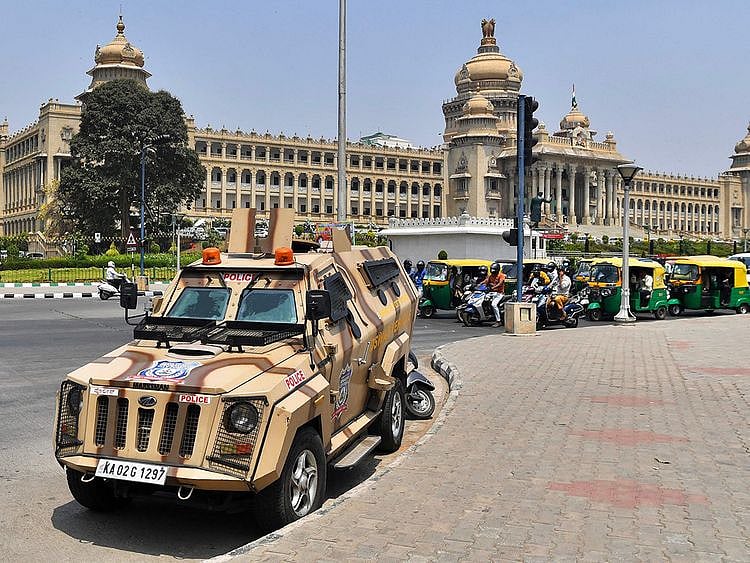
An armoured police vehicle parked outside the Karnataka Vidhana Soudha, Karnataka's legislative building, in Bangalore on March 15, 2022, after the court upheld a local ban on the hijab in classrooms, weeks after the edict stoked violent protests.
AFP
New Delhi: A court in a southern Indian state has upheld the ban on wearing hijab in schools and colleges, saying the Muslim headscarf is not an essential religious practice of Islam.
The high court in Karnataka state delivered the verdict Tuesday after considering petitions filed by Muslim students challenging a government ban on hijabs.
"We are of the considered opinion that wearing of hijab by Muslim women does not form a part of essential religious practice," Chief Justice Ritu Raj Awasthi of the High Court of Karnataka said in the judgement.
He said the government had the power to prescribe uniform guidelines, dismissing various petitions challenging the order. “We are of the considered opinion that the prescription of school uniform is only a reasonable restriction constitutionally permissible which the students cannot object to,” Awasthi said.
The High Court said that the history of mankind is replete with instances of abuse and oppression of women. The region and the times from which Islam originated were not an exception. The era before the introduction of Islam is known as Jahiliya-a time of barbarism and ignorance, the court observed.
The court said that “the Quran shows concern for the cases of ‘molestation of innocent women’ and therefore, it recommended wearing of this and other apparel as a measure of social security. Maybe in the course of time, some elements of religion permeated into this practice as ordinarily happens in any religion.”
“However, that per se does not render the practice predominantly religious and much less essential to the Islamic faith. This becomes evident from Ali’s footnote 3768 to verse 60 which concludes with the following profound line “Alas! We must ask ourselves the question: ‘Are these conditions present among us today?’ Thus, it can be reasonably assumed that the practice of wearing hijab had a thick nexus to the socio-cultural conditions then prevalent in the region,” the court said.
“The veil was a safe means for the women to leave the confines of their homes. Ali’s short but leading question is premised on this analysis. What is not religiously made obligatory therefore cannot be made a quintessential aspect of the religion through public agitations or by the passionate arguments in courts,” the Court noted.
“The Holy Quran does not mandate wearing of hijab or headgear for Muslim women. Whatever is stated in the above suras, we say, is only a directory, because of the absence of prescription of penalty or penance for not wearing hijab, the linguistic structure of verses supports this view. This apparel at the most is a means to gain access to public places and not a religious end in itself. It was a measure of women enablement and not a figurative constraint,” the court said in its order copy. Ahead of the verdict, Karnataka authorities announced closures of schools and colleges and imposed restrictions on public gatherings in some parts of the state to prevent potential trouble.
The dispute began in January when a government-run school in Karnataka's Udupi district barred students wearing hijabs from entering classrooms, triggering protests by Muslims.
More schools in the state followed with similar bans and the state's top court disallowed students from wearing hijab until it delivered a verdict.
Ayesha Imthiaz, a third-year undergraduate student in the Karnataka district of Udupi where the protests began, said she would either drop out of her government-aided college or opt for a correspondence course. She said her fellow Muslim female students were planning to do the same.
“We can’t take off the hijab, we won’t take off the hijab,” she said. “We have fifth semester exams next month. We will have to sit that out unless things change by then.” Ahead of the verdict, Karnataka authorities announced closures of schools and colleges and imposed restrictions on public gatherings in some parts of the state to prevent potential trouble.
National precedent
Last month, Federal Home Minister Amit Shah said he preferred students sticking to school uniforms instead of any religious attire. Currently, there is no central law or rule on school uniforms across the country, but the Karnataka ruling could prompt more states to issue such guidelines.
The Students Islamic Organisation of India, which represents thousands of Muslim students across the country, said their fear was that Tuesday’s verdict would encourage more states to ban the hijab in class.
“We don’t want it to set a national precedent and we want it overturned,” its national secretary Musab Qazi said. “The court verdict might embolden more states to ban it. So in all likelihood, we will approach the Supreme Court.”
‘Deeply disappointing’
Students who had challenged the ban in court had said wearing the hijab was a fundamental right guaranteed under India’s constitution and an essential practice of Islam. Reuters could not immediately contact the challengers.
Muslim politicians, including the former chief minister of Jammu and Kashmir state, Mehbooba Mufti, called the verdict “deeply disappointing”.
“On one hand we talk about empowering women yet we are denying them the right to a simple choice,” she wrote on Twitter. “It isnt just about religion but the freedom to choose.” Karnataka ministers told reporters that Muslim female students who are staying away from class in protest against the ban should respect the judgement and rejoin school.
The ban had led to protests in some other parts of the country too and drew criticism from the United States and the Organisation of Islamic Cooperation.
Counsels to take call on approaching apex court
The counsels appearing for students said they will soon decide on approaching the Supreme Court.
“We will obtain the copy of the order and see whether we can approach the SC on this matter,” advocate Shatabish Shivanna, who appeared for the petitioners, said.
The court has given the verdict after hearing arguments and counterarguments for 11 days. The copy of the order is yet to be obtained. After studying the order, a decision will be taken, he reiterated.
Meanwhile, MLC C.M. Ibrahim, who submitted resignation to the Congress and from the post of MLC, stated that they will challenge the order in the Supreme Court. “I have spoken to the advocates in Mumbai in this regard. No one should come out on the streets,” he said.
Opposition leader Siddaramaiah stated that the party was of the view that hijab didn’t cause any problems for others and they wear it along with the uniform. Now, when the court decision has come, the matter is over.
Former Chief Minister B.S. Yediyurappa stated that all should respect the verdict of the High Court and he appealed to the people not to rake up the controversy again.
Court order suspended freedom of religion: Owaisi
All India Majlis-e-Ittehadul Muslimeen (AIMIM) president Asaduddin Owaisi said the judgment has suspended fundamental rights to freedom of religion, culture, freedom of speech and expression.
The Hyderabad MP observed that one religion has been targetted and its religious practice banned. He said the High Court order has forced kids to choose between education and Allah’s commands.
Owaisi reacted to the High Court order with a series of tweets.
“For Muslims it’s Allah’s command to be educated while also following his strictures (salah, hijab, roza, etc). Now govt is forcing girls to choose. So far judiciary has declared masjids, keeping a beard & now hijab as non-essential. What is left of free expression of beliefs?,” he asked.
He hoped that this judgment will not be used to legitimise harassment of hijab wearing women. One can only hope and eventually be disappointed when this starts happening to hijab wearing women in banks, hospitals, public transport etc, he said.
He hoped that petitioners would appeal before the Supreme Court. He also hoped that All India Muslim Personal Law Board (AIMPLB) and organisations of other religious groups would appeal against this judgment.
“Preamble to the Constitution says that one has LIBERTY of thought, EXPRESSION, belief faith, and WORSHIP. If it is MY belief & faith that covering my head is essential then I have a right to EXPRESS it as I deem fit. For a devout Muslim, Hijab is also an act of worship,” he wrote.
“It’s time to review the essential religious practice test. For a devout person, everything is essential; for an atheist nothing is essential. For a devout Hindu Brahmin, janeu is essential but for a non-Brahmin it may not be. It is absurd that judges can decide essentiality,” the MP added.
He opined that even other people of the same religion have no right to decide essentiality. “It is between the individual and God. State should be allowed to interfere in religious rights only if such acts of worship harm others. Headscarf does not harm anyone.”
The MP also stated that banning headscarf definitely harms devout Muslim women and their families as it prevents them from accessing education. “The excuse being used is that uniform will ensure uniformity. How? Will kids not know who’s from a rich/poor family? Do caste names not denote background?,” he asked.
“What does uniform do to prevent teachers from discriminating? Globally, the experience has been that reasonable accommodations are made in school, police & army uniforms to reflect diversity.”
Owaisi recalled that when Ireland’s government changed the rules for police uniform to allow Hijab and Sikh turban, Modi government had welcomed it.
“So why double standards at home &; abroad,” he asked, adding that hijab and turbans of the uniform’s colours can be allowed to be worn.
“What is the consequence of all of this? First, govt created a problem where none existed. Children were wearing hijab, bangles, etc &; going to school. Second, violence was instigated and counter-protests were held with saffron turbans. Are saffron turbans “essential”? Or only a “reaction” to hijab? Third, GO &; HC order suspended fundamental rights. We saw media, police; admin harass hijab wearing students &; even teachers. Kids have been even banned from writing exams. It’s a mass violation of civil rights,” the MP wrote.
CM warns of stern action against those who disturb peace
Chief Minister Basavaraj Bommai on Tuesday said that stern action will be initiated against those who disturb peace in the state.
“This is the question of our children and it is also the question of their future,” he said.
There is nothing more important than education for the children. The judgment of three-judge bench must be followed by all. When the verdict is implemented, the people must cooperate with the authorities, he said.
“I appeal to all parents, community leaders to abide by the court orders and allow children to get education. It should be seen to it that no one remains outside and students must now focus on building their future,” he explained.
The police have beefed up security and everyone should accept the verdict. If anyone takes law and order into their hands they will be dealt with sternly, he warned. The High Court has settled the matter now, he said.
Sign up for the Daily Briefing
Get the latest news and updates straight to your inbox
Network Links
GN StoreAbout Gulf NewsTerms & ConditionsReach by GNSitemapContact usPrivacy PolicyGN FocusHave your sayWork with usAdvertise with usGulf News epaperPrinting Services
Download our app
© Al Nisr Publishing LLC 2026. All rights reserved.