India: Anti-’Agnipath’ protests turn violent in Bihar, 3 trains set ablaze
Youths vent anger by lying down on railway tracks and blocking roads
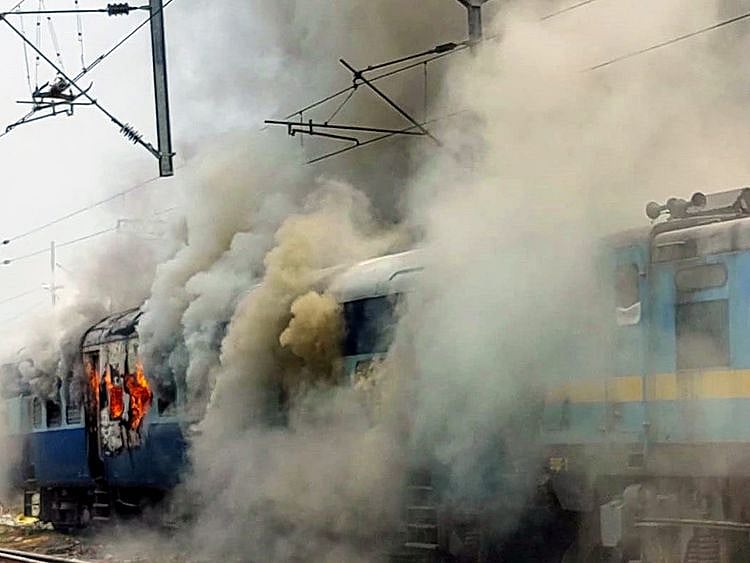
Chhapra (Bihar): At least three trains were set on fire in Bihar as protests against a new military recruitment system called ‘Agnipath’ turned violent in the Chhapra, Gopalganj and Kaimur districts on Thursday.
Several aspirants for the armed forces are unhappy with the changes introduced under the new recruitment scheme for the Indian Army, particularly the length of service, no pension provisions for those released early, and the 17.5 to 21-year age restriction that now makes many of them ineligible.
Agitations have spilled over to several districts as youths protested by lying down on the railway tracks, and blocking roads, demanding the scrapping of the scheme.
“They are protesting on the railway tracks. We are trying to pacify them. We are making an effort to clear the railway track. We are monitoring the situation,” Rakesh Kumar, Superintendent of Police, Kaimur, told reporters.
Huge crowds gathered in the Chhapra, Jehanabad, Munger and Nawada areas of Bihar, demanding the withdrawal of the Agnipath scheme.
Why protests?
The new recruitment system, called Agnipath or "path of fire" in Hindi, will bring in men and women between the ages of 17-and-a-half and 21 for a four-year tenure at non-officer ranks, with only a quarter retained for longer periods. Previously, soldiers have been recruited by the army, navy and air force separately and typically enter service for up to 17 years for the lowest ranks. The shorter tenure has caused concern among potential recruits. "Where will we go after working for only four years?" one young man, surrounded by fellow protesters in Bihar's Jehanabad district, told ANI. "We will be homeless after four years of service. So we have jammed the roads." The new policy has drawn criticism and questions from a section of veterans. Crit-ics have argued that a four-year tenure will hit fighting spirit in the ranks and make them risk-averse. Among the veterans, Major General BS Dhanoa (retired) tweeted, "Two serious recommendations to the just-announced recruitment policy for the armed forces; a. Increase the service period of new recruits to a min of seven years b. Make the retention of those keen to serve longer at least 50 per cent." Retired general Birender Dhanoa told AFP that India's 1.4 million-strong military was "bloated" and in need of reform, but questioned whether the scheme was the appropriate remedy. "Four years is a little on the shorter side and feels exploitative," he said. "We have to examine whether it works well for the armed forces too."
A group of army aspirants protested at Bhabua Road Railway Station and blocked the tracks before setting a train on fire.
“We prepared for a long and now they have brought ToD (Tour of Duty) as a four-year job. We want the old recruitment process back,” protesters said.
The federal cabinet on Tuesday approved the Agnipath recruitment scheme which provides an opportunity for Indian youth to serve in the regular cadre of the Armed Forces for a period of four years.
The scheme has been designed to enable a youthful profile of the Armed Forces and provide a fresh lease of ‘Josh’ and ‘Jazba’ whilst at the same time bringing about a transformational shift towards a more tech-savvy Armed Forces - which is indeed the need of the hour.
The selection will be the exclusive jurisdiction of the Armed Forces. A total of 46,000 Agniveers (soldiers) will be recruited this year.
“We demand that the recruitment be done as it used to be done earlier. Tour of Duty (ToD) be rolled back and exams are held as earlier. Nobody will go to Army just for four years, a protestor in Munger told ANI.
Making armed forces future-ready
Agnipath scheme aims to make the Army a future-ready fighting force capable of meeting multiple challenges across the full spectrum of conflict, Indian Army Chief General Manoj Pande said on Tuesday.
Defence Minister Rajnath Singh, with three services chiefs General Manoj Pande (Army), Air Chief Marshal VR Chaudhari and Admiral R Hari Kumar (Navy), addressed a joint press conference, while unveiling the new scheme.
“Agnipath scheme aims to make the Army a future-ready fighting force capable of meeting multiple challenges across the full spectrum of conflict and it will increase the technical threshold of the Army by recruiting ‘Agniveers’ through ITIs and other tech-institutes, said General Manoj Pande, the Army Chief.
But some army aspirants are unhappy with the Ministry of Defence’s new scheme for recruitment of youth into the armed forces.
“We work hard to get inducted into the Armed forces. How will the service be for four years, with months of training and leaves? How will we protect the nation after getting trained for just three years? The Government has to take back this scheme,” said an irate aspirant in Bihar’s Jehanabad.
Previously, soldiers have been recruited by the army, navy and air force separately and typically enter service for up to 17 years for the lowest ranks.
The shorter tenure has caused concern among potential recruits.
“Where will we go after working for only four years?” one young man, surrounded by fellow protesters in Bihar’s Jehanabad district, told Reuters partner ANI. “We will be homeless after four years of service. So we have jammed the roads.” Bihar and neighbouring Uttar Pradesh saw protests over the recruitment process for railway jobs in January this year.
Students in Uttar Pradesh blocked the GT road in Bulandshahr and raised slogans demanding the withdrawal of the scheme which allow short-term recruitment in the armed forces.
The district officials had a tough time in persuading the protesters to call off the blockade. The protesters submitted a memorandum to the district magistrate.
In Gonda, the protests were led by students who carried placards and shouted slogans against the scheme.
Similarly, in Unnao too, protests were held with students and unemployed youth demanding that recruitment be done in the traditional way instead of short-term contract.
Sign up for the Daily Briefing
Get the latest news and updates straight to your inbox
Network Links
GN StoreDownload our app
© Al Nisr Publishing LLC 2026. All rights reserved.