New Delhi
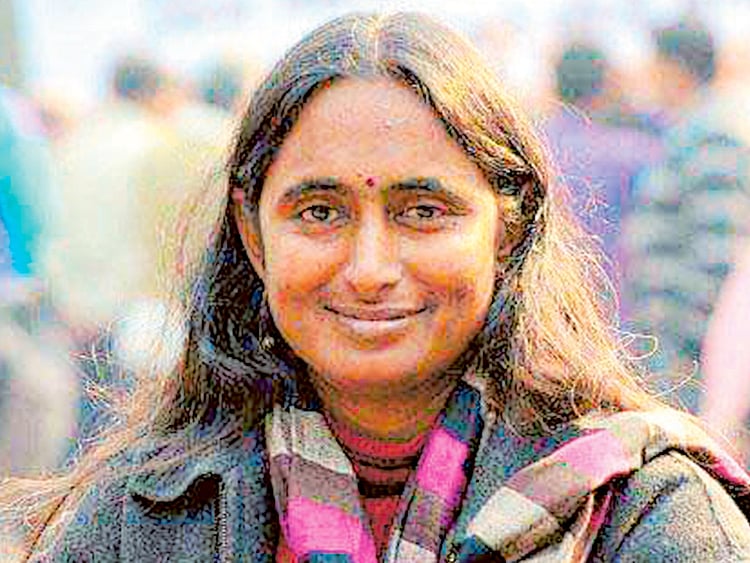
KAVITA KRISHNAN, Secretary, All India Progressive Women’s Association
Kavitha Krishnan, 42, is the secretary of All India Progressive Women’s Association (AIPWA) that fights for equality of women and against all kinds of oppression. A popular figure not just among activists but also among the masses, she started speaking for women’s rights much before it became the buzzword in social circles.
She was at the forefront during protests at Jantar Mantar, India Gate and many other places across the city following the December 16, 2012, gang rape and murder of a 23-year-old girl in Delhi. Krishnan was one of the first activists to take to the streets demanding justice for the victim and calling for changes in the laws on crimes against women.
The 42-year-old activist states, “We aim at building a society, which will provide a conducive environment for carrying forward the struggle for women’s liberation — a society in which women will be assessed on the basis of their contribution to society.”
She speaks to Gulf News in an exclusive interview:
GULF NEWS: Since when have you been campaigning on women’s issues?
KAVITA KRISHNAN: I became involved in the early 90s as a college student in Mumbai. Though at that time I was not much of an activist, issues of gender had concerned me, especially the rise of the Hindutva Right and their emphasis on moral policing and imposing force on women in the name of culture and nation. I remember feeling very upset and agitated over it. After coming to Delhi to study at the Jawaharlal Nehru University in 1994, I became involved in student activism. I was exposed to and got involved with wider mobilising among women of the working class and the poor women in rural India.
Was there any particular instance that triggered it all?
Individual instances are always something, which you feel can be taken on. But when you slowly start to recognise that it’s not only about individual mindset or person, but there are structures as well as political mobilising around sexism that’s happening, then it becomes much harder to fight. For me, that realisation happened in 1994. A talk was organised in our hostel mess by some Shiv Sena youth wing leader, who spoke about the concept of Hindu nation, which he said, his party, was committed to achieve. We asked him what he would do with women who said they were women first and then Hindu or of any other religion. He declared he would put them behind bars and that there were norms on how women were supposed to behave in a Hindu nation. So, it clearly was active reorganising happening to reinforce those ideas and to make it sort of a political rallying point.
Have you personally encountered sexism?
There isn’t a woman alive who has not encountered sexism! There’s so much of sexism that one runs into right from school. Even as an activist, one is not attacked for one’s ideas, but for looks or skin colour. Sexist attacks are now also very common online.
You campaign on a wide range of issues. If you were to pick one, what would it be?
It is not possible to pinpoint or fight on an issue in isolation. However, as a general principle, we need to encourage a far greater space for women’s autonomy in various aspects of their lives. Be it their own bodies — when they want to have children and how many or the use of contraception or whom to marry.
Why is it that even after amendments in laws, the situation for women remains the same and rapes, exploitation and domestic violence continue unabatedly in the country?
Laws, as such, do not rescue women. Essentially, if implemented properly, what they can do is offer some sort of redressal for women. The purpose of justice is not limited only to the law. The entire process and experience of it has to be structured very differently. For instance, the police have to treat a woman without sexism and without assuming she is lying. Also, the courtroom experience can be very humiliating and women judges do not always support the dignity of the woman complainant. All this must change.
But what about rising statistics?
We cannot merely go by statistics, as these are complicated tools. Without saying whether rapes and domestic violence have gone up or down, we need to see how we respond when these things happen and what kind of support can be provided that women can count on. This is where the state governments are responsible because they do not invest in structures that can offer support to women. There’s a huge requirement for shelter homes and skill development centres and an increase in the number of courts and judges, so that women do not continue to suffer.
What other barriers come in the way of social reforms?
Educating men is an important part, but it’s neglected very badly. Political leaders speak about respecting women, worshipping women and protecting women, but they seldom talk about honouring women’s choices. They do not want to listen about a woman’s freedom to live the way she wishes, dress as she pleases and marry whom she wants. They won’t talk of women’s rights because it is considered politically dangerous and means encroaching upon the entrenched powers of the families and institutions.
Do you find any difference after the change in governments — both at the centre and in Delhi?
The change at the centre has, in fact, been very negative for women’s rights in the country because it has inevitably emboldened the anti-women forces in a huge way. For instance: the so-called love jihad campaign has now made it much more harder for women to marry who they wish to irrespective of religion or caste. Earlier, women would just be fighting their parents or the community leaders, but now they find that even the political organisations are pitching in and making such a heightened campaign over their individual lives that makes it all the more difficult for them to assert against it. In addition, such awful language is being used on how many children women should bear, the kind of clothes they should wear and on their live-in relationships. Even in the case of the Delhi government, there’s been disappointment. Although these are still early days and it is yet to be seen whether they will walk the talk, one hopes for things to improve.
Profile:
• Kavita Krishnan was born on January 18, 1973 in Kunoor, Tamil Nadu, to mother Laxmi and father A S Krishnan.
• She was brought up in Bhilai (then in Madhya Pradesh), Chhattisgarh and completed her schooling there.
• Graduated from St Xaviers College, Mumbai.
• Did her Masters’ from Jawaharlal Nehru University, New Delhi.
Sign up for the Daily Briefing
Get the latest news and updates straight to your inbox
Network Links
GN StoreDownload our app
© Al Nisr Publishing LLC 2026. All rights reserved.