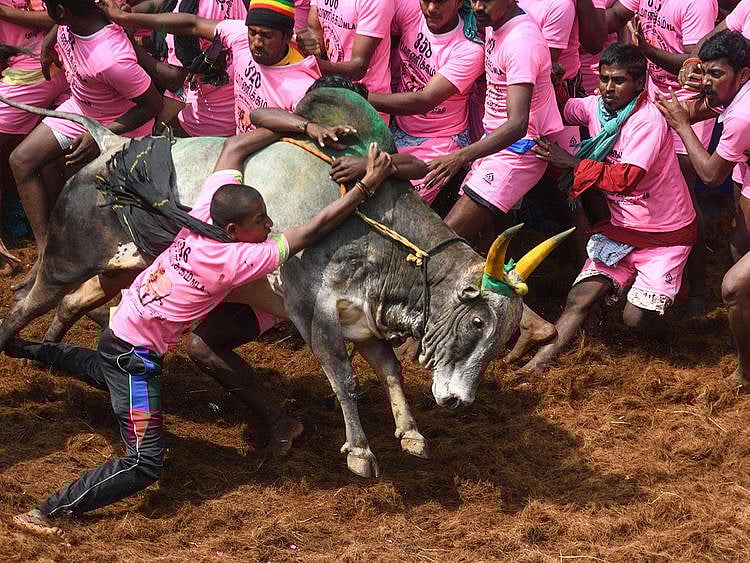
A participant is hit by a charging bull at the annual bull wrestling event 'Jallikattu' in Allanganallur village on the outskirts of Madurai, Tamil Nadu.
As the heat is on about one of India's traditional bull-taming festivals, we question its relevance today.
What is Jallikattu
For the uninitiated Jallikattu also known as Sallikkattu is a traditional spectacle in which a bull, particularly of ‘pulikulam’ or ‘kangayam’ breeds are released into a crowd of people and multiple human participants attempt to grab the large hump on the bull’s back with both arms and hang on to it while the bull attempts to escape.
Participants hold the hump for as long as possible, attempting to bring the bull to a stop. In some cases the participants must ride along enough to remove flags on the bull’s horns.
Animal rights organisations for long called for a ban to the sport owing to the number of injuries and death caused to both the animal and the participants. However hard core Tamilians have fought against the ban and a new ordinance in 2017 allows the sport to be continued in Tamil Nadu.
Supreme court ban
The Supreme Court banned Jallikattu in 2014, upholding concerns raised by activists who said the Jallikattu amounted to cruelty to animal besides posing a threat to humans. Between 2010 and 2014, an estimated 17 people were killed and 1,000-odd were injured during Jallikatu events.
The Supreme Court said, “use of bulls in such events severely harmed the animals and constituted an offence under the Prevention of Cruelty to the Animals Act.”
Motorcycles and bicycles are displayed before gifting them to bull owners and tamers during the Jallikattu, in the village of Palamedu, near Madurai, Tamil Nadu.
Post ban
Two years ago, politicians in the southern Indian state of Tamil Nadu passed an emergency order allowing bull-taming festivals to resume after a ban led to widespread protests that saw a police station set alight in Chennai.
Defying the apex court ruling, people started organising the sport at many places as the ruling AIADMK and opposition parties backed the pro-Jallikattu groups.
The protest which began in the rural areas, soon found support from the urban elite – students, IT professionals, the salaried and even sports persons and actors in capital Chennai.
The iconic Marina Beach in Chennai has turned into a hub of pro-Jallikattu demonstrations since Tuesday with thousands of people camping at the seafront demanding lifting of the ban.
Regulations in place
With the introduction of the Regulation of Jallikattu Act, 2009, by the Tamil Nadu legislature, the following activities were done in preparation of the event:
A bull charges towards a tamer during Jallikattu, in the village of Palamedu, near Madurai, Tamil Nadu. x
A written permission is obtained from the respective collector, thirty days prior to conduct of event along with notification of the event location.
The arena and the way through which the bulls pass through is double-barricaded, in order to avoid injuries to the spectators and by-standers who may be permitted to remain within the barricades.
The necessary gallery areas are built up along the double barricades.
The necessary permissions are obtained from the collector for the participants and the bulls fifteen days prior.
Final preparation before the event include a complete testing by the authorities of the Animal Husbandry Department, to ensure that performance enhancement drugs, liquor or other irritants are not used on the bulls.
An investigation by the Animal Welfare Board of India concluded that "Jallikattu is inherently cruel to animals. Animal welfare organisations such as the Federation of Indian Animal Protection Organisations (FIAPO) and PETA India have protested against the practice
People speak
“I view Jallikattu purely as a sport. There should be sufficient safeguards to protect the participants- humans and bulls involved; a basic evaluation of the skills and training levels of the participating humans in the sport and the spectators are sufficiently ring fenced from the action- I see no reason why this sport should not continue. It's a communal event that brings together harmony and competitive spirit and should be encouraged,” TK Raman, 58, Group CFO Finance House.
“My view is that it is a sport end of the day. From a Tamilian perspective, I can tell they feel they are getting a second class treatment by the Central Government with a ban imposition. They feel side-lined. Period. Yes it Jallikattu is beyond just the sport or a celebration. On a parallel level you have a similar movement in Kerala with the Sabarimala issue.
Ultimately it is a sport. In Spain you have bull fighting, in India you have Jallikattu. You cannot bring cruelty to animals as far as this is concerned,” Suku, Kumar, 56, Finance Head for a private firm in Dubai.
Spectators watch bulls perform during the Jallikattu, in the village of Palamedu, near Madurai, Tamil Nadu.
It is a blood sport
By Anjana Kumar, Web Reporter
So what do I, as a Tamilian, whose ancestors hail from Chennai and Coimbatore predominantly, believe in? Am I for or against Jallikattu.
Call me a rebel, call me an animal lover, call me whatever you want. I am a 100 per cent against Jallikattu.
And I have my reasons for it.
I don’t think our society needs to be bogged down in the past. It is not that I disrespect traditions. I do respect my traditions and cultures but I think we have to also challenge them every now and then for its relevance today. For sure, if some customs inflict any kind of cruelty, I mean any kind - whether mental or physical – it is totally unacceptable for me. Anything that propagates cruelty should be challenged. And it is high time our society evolves.
As for the festival of Pongal, believe me when I say it, it can be celebrated in many harmonious and joyous ways than this. Why welcome the harvest season in South India – a time in the year which signifies progress and evolution – with cruelty, death and mental and physical torture. Why?
Secondly I personally do not believe the concept of this festival remains for what it was designed in the first place.
It is no more a festival, no more a sport but it is more a commercial activity. I will tell you why.
Bulls that participate in the Jallikattu event are used as studs for breeding. These bulls fetch higher prices in the market.
Owners and others use ropes to control a bull during the Jallikattu, in the village of Palamedu, near Madurai, Tamil Nadu.
One of India’s pride is its varied culture and traditions. Yes Indians can sure be proud of the varied culture and traditions that have been handed down to them over the years.
But are all these customs – that were put in place thousands of years ago – still relevant today.
More importantly, in the name of tradition, are some of these customs posing a danger to lives?
The reason I bring this up now is because a gory incident took place on Sunday in Tamil Nadu, India which took the lives of two people and left 30 others injured.
The two men who died were gored by bulls while watching a traditional India sport Jallikattu, which is played as part of Pongal (harvest festival) celebrations in South India. These men were attending the ‘bull taming’ festival called Jallikattu in Tamil Nadu’s Pudukottai district on Sunday.
I believe in tradition
A.K.S. Satish, Senior Pages Editor
I see no reason why there is so much ado about nothing. If it is about the men who climb the bull, especially those who succumb to injuries, let me tell you it is part and parcel of any adventure sport. Deaths and injuries happen in mountaineering, rock climbing, skiing, or any motor sports for that matter.
A tamer reacts as a bull charges towards him during the Jallikattu, in the village of Allanganallur, near Madurai, Tamil Nadu.
So these men or women, who enter these sports, are aware of the lurking dangers and as adults they are entitled to make their own decisions. If one is worried about the condition of the bull, rest assured that the owner of the bull will ensure no harm is done to his prized possession, which is very costly for him to lose.
Seeing from the periphery one would get the feeling that it is cruelty to animal or putting a man at risk. But a deeper understanding of the whole event that precedes and surrounds Jallikattu will shed more light on the nature of the sport.
Jallikattu is traditionally held during the harvest festival, Pongal. The day after the festival is dedicated to the cattle of the farmers, on a day when they garland the bulls and decorate it and even worship it, not just by the owners but across the neighbourhood in the villages.
Jallikattu is a sport that helps the human beings test their courage and by that way get closer to the fiery animals. There are rules to protect the animal. It is one man against one animal, obviously there is no cruelty and on strength the animal is stronger than the man.
On the positive side, the youth of the village prepare well in advance for Jallikattu, as their pride is at stake. So with that goal in mind, they lead a healthy lifestyle to get stronger and stay away from the vices that are normally associated in the villages.
It is these traditional events that help in keeping the rich heritage of the country alive.
Network Links
GN StoreAbout Gulf NewsTerms & ConditionsReach by GNSitemapContact usPrivacy PolicyGN FocusHave your sayWork with usAdvertise with usGulf News epaperPrinting Services
Download our app
© Al Nisr Publishing LLC 2026. All rights reserved.