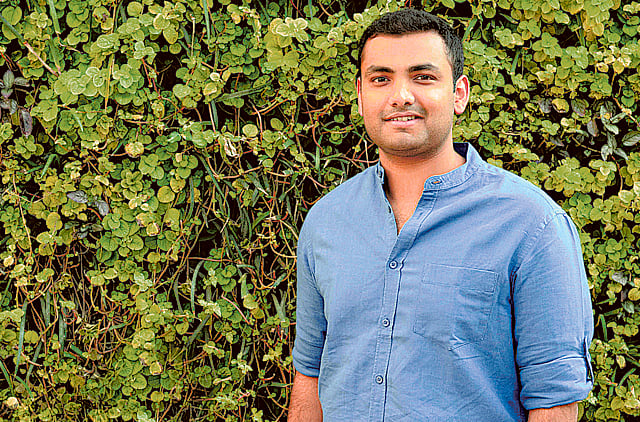
New Delhi: Bengaluru-based architect Alok Shetty, 28, is the new role model for youngsters desiring to mix philanthropy and business in a unique experiment. He featured in Time magazine among “leaders of tomorrow” who are “working hard to change their worlds today”.
Shetty is one of the six international next generation leaders, named by Time, for his pioneering work in designing affordable flood-proof houses for slum dwellers in Bengaluru. “Finding simple solutions to complex problems,” Shetty is “building hope in India”, the magazine said. He is involved in other philanthropic projects as well.
He founded Bhumiputra Architecture at the age of 19 in 2006 and the practice has seen a steady growth, with awards and recognition from institutions at the national and international level.
Shetty has also been featured in the National Geographic magazine as “One of India’s Future Leaders” and Forbes listed him as part of its annual 30 under 30 list of young achievers.
From designing a hospital in his teens, he is working on a school project in Uttarakhand. “The school is nearing final stages of completion. We have kept the design very straightforward and simple. Considering the past floods and earthquakes, the building was designed to respond to hydro static and hydro pneumatic loads. We have used naturally available stone and it has been built on a rocker foundation, which counter attacks the tectonic plate movement during an earthquake,” Shetty explains.
He provides more details about his works to Gulf News in an exclusive interview.
GULF NEWS: How did you end up designing a hospital even while you were in your teens?
ALOK SHETTY: I was 19-years-old and in the second year of my architectural school when I heard about the competition to design a hospital in Jaipur, Rajasthan. I decided to give it a shot and ended up winning the competition. Though it was just a concept at that point, the management and administrative team of the hospital, Narayana Health, loved it so much that they asked me to come on board. So, I spent a year doing research — interacting with doctors, nurses and patients enquiring about what they wanted from a hospital. I would go home and teach myself the software and get the drawings ready. This was entirely different from what we did at the architectural school; where it was restricted to hand drawing the designs, and finally came up with an improved design.
Were you present at the construction site to see the design turn into reality?
I would visit at least once a month as I was also studying at the time. There was a lot of learning on the job and I had a very supportive team of structural and service consultants and engineers who guided and helped me through the process. Theory and reality are very different. The best lesson was that of co-ordination and learning how to deal with different people and working as a team. At the design stage, I had felt walking through the courtyard of the building. But a year later, I actually walked through the building, which was constructed with steel and concrete. It now serves thousands of people.
Would you say, it’s a ‘model’ hospital for others to follow?
That would be presumptuous of me to assume. The people who work there seem to be happy with how it was planned and executed. That’s enough for me. The end user should be happy and content. That is the goal in all our projects.
You became interested in buildings and construction after the hospital project?
My father is in the construction business and all my summer vacations would be spent at construction sites when I was nine-years-old. I knew at that point of time itself that this is what I wanted to do.
How did the designing of the Black Box theatre happen?
It happened in May 2011 during my final semester at Columbia University with two of my classmates, Nathan and Shea. It was a design challenge posed to my class by TED Talks, a non-profit organisation devoted to spreading ideas, asking us to design a mobile auditorium. We used a 40-foot shipping container that completely opens itself out to become a 250-seat auditorium within four hours. I became the youngest recipient of the Lucille Smyser award for Design Excellence.
Is the design and construction of low-cost modular schools and hospitals an offshoot of that model?
One can say that, as we have developed the concept of the theatre further to come up with foldable mobile schools and health clinics. The idea is to attach them to train compartments. This could be very helpful, as in India railways have an enormous reach.
It’s a great idea to use the country’s vast rail network. But for that, the railway ministry has to pitch in. Is there a connect with them?
We have not approached the railway ministry, as we are not ready yet ready with our product. Once we are in a position to make the presentation, we will be able to collaborate with them.
How do you plan to work on the slum development project in Bengaluru and who will be funding it?
The testing phase will finish by the end of this year. Once we receive feedback from the users, necessary changes will be made and we shall proceed to deliver 200 houses by the first quarter of next year. We are funding this and the mobile auditoriums project.
Which other projects are you working on?
I am handling various large-scale projects ranging from Olympic training academies, design universities, R & D biotech facilities and parametric hotels in various parts of the country.
Will you be restricting your ideas and work in India or plan to take them forward to help other developing countries?
Our work is focused on intelligent design, which can hopefully solve infrastructural and environment problems and this could be anywhere in the world.
BOX
•Alok Shetty was born on July 21, 1986 to mother Namitha and father Dr Sitaram Shetty.
•He did his early schooling from Bishop Cotton Boys’ School, Bengaluru.
•Graduated from R V School of Architecture, Bengaluru – 2004-09.
•Masters’ in architecture from Columbia University in New York – 2010-11.
Sign up for the Daily Briefing
Get the latest news and updates straight to your inbox
Network Links
GN StoreDownload our app
© Al Nisr Publishing LLC 2026. All rights reserved.