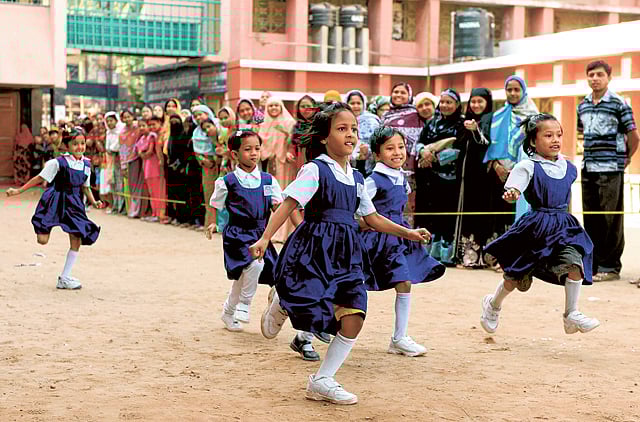
Dhaka: The story of a young girl in a village who cherishes a dream of attending school is well-known throughout Bangladesh.
In the tale, a popular comic character called Meena, yearns for an education but initially has to stay at home to help with the housework.
But by the end of the tale, Meena's relatives realise the value of education and the earnest young girl heads to school with her younger brother.
The focus on education is evident among policymakers across Bangladesh who are taking measures to achieve a 100 per cent literacy rate within the next decade.
Daily hardship
The task will not be an easy one, especially since earning a living is often a more immediate need than acquiring a high school or university-level education.
The problem is further compounded by the high dropout rate among students, many of whom leave school in order to support their extended families with the skills they have. "In fact, the challenge at present is c
Convincing children to stay in school. Our goal is to get all children to primary schools by 2014, and then to ensure they do not leave without a high school degree," Abul Kalam Azad, the minister for information and cultural affairs, told Gulf News. In the last two years, literacy in the densely populated nation has increased slightly, from 54.8 per cent in 2009 to 63 per cent last year.
Part of this increase in literacy was achieved with the distribution of 190 million free textbooks over 2010.
"Thirteen million takas (Dh658,836) worth of new textbooks were distributed, with the hope that the brand new books would act as an incentive for children to stay in school," Azad explained.
According to reports by the Bangladeshi Ministry of Education, stipends for primary school children in public schools have also recently been increased by 10 per cent. This means that up to 7.8 million deserving children across the country now receive stipends to encourage them to stay at school.
Affirmative action
"We also have a system of affirmative action when it comes to female students, mainly because school attendance among girls lags behind male school attendance. As a result, education is free for girls in public schools up to the high school level, and we are also in talks to extend this benefit up to university level in order to increase the number of people pursuing further education in Bangladesh," Azad said.
The minister added that children who attended public schools were also given free lunches so that the meals would be a further disincentive against removing students from school.
When asked whether public school children, including those in rural areas, were receiving education in information technology, he said that the focus was on first increasing the basic literacy rate.
Sign up for the Daily Briefing
Get the latest news and updates straight to your inbox
Network Links
GN StoreDownload our app
© Al Nisr Publishing LLC 2026. All rights reserved.