US Supreme Court upholds birthright citizenship, strikes down Trump's order
Judges rule Constitution guarantees citizenship regardless of parents' immigration status
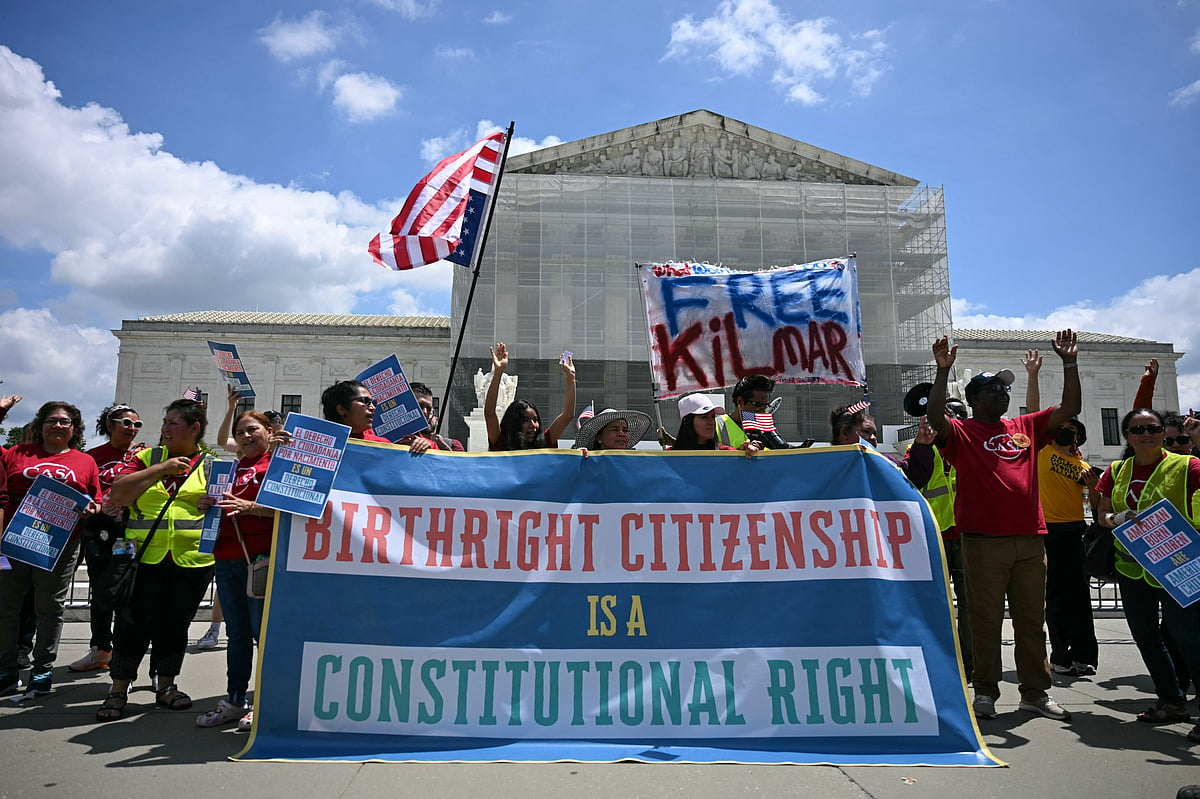
Washington: In a major blow to President Donald Trump, the US Supreme Court on Tuesday struck down his executive order seeking to limit birthright citizenship, ruling that the Constitution guarantees American citizenship to children born in the United States regardless of their parents' immigration status.
In a 5-4 decision, the court held that Trump's January 2025 executive order violated the 14th Amendment's Citizenship Clause, which grants citizenship to anyone born in the United States and "subject to the jurisdiction thereof."
Chief Justice John Roberts wrote the majority opinion, joined by Justices Sonia Sotomayor, Elena Kagan, Amy Coney Barrett and Ketanji Brown Jackson, US media reports said.
"Children born in the United States to parents unlawfully or temporarily present are 'subject to the jurisdiction' of the United States and are citizens at birth under the Fourteenth Amendment's Citizenship Clause," the court said.
Writing for the majority, Roberts described citizenship as "the right to have rights" and said the framers of the 14th Amendment intended that promise to extend to "every free-born person in this land."
What is birthright citizenship?
Birthright citizenship is the automatic right to become a citizen simply by being born in a country.
In the United States, the 14th Amendment to the Constitution states that all persons born in the US and subject to its jurisdiction are US citizens, regardless of their parents' immigration status.
The principle was adopted in 1868 after the Civil War to ensure citizenship for formerly enslaved people and has since applied to almost everyone born on US soil.
President Donald Trump sought to end automatic citizenship for children born to parents who are in the US illegally or temporarily, arguing that the Constitution does not require it.
On Tuesday, the US Supreme Court rejected that interpretation, ruling that the Constitution protects birthright citizenship and that a president cannot rewrite that guarantee through an executive order.
Executive order never took effect
Trump signed the executive order on his first day back in office, directing federal agencies to deny automatic citizenship to babies born in the US unless at least one parent was a US citizen or lawful permanent resident.
The order triggered immediate legal challenges from immigrant rights groups, expectant parents and 22 state attorneys general. Lower courts blocked it from taking effect before it could be implemented.
The case, Trump v. Barbara, centred on the interpretation of the 14th Amendment, adopted after the Civil War, which has long been understood to guarantee birthright citizenship.
Conservatives split
Justice Brett Kavanaugh agreed that Trump's order could not stand but said he would have ruled against it on narrower statutory grounds, arguing it conflicted with a 1952 immigration law rather than the Constitution.
Justices Clarence Thomas, Samuel Alito and Neil Gorsuch dissented.
Thomas argued the ruling "devalues" American citizenship and said it was unlikely to "stand the test of time."
Another setback for Trump
The decision marks another significant judicial setback for Trump after the Supreme Court earlier struck down his signature tariff policy. However, the court has backed the administration in several other immigration disputes, including a recent ruling allowing it to end deportation protections for hundreds of thousands of migrants.
Tuesday's judgment reaffirms a constitutional principle that has stood for more than 150 years, making clear that the definition of American citizenship cannot be altered by executive order alone.

Sign up for the Daily Briefing
Get the latest news and updates straight to your inbox
Network Links
GN StoreDownload our app
© Al Nisr Publishing LLC 2026. All rights reserved.