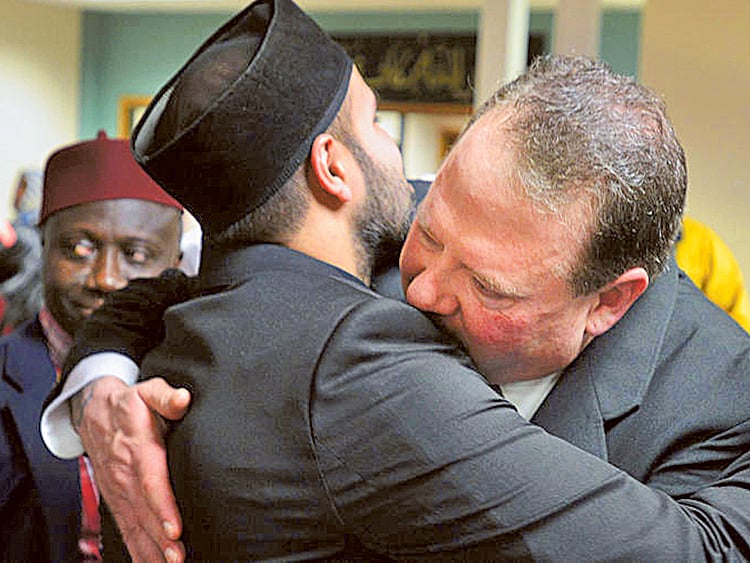
Hartford, Connecticut: Ted Hakey, a former Marine, knelt in prayer, his forehead on the floor, beside his Muslim neighbours inside their Connecticut mosque last Saturday. The enormity of that gesture was lost on no one.
It was only several months earlier, on the night of the terror attacks in Paris, when Hakey, 48, went to a local bar and downed 10 drinks. In the early morning, he went home, drank some more and loaded his 9mm handgun and an M14 rifle. He went into his yard and fired rounds at the side of the mosque next door.
His Facebook page was laden with vile anti-Muslim hate speech. Text messages with friends, obtained by law enforcement, showed the same. In one post, he noted living next to a mosque and keeping watch on them with “binos” (presumably, binoculars). In another, he wrote, “Is Muslim season open yet? I’m in a target rich environment.”
But rather than hate him back, Dr Mohammad Quraishi, president of the Baitul Aman “House of Peace” Mosque, wished he had been a better neighbour by making an effort to get to know Hakey and his wife. Perhaps then, he reasoned, Hakey would not have harboured so much anger.
So, five months after Hakey’s bullets were found inside near the prayer area, Quraishi invited him to an event at the mosque, titled True Islam and the Extremists. When the Hakeys arrived, the congregants welcomed them without judgement. Hakey tearfully apologised for the pain he caused them.
Hakey had asked his lawyer for the chance to apologise, so Quraishi and a few others had met with Hakey privately a week earlier on Good Friday. Quraishi, before even hearing the apology, brought Hakey chocolate Easter eggs as a gift.
“I’ve never had anything like this,” Quraishi said of that first meeting. “It was very emotional. He came in tears, he was quivering. I could feel it in his heart and his eyes that he meant what he said. I felt like he was saying it from his heart. It’s a rare moment when you see someone with so much hate for you come and apologise.”
But some members of the congregation remained wary knowing a man lived next door who had wished them harm. Quraishi invited Hakey to come visit the mosque so he could show them he was sorry.
“As a neighbour, I did have fears, but fear is always when you don’t know something. The unknown is what you are always afraid of,” Hakey told them, according to the Hartford Courant, which covered the April 2 event. “Going forward I want to help you bridge that gap and help someone else not make the same mistake I did.”
Hakey, in an interview, said he was “so overwhelmed” by how graciously he was treated after what he had done. He said he’s now hearing from Muslims all over the world thanking him for coming forward to apologise.
“The forgiveness was so genuine,” he said. “I realised they were really good people and the whole way they handled it was above and beyond.”
His wife, Myra, who went with him, said she too was amazed by how warmly they were welcomed. She admitted that while she didn’t hold the same extreme feelings as her husband against Muslims, she too was uneducated and felt afraid.
“There were women crying and thanking me and said they were praying we would come,” she said. “There’s so much hate and these people just want peace.”
In February, Hakey pleaded guilty to damaging religious property, which is a federal hate crime. He will be sentenced in May and faces up to 14 months in jail. Quraishi said his community will do its part to advocate for a lesser sentence.
Hate crimes against Muslims increased tenfold after 9/11 to nearly 500 in 2001. In 2014, the last year for which data is available from the FBI, there were 154 incidents recorded. That’s still about five times higher than the rate before 9/11.
To Quraishi’s point that most prejudice is rooted in people being uninformed, more than 60 per cent of Americans say they don’t personally know someone who is Muslim, according to a 2014 Pew Research survey. And Americans viewed Muslims more negatively than any other religious group.
Quraishi said he is heartened by his new friendship with Hakey, hoping the former antagonist can now be a powerful voice to counter the negativity against Islam.
“To see him there was very emotional,” Quraishi said. “Imagine a few months ago he was our enemy. You have to see his side. His side is he had to have courage to be there among those people he once didn’t like. I think the man has had a change of heart.”
Hakey — who also credits a court-mandated addiction treatment programme that includes meditation and gardening with helping him find some inner clarity — said he has already started countering hateful posts on Facebook.
“Please listen to me, you’re absolutely wrong about this,” he said he commented when he saw someone disparaging Muslims. When they argued back, he said he replied, “I shot a mosque, don’t tell me about it. You need to be educated.”
“Every day you’re bombarded with negative images and posts misquoting the Quran,” Hakey said. He said it was all confusing and made the distinction between terrorists and all Muslims blurred.
“He was misguided in that sense and that is what made him do what he did,” Quraishi said. “Once I showed him our faith it made sense to him.”
Sign up for the Daily Briefing
Get the latest news and updates straight to your inbox
Network Links
GN StoreDownload our app
© Al Nisr Publishing LLC 2026. All rights reserved.