SpaceX rocket stage believed to have slammed into Moon
Four-tonne piece of rocket expected to leave a lunar crater, but no danger to Earth
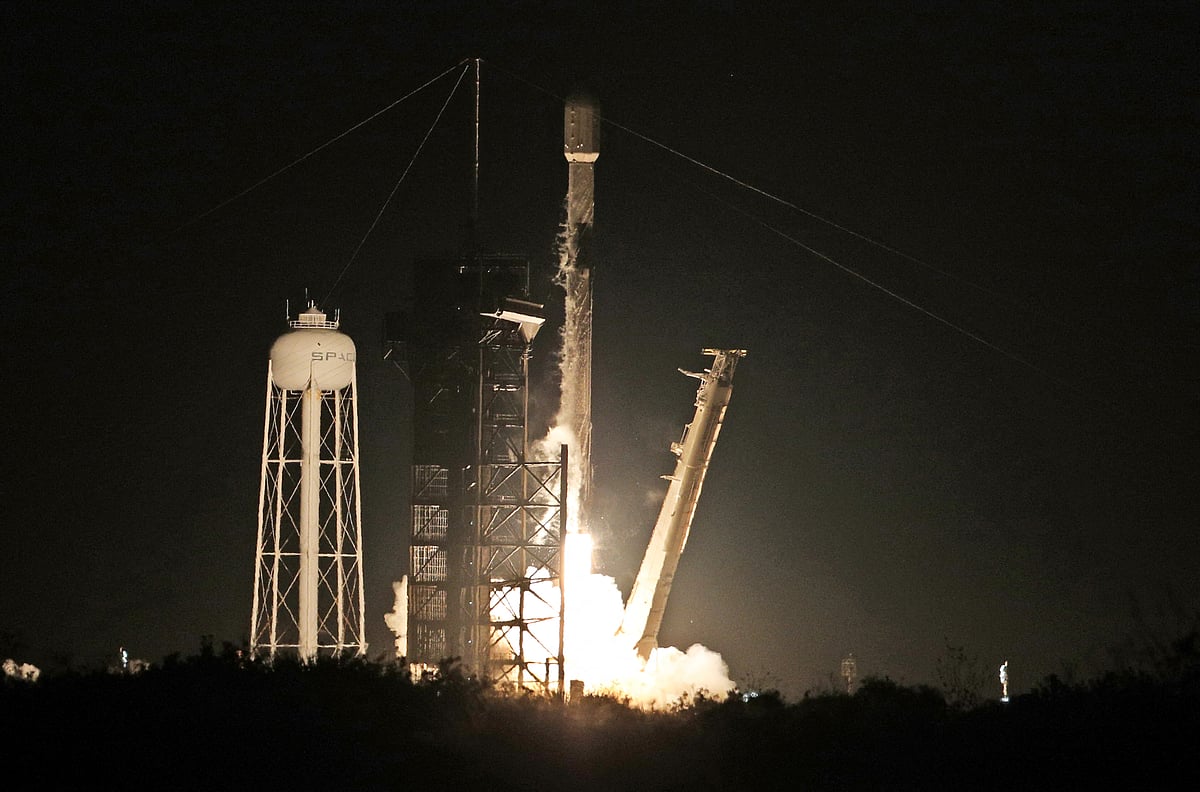
New York: A four-tonne piece of a SpaceX rocket was believed to have unintentionally crashed into the Moon on Wednesday, a collision that posed no danger to Earth but is expected to leave behind a lunar crater.
While there is not yet official confirmation that the Falcon 9 upper stage struck the lunar surface, it had been expected to make impact at approximately 0635 GMT.
NASA and its Lunar Reconnaissance Orbiter probe and South Korea’s Pathfinder Lunar Orbiter were planning to take images of the site after impact, but it may take days to receive that information.
Scientists and amateur stargazers alike had been looking forward to observing the sunlit plume of rubble and debris created by the smash.
“It might be possible for folks with a telescope to observe the plume of ejecta created by the impact,” said Benjamin Fernando of Los Alamos National Laboratory in New Mexico, the lead author on a recent paper on the anticipated impact.
“It is unclear how bright it will be, which is one of the reasons why we are looking to study this event,” the researcher told AFP before impact.
Assuming all of the propellant is spent, authors of the paper estimate the spacecraft weighs approximately 4,000 kilograms.
It was expected to slam into the Moon’s northern hemisphere near the Einstein Crater, at some 8,690 kilometres per hour.
What went wrong? Why did the rocket stage hit the Moon?
The upper stage was never meant to hit the Moon. After launching two lunar landers in January 2025, the Falcon 9’s first stage returned to Earth as planned, while the upper stage remained in space after sending the payload on its way.
SpaceX carried out the planned disposal manoeuvre. According to the company, it followed the required procedures to place the upper stage on a safe post-mission trajectory.
Natural forces gradually altered its orbit. Over time, a combination of solar activity and the gravitational pull of the Earth and Moon changed the rocket stage’s path.
The trajectory eventually intersected with the Moon. Instead of remaining in a stable orbit or drifting harmlessly through space, the spent stage was nudged onto a collision course.
The impact was accidental, not deliberate. Unlike NASA’s intentional Apollo-era crashes to study the Moon’s interior, this was an unintended consequence of orbital dynamics.
The rocket stage struck at high speed. Scientists expected it to hit the Moon at about 8,690 km/h, creating a fresh crater near the Einstein Crater in the Moon’s northern hemisphere.
There was no risk to Earth. The impact occurred on the Moon and posed no threat to people or satellites around Earth.
‘Space junk’
“There is no danger to Earth,” said NASA spokesperson Jimi Russell in a statement.
“NASA will continue to track the booster for training purposes, as well as later observe the impact site for scientific purposes.”
The Falcon 9 rocket made by Elon Musk’s SpaceX firm took off in January 2025, carrying two lunar landers. The booster returned to Earth, but the upper stage stayed in space to push the landers onward.
Generally, for such “high-energy missions” SpaceX performs a maneuvre to make sure the second stage “is safe per the appropriate rules and regulations,” said Julianna Scheiman, director of NASA Science and Dragon Programs at SpaceX, at a Monday news conference.
“We did that,” she continued, but “what has happened is essentially a mixture of solar activity and gravity forces have put it on a path towards the Moon.”
Like many scientists, Scheiman added she was “very excited” to see the impact.
The paper authors encouraged both professional and amateur astronomers to attempt viewing or recording the collision.
“This event provides an opportunity to test a pipeline for localising impacts on the lunar surface for future seismic experiments, investigating the dust and plume dynamics from impact events on the Moon, and considering hazards from artificial space debris impacts,” wrote the research team.
NASA hopes to soon establish a sustained human presence on the Moon, making it critical to better understand space debris in lunar orbit.
The Moon routinely weathers impact from space debris including meteoroids. Artificial collisions are less common.
In the 1970s, the US space agency carried out deliberate crashes during its Apollo program to collect seismic data.
The rocket stage had been just one many pieces of “space junk” orbiting Earth.
There are more than 46,000 pieces of space debris weighing a total of 17,000 tonnes currently in orbit, the European Space Agency said in late July.
Some experts have warned that amassing too much space junk around Earth could lead to a dangerous chain reaction of collisions known as the “Kessler syndrome”.
Sign up for the Daily Briefing
Get the latest news and updates straight to your inbox
Network Links
GN StoreDownload our app
© Al Nisr Publishing LLC 2026. All rights reserved.