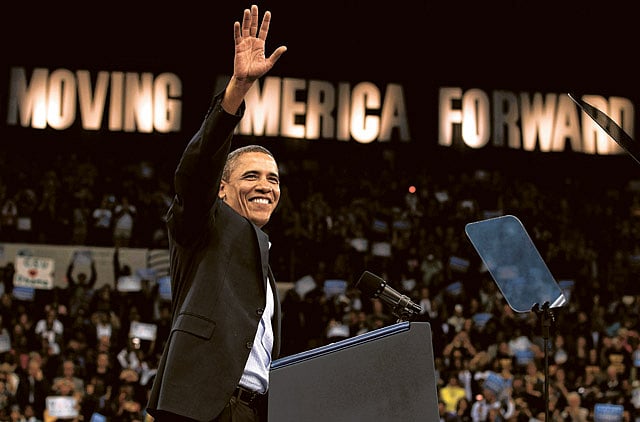
Washington: There is no chorus of Hail to the Chief, no bellowed introduction from the platform. In fact, there is no platform. Instead, Barack Obama simply and suddenly appears, emerging without entourage or fanfare from between a wall of large cardboard boxes and some kind of shelving unit, into a cleared area on the factory floor. With no jacket, just a plain white shirt and tie, he offers a modest "Hello, everyone" as he moves toward the lectern set up for the occasion.
His audience are taken by surprise: they had been expecting more build-up. They leap to their feet anyway and applaud warmly. But there are fewer than a hundred of them, arranged in just five rows of seats. The only hint of grandeur comes from the seal just below the two microphones, the crest of the President of the United States.
Obama is visiting American Cord Webbing, a family-owned firm in the small town of Woonsocket, Rhode Island. The contrast with the glory days of 2008, when stadium-sized rallies echoed to "Yes, we can!", could not be sharper. If the old saw holds that you campaign in poetry, but govern in prose, then this is government at its most prosaic.
Today, the depth of the contrast will be revealed, as American voters deliver their interim verdict in midterm elections. The president's name is not on the ballot — it's all 435 members of the House of Representatives, a third of the Senate and a slew of state governorships that are up for grabs — but few deny that today represents, in part, a referendum on Obama.
The polls suggest defeat is on the way, with Democrats trailing Republicans badly and most pundits forecasting that the president's party will lose its current control over the House and see most of its majority wiped out in the Senate.
What's gone wrong? To quote the battle cry of the previous Democratic president, "It's the economy, stupid."
The central explanation for Obama's woes is that he inherited a dire economic situation and it hasn't gone away: unemployment still stands at 9.6 per cent.
Administration officials insist that almost all of that damage was done under Bush, with 3 million jobs lost in just the six months before Obama took over.
But, says Democratic pollster Stan Greenberg — who crunched the numbers for Bill Clinton — you can't keep saying that, even though voters know it's true. It sounds too much like "whining".Much depends on the exact result, the difference between a bad night and a wipeout.
Assuming the House changes hands, the Obama presidency will now rest on his agility in dealing with a Republican majority. Will he show the political smarts of Clinton, whose jujitsu turned the Republicans' strength back on them in the mid-1990s?
Above all, Obama needs the economy to brighten. If it does, then what began as an extraordinary story more than two years ago will have yet another twist.
Sign up for the Daily Briefing
Get the latest news and updates straight to your inbox
Network Links
GN StoreDownload our app
© Al Nisr Publishing LLC 2026. All rights reserved.