LOS ANGELES
The day Vinicio Nicolas found out whether he would be allowed to stay in the United States, and hopefully far from the gang trying to recruit him in Guatemala, he brought along an interpreter.
With the stakes so high, he wanted someone who spoke his native tongue. He had arrived in the US just eight months before, and his English wasn’t good. But neither was his Spanish.
The language the 15-year-old needed an interpreter to wrestle with — for the sake of his future _ was an ancient Mayan one called Q’anjob’al, or Konjobal.
Successive waves in recent years of more than 100,000 immigrants from Central America _ many of them boys and girls who arrived without their parents _ have created a shortage of people who can translate Mayan languages, especially K’iche (Quiche) and Mam. This is an especially acute need for arrivals from Guatemala, which is home to more than two dozen indigenous languages.
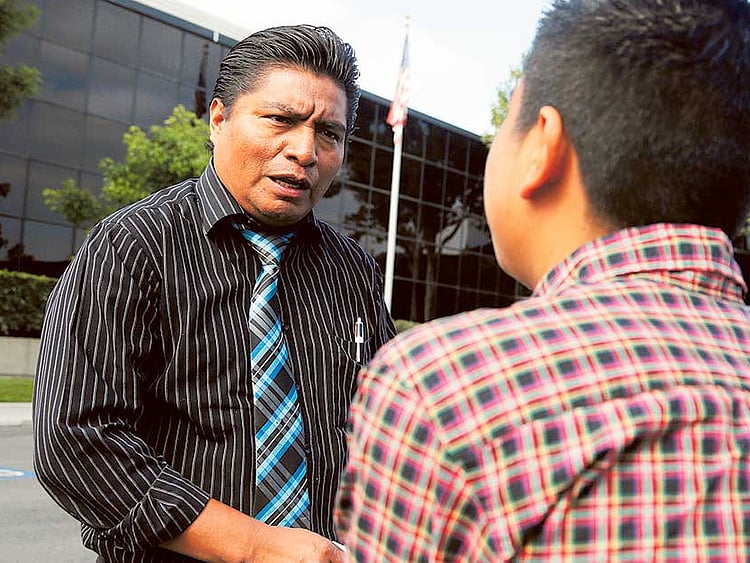
Before entering an asylum office in Anaheim, interpreter Aldo Waykam asked Vinicio how he was feeling: “Tzet x’i a kul?”
“Watx,” the teenager replied. Good.
Spoken by almost 80,000 people in mostly rural municipalities in Huehuetenango, Guatemala, Konjobal is common in places like Santa Eulalia _ where Vinicio grew up _ but rare everywhere else.
Mam, a Mayan language spoken by more than 500,000 people in Guatemala, ranked ninth in the top 10 languages spoken in US immigration court last fiscal year. Quiche ranked 11th. Both surpassed French, according to the Department of Justice Executive Office for Immigration Review.
Five years ago, Quiche and Mam didn’t even break the top 25 languages spoken in immigration court.
The shortage of interpreters is leading to a host of issues. Often, judges delay immigration hearings until one is found. At times, asylum seekers are deported even if they have a strong case because a qualified interpreter cannot be found in time. And unlike immigration court, interpreters aren’t provided for free during asylum hearings.
The interpreter shortage is exacerbated by a lack of Mayan-language interpreter courses, said Naomi Adelson, a Spanish-English court interpreter and coordinator of the Mayan-languages interpreter program at San Francisco non-profit Asociacion Mayab.
Mam speakers
Oakland is home to one of the largest concentrations of Mam speakers in the nation.
“I’m very concerned about meeting the demand, especially since more are coming,” Adelson said. “The demand for Mam has just gone off the charts.”
Vinicio’s case was Waykam’s second of the week. If he wasn’t already employed managing several shops and restaurants in the L.A. area, Waykam said, he could probably do interpreting full time.
Vinicio and his brothers, who live in Compton, heard Waykam on a Konjobal radio station that streams online and hired him on the spot. Waykam helped translate Vinicio’s story to the asylum officer.
Vinicio was 14 when the gang recruiters came looking for him outside his school. They offered him drugs, a knife and even a gun.
“I’m Christian,” he told them. “I just want to go to school. I don’t want to sell drugs.”
But they wouldn’t give up, Vinicio said. They told him they would kill his entire family if he didn’t join.
One night, they came looking for him, and he escaped through the back door. He said he slept in the wooded mountains near his village before catching a bus to Guatemala City the next day. He couldn’t stay in the nation’s capital because the gang has a network there, Vinicio said.
Instead, he borrowed $3,000 from an aunt and made his way to the United States. He walked into a US. Customs and Border Protection station in Arizona, asking for asylum.
Policarpo Chaj of Maya Vision, which serves indigenous Guatemalans in the Los Angeles area, said he’s fielded an increasing number of requests for interpreters.
Chaj, a Quiche interpreter, used to get one or two calls a year for interpreter services. Now, he said, he gets about 10 calls a month.
“We can’t meet the demand,” Chaj, of Alhambra, said. His organisation has 17 interpreters in six Mayan languages.
Many of the services are for immigration court, asylum hearings and Superior Court. But interpreters are also used in hospitals and schools, he said.
Some immigrants are unaware of their right to an interpreter in immigration court and settle for a Spanish interpreter who can’t accurately convey the client’s case for staying. Mariano Garcia Matias, a 52-year-old Mam interpreter who lives in Los Angeles, travels the nation offering his services. Sometimes he’s so busy, Matias said, that he has to turn away clients.
Relay interpreting
Like most Mayan language interpreters, Matias does what’s called “relay interpreting.” That means another interpreter provides the English-to-Spanish translation while Matias translates from Spanish to Mam.
Although he speaks English reasonably well, he said he doesn’t feel comfortable enough to provide direct English-to-Mam interpretation.
“It has to be a perfect translation, and we’re talking about someone’s life on the line, including that person’s family,” he said.
Before walking up to the window at the asylum office waiting room, Vinicio said he was optimistic about being allowed to stay. Waykam wasn’t so sure. Only a tiny percentage of cases are approved.
Minutes later, the two walked to a counter with a glass partition. An immigration official informed Waykam of the outcome of Vinicio’s case.
He delivered the news to the teenager in a language made more intimate by the distance from home and the small fraternity of people who could wield it to share both heartache and joy.
“Maj ak’lay a caso.”
You didn’t win your case.
— Los Angeles Times
Sign up for the Daily Briefing
Get the latest news and updates straight to your inbox
Network Links
GN StoreDownload our app
© Al Nisr Publishing LLC 2026. All rights reserved.