Talipot palm trees, native to India and Sri Lanka, is in bloom for the first and only time in its life, in Aterro do Flamengo, Rio de Janeiro, Tuesday, Dec. 2, 2025. (AP Photo/Lucas Dumphreys) (Photo: AP)
Decades-old palm trees in Rio de Janeiro flower for the first - and only - time
Originating from southern India and Sri Lanka, the talipot palm can reach up to 30 meters
Last updated:
3 MIN READ
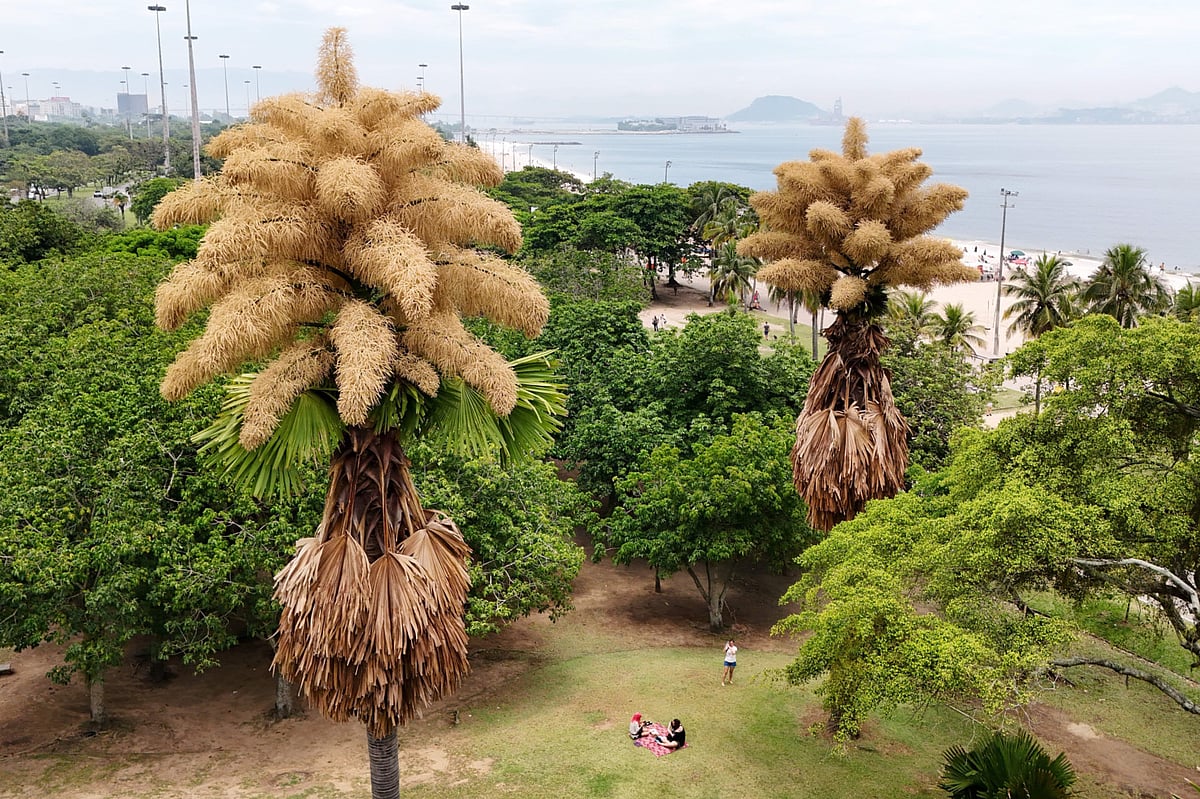
Talipot palm trees, native to India and Sri Lanka, is in bloom for the first and only time in its life, in Aterro do Flamengo, Rio de Janeiro, on December 2, 2025.
AP
RIO DE JANEIRO Towering talipot palms in a Rio de Janeiro park are flowering for the first and only time in their lives, decades after famed Brazilian landscape architect Roberto Burle Marx introduced them in the 1960s.
Towards the end of its life - which can span between 40 and 80 years - the palm tree sends up a central plume crowded with millions of small, creamy-white blossoms that rise high above its fan-shaped leaves.
The rare phenomenon that ties past to present has sparked the curiosity of passersby in Flamengo Park who stop, crane their necks to admire them and take photos.
Vinicius Vanni, a 42-year-old civil engineer, was even hoping to collect seedlings and plant them.
What are Talipot palms?
Scientific name: Corypha umbraculifera
Origin: Southern India and Sri Lanka
Introduced to Brazil in the 1960s by landscape architect Roberto Burle Marx
Lifespan
Live 40 to 80 years
Bloom only once at the very end of their lives
After flowering and fruiting, the tree dies naturally (a botanical process called monocarpy)
Produces a central plume with millions of creamy-white flowers
Can reach up to 30 metres (98 feet) tall
Each bloom can contain around 25 million flowers
Seeds & Reproduction
If pollinated, flowers produce fruits
Fruits can generate seedlings for the next generation
One bloom = one shot at reproduction
Why are they blooming together?
Planted together in Rio in the 1960s
Same age, same photoperiod (daylight rhythm)
Result: synchronized blooming decades later in Flamengo Park and Rio Botanical Garden
Are they dangerous to the environment?
Not invasive, due to extremely slow growth
Strict environmental laws regulate transport of foreign species
Safe in managed spaces like parks and botanical gardens
Why it matters
A once-in-a-lifetime event most people will never see again
Raises awareness about biodiversity and long-term conservation
“Roughly the same lifespan as a human,” prompting reflection on time and nature
“I probably won’t see them flower, but they’ll be there for future generations,” he said from Flamengo Park, which hugs a nearby beach and offers a spectacular view of Sugarloaf Mountain.
Originating from southern India and Sri Lanka, the talipot palm can reach up to 30 meters (98 feet) in height and produce around 25 million flowers when it blossoms, using energy accumulated over decades.
If the flowers are pollinated, they produce fruits that can become seedlings.
In addition to Flamengo Park, the talipot palms can be found in Rio’s Botanical Garden, where they are also flowering.
That’s because they were brought across from southern Asia together, have the same metabolism and have been exposed to the same Brazilian rhythm of daylight, according to Aline Saavedra, a biologist at Rio de Janeiro State University.
Saavedra said that environmental laws strictly regulate transporting species native from another continent, although talipot palms are not invasive due to their slow development.
The interest the phenomenon has generated is positive and could encourage a sense of belonging for human beings to preserve rather than destroy the environment, according to Saavedra.
“This palm species gives us a reflection on temporality, because it has roughly the same lifespan as a human being,” said Saavedra. “Marx also wanted to convey a poetic perspective.”
Sign up for the Daily Briefing
Get the latest news and updates straight to your inbox
Network Links
GN StoreAbout Gulf NewsTerms & ConditionsReach by GNSitemapContact usPrivacy PolicyGN FocusHave your sayWork with usAdvertise with usGulf News epaperPrinting Services
Download our app
© Al Nisr Publishing LLC 2026. All rights reserved.