Guinness World Records lists Jonathan, a Seychelles giant tortoise, as the oldest living land animal.
Giant tortoises now outnumber people in Seychelles
New study estimates 183,000 tortoises on Aldabra Atoll after decades of conservation
Last updated:
3 MIN READ
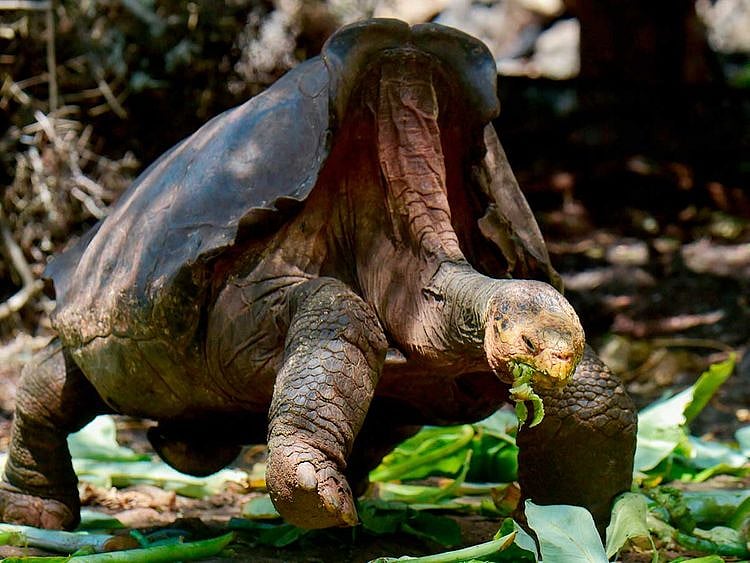
In this file photo taken on February 27, 2019 Diego, a tortoise of the endangered Chelonoidis hoodensis subspecies from Espanola Island, is seen in a breeding centre at the Galapagos National Park on Santa Cruz Island in the Galapagos archipelago, located some 1,000 km off Ecuador's coast. Picture for illustrative purposes only.
AFP
Giant tortoises that were once hunted to the brink of extinction now outnumber humans in the Seychelles, with a landmark scientific survey estimating that nearly 183,000 of the animals live on a remote Indian Ocean atoll.
The remarkable recovery of the Aldabra giant tortoise, whose population had fallen to fewer than 1,000 during the 19th century, is being hailed as one of the Indian Ocean’s greatest conservation success stories.
The new estimate, the highest ever recorded for the species, comes from research conducted by the Seychelles Islands Foundation (SIF) and Britain’s University of Exeter.
The findings, published in the scientific journal Ecology and Evolution, show that approximately 183,000 adult and subadult giant tortoises inhabit Aldabra Atoll, exceeding the human population of the Seychelles which stood at approximately 123,000 at the end of 2025, according to official statistics.
The survey analysed five years of population monitoring data collected between 2018 and 2022, according to a University of Exeter statement released on October 7.
From near extinction to recovery
Aldabra Atoll, one of the world’s most isolated island ecosystems, is among only two places where giant tortoises still survive in the wild, the other being Ecuador’s Galápagos Islands.
During the 19th century, extensive hunting and exploitation devastated Aldabra’s tortoise population, leaving fewer than 1,000 animals.
Conservation efforts gradually reversed the decline. The atoll was declared a strict nature reserve in 1981 and designated a UNESCO World Heritage Site in 1982.
The protection allowed the tortoises to recover over subsequent decades.
“More than 180,000 giant tortoises roaming freely on our atoll is proof of what long-term commitment to conservation can achieve,” said Frauke Fleischer-Dogley, chief executive of the Seychelles Islands Foundation.
“This is wonderful news for Seychelles, for the world, and for everyone who has worked to protect Aldabra.”
Why the numbers are higher
The new population estimate is substantially higher than the widely cited figure of around 100,000 tortoises from the late 1990s.
However, scientists caution that this does not necessarily mean the population has nearly doubled.
Earlier surveys failed to account fully for animals concealed beneath vegetation or resting in shaded areas, making accurate counting difficult.
Researchers used advanced statistical modelling to estimate the number of tortoises that survey teams could not directly observe.
The study found that the population remained relatively stable during the main survey period, suggesting that conservation efforts have helped establish a healthy population.
According to CNN, the findings offer fresh evidence of how long-term protection has helped one of the world’s largest tortoise species recover from near extinction.
New threats remain
Despite the encouraging findings, scientists warn that climate change and invasive species continue to threaten the animals.
Longer and more frequent droughts could reduce the vegetation and shade on which tortoises depend, while rising sea levels threaten the atoll’s low-lying habitats.
Feral cats and black rats also prey on tortoise eggs and hatchlings.
Although feral goats, which previously damaged Aldabra’s vegetation, were successfully eradicated in 2012, researchers say removing the remaining invasive mammals could further strengthen the tortoise population.
Dave Hudson, a postdoctoral researcher at the University of Exeter, said the findings provide an important foundation for future conservation work.
“But it’s important to remember that the numbers provide a baseline – not an endpoint,” he said.
Researchers hope the new estimate will help conservation managers track population changes and respond early to emerging environmental threats.

Alex has been on the frontline of global headlines for nearly 30 years. A Senior Associate Editor, he’s part newsroom veteran and part globe-trotting correspondent. His credentials? He was part of the select group of journalists who covered Pope Francis’ historic visit to the UAE - flying with the pontiff himself. With 27 years on the ground in the Middle East, Alex is one of the most trusted voices in the region when it comes to decoding politics and power plays. He breaks down global affairs into slick, 60-second news - his morning reels are practically a daily ritual for audiences across the UAE. Sharp. Grounded. Fast. Insightful. That’s Alex at his best, bringing a steady editorial hand to every story he tells.
Sign up for the Daily Briefing
Get the latest news and updates straight to your inbox
Network Links
GN StoreAbout Gulf NewsTerms & ConditionsReach by GNSitemapContact usPrivacy PolicyGN FocusHave your sayWork with usAdvertise with usGulf News epaperPrinting Services
Download our app
© Al Nisr Publishing LLC 2026. All rights reserved.