Watch: Thrilled UAE students to send their satellite into space this month
HCT-SAT 1 will blast off along with MBZ-SAT on Elon Musk’s SpaceX rocket from California
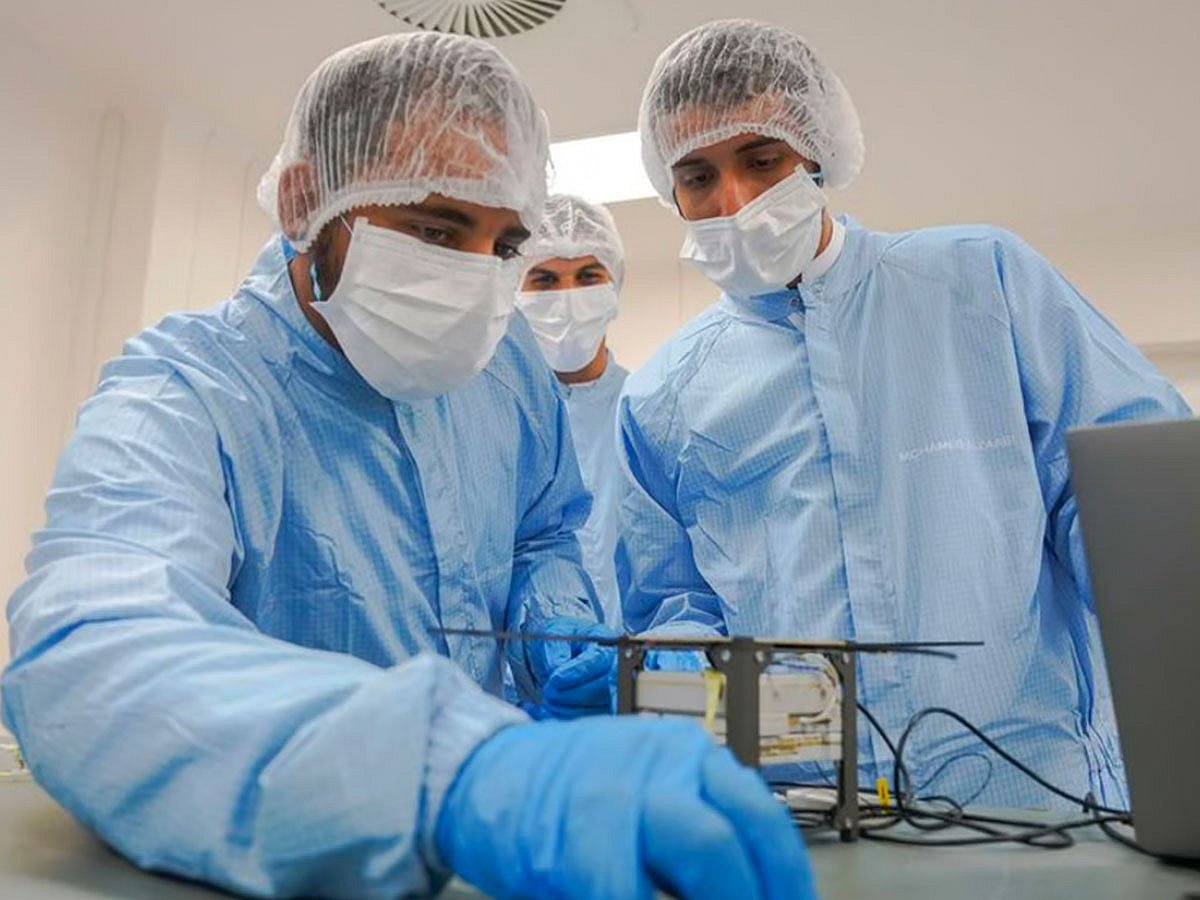
Dubai: Three dozen students from various campuses of the Higher Colleges of Technology (HCT) are thrilled to send a tiny satellite, which they have built, into space this month.
HCT-SAT 1 is the first satellite built by students of HCT under the mentorship of space engineers from the Mohammed Bin Rashid Space Centre (MBRSC) in Dubai.
The nanosatellite weighing just around 1kg will blast off to space along with the region’s most advanced Earth observation satellite MBZ-SAT. which weighs one tonne, aboard a rocket belonging to Elon Musk’s Space X, MBRSC had announced last week.
MBZ-SAT, named after the President His Highness Sheikh Mohamed bin Zayed Al Nahyan, and HCT-SAT 1, named after the university, will be launched aboard a SpaceX Falcon 9 rocket during the Transporter-12 Rideshare mission from Vandenberg Space Force Base, California, US.
As many as 34 students and nine faculty members were involved in the making of the Earth observation CubeSat which carries a payload camera with 5 mega pixels’ resolution, marking a historic milestone in space education in the UAE.
As they prepare for the day their dream project will spread its wings, MBRSC has released a video of some of the students behind satellite with the dimensions around 10x10x11.35 cm.
Students speak
Mira Abdallah, a member of the Electrical Power Subsystem Team, said she was incredibly proud to be part of HCT’s first space mission in collaboration with MBRSC.
“This experience has provided me with the opportunity to learn from their skills and experiences especially within the cleanroom environment,” she stated.
Adel Issa from the Main Payload Team said: “Working with MBRSC has allowed us to understand all phases of satellite development from the inception of the project to its completion.”
Meanwhile, Khaled Mohammed Al Harthi from the Mechanical Team said participating in the project had been a significant experience for him.
“It has allowed me to contribute to the Emirati space sector in which has made global achievements and provided me with new experiences,” he added.
Another student, Sarah Nabil from the Electrical Power Subsystem Team, said: “One of the essential skills I have acquired is understanding the energy related to all the satellite’s components. This knowledge was gained by working on the project with MBRSC.”
Mentors speak
Vu Thu, Project Manager of HCT-SAT 1, explained that students from various campuses across the UAE had been involved in building the satellite from the beginning of the mission. “They went through the whole life cycle of the project,” he pointed out.
Meanwhile, Abdulla Al Shehhi, Project Manager, HCT-SAT 1, MBRSC, said the technical and scientific objectives of the project include the involvement of students in building this nano-satellite, preparing them for the future to build bigger satellites.
Enhancing applied education to equip students of HCT with future skills, integrating space technologies into educational programmes and enabling students and faculty to understand the CubeSat methodology as well as inspiring students to engage with space science and innovation are also among the key objectives.
Landmark achievement
Dr Faisal Alayyan, HCT President and CEO, emphasised that the launch of HCT-SAT1 is a landmark achievement for the institution and a powerful demonstration of its commitment to the national vision and leadership directives.
"This project, developed in collaboration with the Mohammed bin Rashid Space Centre, reflects our unwavering dedication to shaping the future with a new generation of Emirati leaders in space science and technology. We are empowering our students to contribute meaningfully to the UAE’s growing space sector, supporting the country’s ambition to become a global leader in space exploration," he said.
Dr Alayyan added that the HCT-SAT1 mission represents an exemplary model of applied education linked to real-world outcomes. He also highlighted the importance of collaboration with MBRSC, which enhances the quality of educational programs and provides students with a unique opportunity to work alongside experts in the field, both locally and internationally.
The project involved 34 students from various engineering disciplines, including aeronautical sciences, airframe design, and electrical engineering, as well as media students who contributed to the marketing aspect of the project. Additionally, nine faculty members joined the team to work alongside MBRSC’s experts to complete all stages of the project, from satellite design and assembly to rigorous testing, launch, and placement into orbit.
Salem Humaid Al Marri, Director-General of MBRSC, stated that the development of the HCT-SAT1 satellite in collaboration with HCT marks a significant step in enhancing the role of national educational institutions in the space sector. He emphasized that the project reflects MBRSC’s commitment to developing human capabilities and nurturing a new generation of distinguished Emirati talent.
He explained that it has provided students with valuable hands-on experience in satellite development and the implementation of advanced projects that align with the country’s vision for innovation and scientific excellence.
Al Marri further noted that the project highlights the high capabilities of Emirati youth in working with cutting-edge technologies and underscores MBRSC’s dedication to forging strategic partnerships that strengthen the UAE’s position as a global center for space-related research and development. Al Marri expressed pride in the achievement, emphasizing MBRSC’s role in enabling students to contribute to scientific and technological projects that enhance the UAE’s leadership in space exploration.
A team from HCT is preparing to travel to the United States later this month to participate in the launch of HCT-SAT1.
HCT-SAT 1 at a glance
• First Satellite developed by students of HCT
• A Nanometric Earth-observation satellite
• Size: 1U
• Dimensions: 10x10x11.35 cm
• Payload camera resolution: 5 mega pixels
• Orbit: 500-600km
• Number of students who participated: 34
• Number of faculty members who participated: 9
Sign up for the Daily Briefing
Get the latest news and updates straight to your inbox
Network Links
GN StoreDownload our app
© Al Nisr Publishing LLC 2026. All rights reserved.