US-Iran war at six months: What UAE residents need to know today (Aug. 29, 2026)
Why UAE residents must plan airport trips early
The US-Iran war reached six months on Friday, and American diplomats began returning to embassies in the Gulf, the first easing of wartime staffing restrictions since the fighting started.
There was no sign of a breakthrough elsewhere. Iran said it would return to talks if Washington drops its pressure campaign. Hezbollah's leader rejected the deal between Israel and Lebanon. US Central Command said the number of commercial ships turned away under its blockade of Iran had risen to 82.
Here is where things stand on Saturday, August 29, 2026.
American diplomats are coming back
US embassies across the Middle East have begun receiving staff again, along with some of their families, reversing an evacuation ordered in the opening weeks of the war.
The return is partial. Missions are not being restored to full complement, and the State Department is lifting restrictions selectively rather than all at once. Qatar, Kuwait and Bahrain announced on Friday that diplomats' families could come back, though Bahrain and Kuwait have limited that to adults over 18.
Tehran keeps the door open, on its own terms
Iran used the six-month mark to restate that a negotiated settlement is still available, provided Washington first drops its campaign of pressure.
Foreign Minister Abbas Araghchi made the point on X, arguing that a return to diplomacy is achievable and resting the whole case on a single assertion: that pressure does not work.
The record of the past six months gives both sides something to point at. Pakistan and Qatar have led mediation efforts for months. A ceasefire held from April; a memorandum of understanding pointing toward a final settlement was signed in June. Neither produced an agreement, and Washington has since moved to open economic warfare against Tehran.
Araghchi's own week was busy. He hosted Qatar's foreign minister in Tehran on Thursday for talks centred on the Strait of Hormuz, which Iran closed at the outset of the war, capping a stretch of intensive Iranian contacts with Oman and Pakistan.
Kuwait joins the diplomatic traffic
Kuwait's Foreign Minister, Sheikh Jarrah Jaber Al-Ahmad Al-Sabah, spent Saturday on the phone, taking separate calls with his Omani counterpart, Sayyid Badr Hamad Al Busaidi, and with Qatar's Prime Minister and Foreign Minister, Sheikh Mohammed bin Abdulrahman bin Jassim Al-Thani.
The Kuwaiti foreign ministry, in a statement issued through KUNA, said the conversations covered the state of the region and the diplomatic push to shore up security and stability, with particular attention to keeping navigation through the Strait of Hormuz safe and open.
The blockade tally climbs to 82
US Central Command put its running count at 82 commercial vessels turned away as of Aug. 28, with three disabled and two boarded in the course of enforcing the blockade on Iran.
Hezbollah refuses the Lebanon deal
Naim Qassem returned to the airwaves on Friday to reject the agreement between Israel and Lebanon outright, telling viewers of the group's Al-Manar channel that Hezbollah would not surrender after nearly six months of fighting.
"We are against the framework agreement and call for its downfall," he said, describing it as unlawful, humiliating and a blow to Lebanese sovereignty.
The deal in question emerged from US-brokered direct talks that followed Hezbollah's decision to bring Lebanon into the war on March 2 with an attack on Israel. The Israeli response, made up of sustained strikes and a ground offensive, has killed more than 4,300 people by Lebanese government count.
Signed in late June, the framework commits Hezbollah to disarm, sets out a phased Israeli pullback from southern Lebanon, and sends the Lebanese army into the vacated ground, beginning with designated pilot zones.
Qassem's speech leaves the country's most heavily armed movement publicly opposed to a document its own state has endorsed.
A rare Israeli airstrike in the West Bank
Israel's military said it killed three militants in an airstrike in the occupied West Bank on Friday. Air power is an unusual method in a territory where tension has been building.
Settler violence there has climbed sharply, but the West Bank has largely been spared the aerial campaign that has flattened much of Gaza since the Hamas attacks of October 7, 2023. Ground raids on Palestinian towns are routine; strikes from the air have been rare since early 2025.
Flying from the UAE
Emirates, Etihad, Air Arabia and flydubai are all operating. Individual services on Gulf routes are still being pulled or pushed back at short notice as carriers work around security conditions.
Some restrictions have loosened and airlines are edging back toward normal networks. Others have suspensions on the books stretching deep into the autumn.
UAE carriers today
Emirates is flying from Dubai with scattered disruption. EK837 to Bahrain is cancelled; EK839 on the same route is scheduled. EK857 to Kuwait is scheduled. EK719 to Nairobi is delayed.
Etihad is largely unaffected on its Bahrain and Kuwait services from Abu Dhabi. EY647 landed late; EY641, EY643 and EY645 are all scheduled. EY653 to Kuwait has departed.
Air Arabia has cancelled several Gulf services: G9068 and G9124 from Sharjah to Kuwait, G9107 from Sharjah to Bahrain, and 3L020 from Abu Dhabi to Kuwait.
flydubai is running late on several services, including FZ739 to Ashgabat. It wants passengers leaving Dubai at the airport four hours ahead of departure, and online check-in completed beforehand where possible.
Other services out of Dubai
Delays and cancellations are also listed across SpiceJet's Indian network, covering Pune, New Delhi, Mumbai, Jaipur, Kozhikode, Kochi and Amritsar, along with Air India Express to Jaipur and Kannur, Kenya Airways KQ311 to Nairobi, Oman Air WY604 to Muscat and PIA PK284 to Peshawar.
International carriers still suspended
Lufthansa Group: Lufthansa, SWISS, Austrian, Brussels Airlines and ITA Airways, multiple Middle East destinations, through Oct. 24
British Airways: Dubai, Tel Aviv, Bahrain and Amman until Oct. 25, returning on reduced frequencies
Singapore Airlines: Dubai until Oct. 24
Cathay Pacific: Dubai until Oct. 25, Riyadh until Oct. 26
Wizz Air: Dubai and Abu Dhabi from mainland Europe until Oct. 24, Amman until Sept. 21
KLM: Dubai, Riyadh and Dammam until Oct. 24, with Tel Aviv already resumed on Aug. 25
Air France: Dubai and Riyadh back in service, Beirut suspended until Sept. 1
Air Canada: Dubai and Tel Aviv cancelled until mid-January 2027
Finnair: Dubai until March 27, 2027
And DXB is filling up again
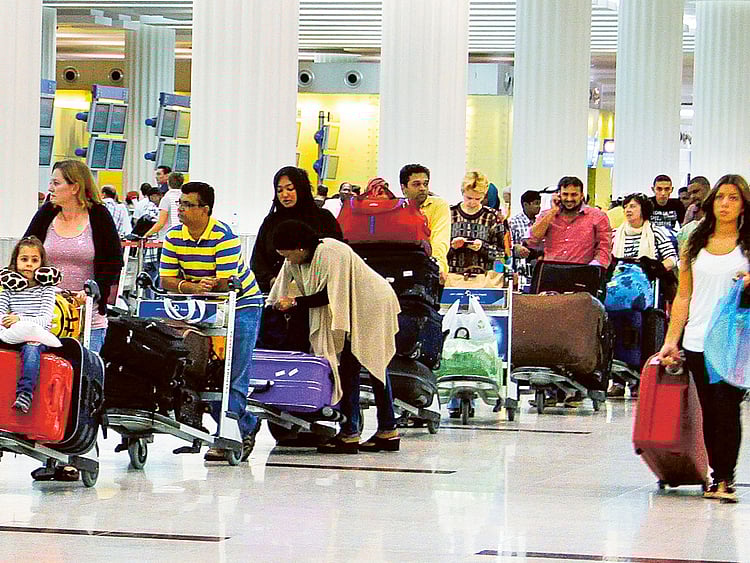
There is a second, entirely unrelated reason to leave earlier this weekend. The post-summer return is under way, and Dubai's airports are busy with residents and visitors coming back from holidays. Airport authorities have stepped up readiness across terminals and checkpoints to absorb it.
The practical effect is that the queue, not the conflict, may be what costs you time, so budget for the drive, the desk, security and passport control, not just the flight.
Before you leave for the airport
Re-check the flight status on the day, even if it was confirmed earlier in the week
Allow three hours before departure as a minimum, more if your airline says so
Check in online wherever the option exists
Build in extra time for traffic, check-in, security and immigration
Make sure the airline has your current phone number and email for disruption alerts.
Sign up for the Daily Briefing
Get the latest news and updates straight to your inbox
Network Links
GN StoreDownload our app
© Al Nisr Publishing LLC 2026. All rights reserved.