UAE urges UN Security Council action on Iran threats to maritime security and Strait of Hormuz
Abu Shihab says freedom of navigation remains a pillar of international law
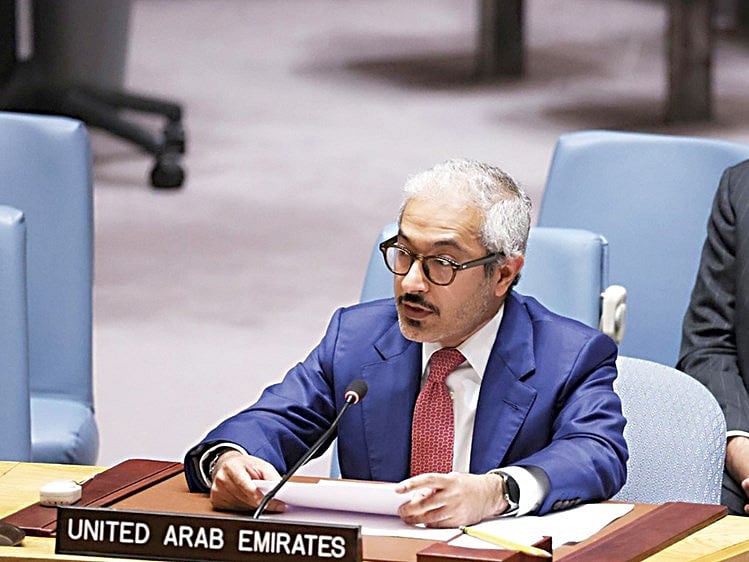
United Nations: The UAE has accused Iran of threatening maritime security and disrupting the global economy through actions in the Strait of Hormuz, while urging the UN Security Council to uphold international law and take decisive action to safeguard international peace and security.
Speaking during a Security Council open debate on upholding the purposes and principles of the UN Charter, Mohamed Abushahab, Permanent Representative of the UAE to the United Nations, said freedom of navigation is a fundamental pillar of international law and warned that recent developments had underscored the importance of protecting vital global trade routes.
Get updated faster and for FREE: Download the Gulf News app now - simply click here.
Abushahab said the UAE is committed to a future based on stability, dialogue and shared prosperity, arguing that sustainable peace could not coexist with impunity or repeated violations of international norms.
"After eight decades of international cooperation in pursuit of peace and a shared global order, the United Nations Charter remains our primary shield against global disorder and the cornerstone of international cooperation," he told the council.
The UAE representative said long-term stability and prosperity could only be achieved through dialogue and de-escalation rather than confrontation or ideological extremism. He argued that regional tensions had been exacerbated by the actions of a single state that had, for years, pursued destabilising policies and supported armed proxy groups.
Abushahab said the UAE had faced unlawful Iranian attacks over the past three months targeting civilian infrastructure, including commercial ports, airports, energy facilities and communications networks.
He further accused Iran of obstructing navigation through the Strait of Hormuz, saying such actions constituted a violation of international law and posed risks to maritime security and the global economy.
The ambassador also referred to a drone attack launched from Iraqi territory against the UAE's Barakah Nuclear Energy Plant, calling it a dangerous escalation. He noted that the Security Council had condemned the incident earlier this week and described the attack as a serious violation of international law.
Abushahab stressed that the UAE retains its right to protect its territory and population in accordance with international law. He also called for accountability for attacks against civilian infrastructure and urged the Security Council to ensure the full and consistent implementation of its resolutions.
"The credibility of the international system depends on our willingness to uphold its rules when they are violated," he said, adding that deliberate attacks on civilian infrastructure must be unequivocally condemned and should never be normalised.
The UAE concluded by urging the Security Council to fulfil its responsibilities under the UN Charter and act with the determination necessary to preserve international peace and security.
Network Links
GN StoreDownload our app
© Al Nisr Publishing LLC 2026. All rights reserved.