The exhibition throws light on Rumi’s perception of divine knowledge, leading to a period of deep introspection and prolific creativity.
Sharjah exhibition gives rare insights into mystic and poet Rumi’s life
It turns out that a chance encounter with his muse led to his transformation
Last updated:
3 MIN READ
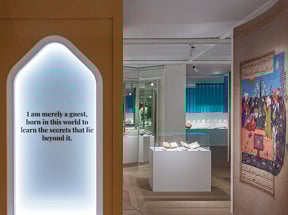
A section of the "Rumi: 750 Years of Absence... Eight Centuries of Presence" exhibition at the House of Wisdom in Sharjah.
Supplied
Sharjah: Few historical figures have captured the essence of spiritual longing and universal love quite like Jalal al-Din Rumi. The House of Wisdom’s exhibition, Rumi: 750 Years of Absence… Eight Centuries of Presence, taking place till February 14, provides little known insights into the life of the extraordinary mystic, poet, and thinker through rare artefacts, manuscripts and immersive displays.
The exhibition unravels the story of Rumi’s transformation into a beacon of spiritual wisdom.
The journey starts with ‘The Beginnings’ section, which explores the cultural and intellectual currents that defined Rumi’s early years. It opens a window into Rumi’s childhood in Balkh, his migration to Konya, and the influences that laid the groundwork for his profound spiritual evolution. It is here that visitors first encounter the historical and personal forces that shaped Rumi’s identity, setting the stage for the transformative journey on display in the second section, ‘The Transformation’.
Speaking to Gulf News, Marwa Al Aqroubi, Executive Director of House of Wisdom in Sharjah, said, “Rumi’s wisdom continues to transcend time and resonate across generations. His universal themes of love, unity, and human connection bridges cultures and borders. At House of Wisdom, we are honouring Rumi with an exhibition that tells his story in a new light while bringing his poetry and works to life like never before.”
The Transformation
Returning to Konya after his pilgrimage to Mecca, Rumi experienced a fateful meeting in 642 AH with Shams Al-Din Tabrizi, a mystic whose influence would shape the poet’s spiritual journey. This life-changing moment is illuminated through the lens of their philosophical exchange. Their profound dialogue shifted Rumi’s perception of divine knowledge, leading to a period of deep introspection and prolific creativity.
Historical accounts reveal that Rumi retreated from his teaching to embark on an intense spiritual companionship with Tabrizi, believed to have lasted for nearly two years. During this time, Rumi’s writings flourished, marking the genesis of his celebrated works, which continue to inspire seekers of truth across generations.
Gateways to the past
The Transformation brings this period to life through a collection of rare artefacts. Among the highlights are intricately crafted pages from The Divan-i Kebir (The Great Collection), where over 35,000 verses are in flowing calligraphy of red and black ink. Nearby, manuscripts of Maqalat-e Shams-e Tabrizi (Discourse of Shams-i Tabrizi) from the Mevlâna Museum provide a glimpse into the teachings of the mystic who profoundly influenced Rumi.
The most significant works of Rumi
It also houses the Masnavi manuscript in Naskh script from the Mevlâna Museum, dating back to 701 AH. The manuscript, considered Rumi’s most significant work, is decorated with intricate geometric and botanical motifs. Alongside it is the Masnavi manuscript from the 10th century AH, part of the Manuscripts House in Sharjah.
The exhibition also hosts two royal copies of the Masnavi from Abdulrahman Al Owais’s collection. These manuscripts highlight the exceptional care and reverence given to this work by kings, sultans and princes, owing to its profound wisdom and moral lessons composed by Rumi in over 25,000 verses of poetry. This was his final work before his passing.
Sign up for the Daily Briefing
Get the latest news and updates straight to your inbox
Network Links
GN StoreAbout Gulf NewsTerms & ConditionsReach by GNSitemapContact usPrivacy PolicyGN FocusHave your sayWork with usAdvertise with usGulf News epaperPrinting Services
Download our app
© Al Nisr Publishing LLC 2026. All rights reserved.