"Bees saved me from myself," she says. Back then, she describes herself as a lost teenager, just following her parents' path with no direction of her own.
Meet Dubai's 'Bee Fairy Lady' who handles bees without a protective suit
An accidental beekeeper, a honeybee mission and the story behind Dubai's Bee Fairy Lady
Last updated:
5 MIN READ
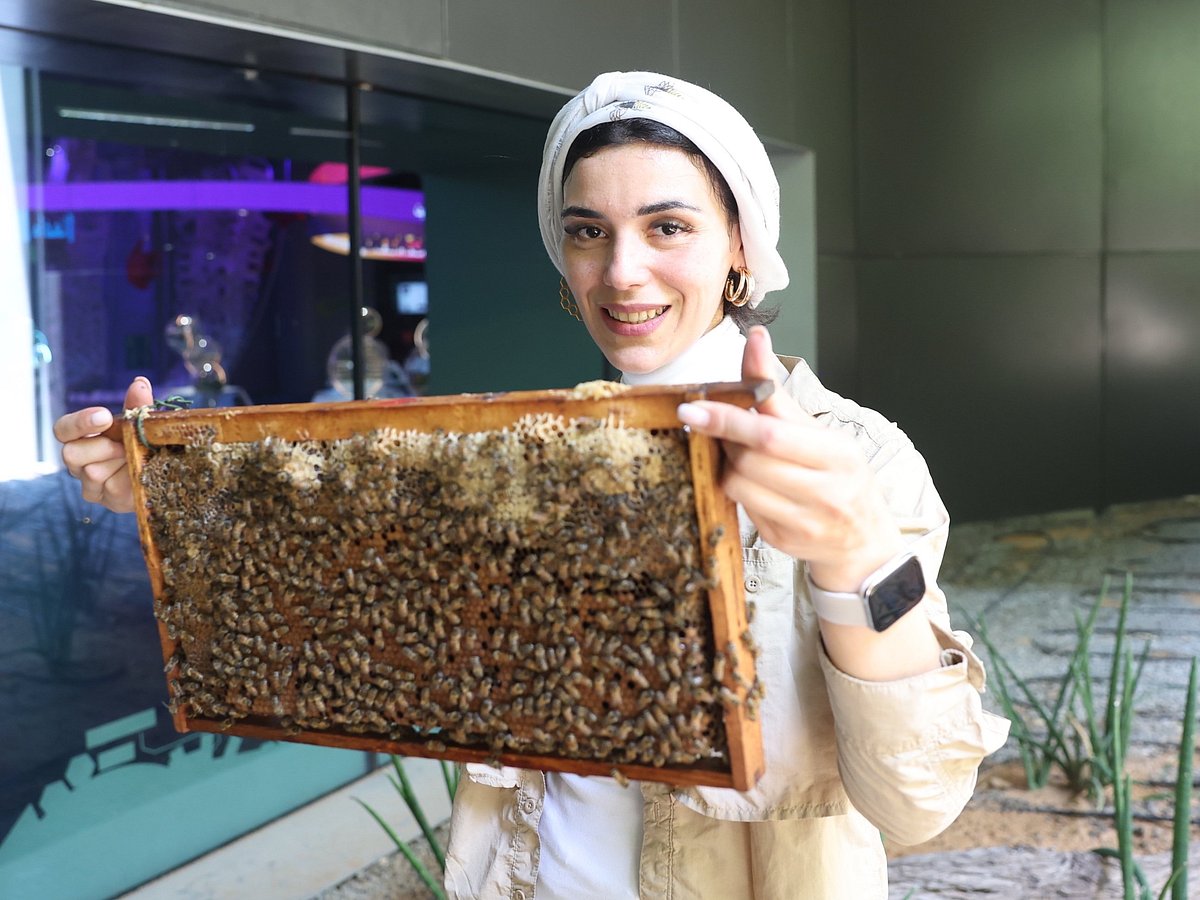
Meeting Dr. Hammal's hives at the Jane Goodall Pollinator Garden we saw how she handles her bees, all without a suit of course.
Ahmad Alotbi/Gulf News
Dubai: Meet the woman the bees don't sting.
Kids at Terra have a name for Dr. Meriem Hammal.
They call her the Bee Fairy Lady. No suit. No veil. No gloves. Just her and the hive.
"I qualify myself as an accidental beekeeper," she says. It's not false modesty. Her entire path into this world happened almost by mistake.
A vet school she never wanted
Dr. Hammal trained as a vet, as her parents wished for it. Not because she did.
By her third year, she'd had enough. She went home and told them straight: "I'm not doing it anymore. Call us done." Around the same time, a professor pushed her toward practical training. Pick a specialism, he said. Dogs, cats, horses, or bees.
She picked bees. Not because she liked them but because, "I heard beekeepers only open their hives once a week." She barely had a spare hour between vet school and a remote MBA.
Her mentor opened his first hive for her without a suit. The bees stayed calm the entire time. Dr. Hammal, fully suited and nervous, couldn't understand why.
He explained his own selective breeding programme. In detail. Citing Mendelian genetics, despite never having set foot in a university himself.
"It was the first time in my life I felt so small," she says.
A three-month visit turned into three years. Her mentor eventually gave her a hive of her own.
She killed it. Out of anxious over-attachment, she admits, checking on the hive so often that she disturbed it into losing its queen. "Because I loved the queen," she says.
Choosing bees over a clinic
Dr. Hammal went on to finish her MBA and a surgical specialism in France. She came home to Algeria fully qualified. A surgeon. Her parents were thrilled. Her father wanted to open a clinic.
She told him she wanted to be a beekeeper instead.
"They weren't against me being a beekeeper," she says. "They were against their surgeon daughter turning into a farmer."
Her father's first worry was what he'd tell his friends.
She went to her mentor anyway, offering to work for free in exchange for her first bees. He wasn't interested. "Stop the drama," he told her. "I'm not hiring. And you cannot put your conditions from now."
Every inspection still holds a surprise, she says. Fresh wax means the colony needs more room. A frame of sealed brood means a new generation is on the way.
Instead, he recruited her to help launch Algeria's first professional beekeeping association.
Through it, she trained women in rural areas to keep their own hives and earn their own income. She worked with deaf beekeepers too, teaching them the same skills.
"Bees saved me from myself," she says. Back then, she describes herself as a lost teenager, just following her parents' path with no direction of her own.
The sound of an opened hive, she says, was the first time she ever felt grounded.
Finding her way back to people, in Dubai
Work eventually brought Dr. Hammal to Dubai. The role was heavy on genetics and selective breeding. Something was missing. The human side of the work, the part she'd loved most in Algeria.
That changed at Terra, at Expo City Dubai, during a World Environment Day workshop.
A year later, a woman approached her. Half Jordanian, half Palestinian. She said, in Arabic, that she didn't know who to complain to about Hammal. "Ma ba'rif lemeen ashtiki."
It wasn't a complaint. After that workshop, the woman had taken a beekeeping course, gone home to Jordan, and taught her own niece to keep hives. She brought Hammal a jar of their honey to taste.
"Their whole life changed," Hammal says, "just because they got introduced to beekeeping."
Dr. Hammal always puts a coloured dot on her queens. Can you spot it in this picture?
How Terra got its bees
Terra's bees arrived before Dr. Hammal did.
In 2019, during construction for Expo 2020 Dubai, a small swarm landed on the site. Around 2,000 bees.
Nobody called pest control. The team decided to adopt the colony instead.
Those bees turned out to be Apis mellifera jemenitica, the honeybee subspecies native to the Arabian Peninsula, rarer now than the imported bees most beekeepers in the region actually work with.
They were reintroduced to a purpose-built garden in October 2024. In January 2025, Dr Jane Goodall attended in person to officially open the Jane Goodall Pollinator Garden. She named the resident queen Gaia.
Dr. Hammal now runs a breeding programme aimed at protecting that native subspecies. She calls the threat from imported bees "genetic pollution."
"You don't really have to move mountains," she says. "You just need to be aware of what's around you. When people don't know, they don't care."
“In Dubai, urban beekeeping is possible,” Dr. Hammal says. If you spot a bee near your house or spot a hive, it means there's rich variety of flowers nearby. What you can do instead of calling pest control is providing a tray of water with some rocks so they can have a safe clean water source.
What visitors can do at Terra
There's a full programme now. A novice beekeeping course. Hive visits through Inside the Hive. Honey tastings through Taste from the Hive, paired with the native plants each honey comes from.
A four-hour introduction for children, called Bee Scientist. A schools initiative, 100 Hives, 100 Schools, starting with Deira International School. A corporate hive-adoption scheme, Be Kind. An ethical swarm-relocation service, Be Ethical.
Meeting Dr. Hammal's hives at the Jane Goodall Pollinator Garden we saw how she handles her bees, all without a suit of course.
Becoming the Bee Fairy Lady
Dr. Hammal breeds queens herself now. Always selecting for calm, resilient, native genetics.
That breeding is exactly what lets her walk into a hive without a suit. Kids when they saw her they noticed it first. The fact that bees simply didn't sting her.
The nickname was then born and then stuck.
"If you manage to control your emotion enough, and the bees are from good breed," she says, "they will be calm. They will be gentle."
Meeting Dr. Hammal's hives at the Jane Goodall Pollinator Garden we saw how she handles her bees, all without a suit of course.
However, as much of a bee whisperer that she is, smoke still helps, even for her. It convinces the colony there's a fire nearby, so the bees gorge on stored honey to prepare for escape, and end up too sluggish afterwards to sting. It also masks a beekeeper's scent from the hive's guards.
Every inspection still holds a surprise, she says. Fresh wax means the colony needs more room. A frame of sealed brood means a new generation is on the way.
"Hello, ladies," she says, easing open another frame. It's not for the cameras. It's just how she talks to them.
Network Links
GN StoreAbout Gulf NewsTerms & ConditionsReach by GNSitemapContact usPrivacy PolicyGN FocusHave your sayWork with usAdvertise with usGulf News epaperPrinting Services
Download our app
© Al Nisr Publishing LLC 2026. All rights reserved.