Nadhifa drying her seaweed on a traditional rack, leaving it exposed to external elements such as wind, dust, and other environmental factors
Dubai: For more than 112 days each year, Nadhifa Ibrahimu walks into the shallow waters off Zanzibar’s coast to tend the seaweed that helps support her family.
The 35-year-old mother of four from Muungoni Village has spent years laying cultivation lines, tending crops through the tides and waiting for harvest time.
But for Nadhifa, reaching the harvest was never the end of the uncertainty.
She could spend weeks growing and drying her seaweed and still earn nothing if a buyer failed to come, or if the weather turned before the crop could be sold.
“I spend over 112 days a year in the water. I do it for my children. But when the buyer does not come, those 112 days become nothing,” she said.
In 2025, she lost two harvests.
The first time, a buyer did not arrive. With no contract, no guaranteed market and no alternative outlet, the seaweed she had spent weeks drying spoiled. The second time, sudden rain reached the crop before she could move it from the community drying racks located away from her home.
Get updated faster and for FREE: Download the Gulf News app now - simply click here.
For a family whose income also depends on her husband’s fishing, such losses carried a direct impact on the household.
Before joining the Seaweed Social Enterprise Project, Nadhifa targeted around 1,200 kilograms of dried seaweed each year. At a selling rate of about TZS 800 per kilogram, that represented approximately TZS 960,000, or around $369, in potential annual income from seaweed farming.
Today, her story is beginning to look different.
Supported by The Big Heart Foundation and implemented by the Zanzibar Maisha Bora Foundation, the Seaweed Social Enterprise Project is helping farmers in Uzi and Muungoni villages move towards a more structured model built around training, farming inputs, technical support, formal agreements and market access.
For Nadhifa, the significance lies in reducing the uncertainty that has long followed the work she puts into the sea.
200 farmers reached, with women at the centre
Nadhifa is one of 200 seaweed farmers registered under the programme.
Of those, 175 are women, representing 88 per cent of participants, while 51 are young people.
All 200 farmers have completed training in areas including seaweed cultivation, farm management, harvesting, post-harvest handling, financial literacy and contract farming.
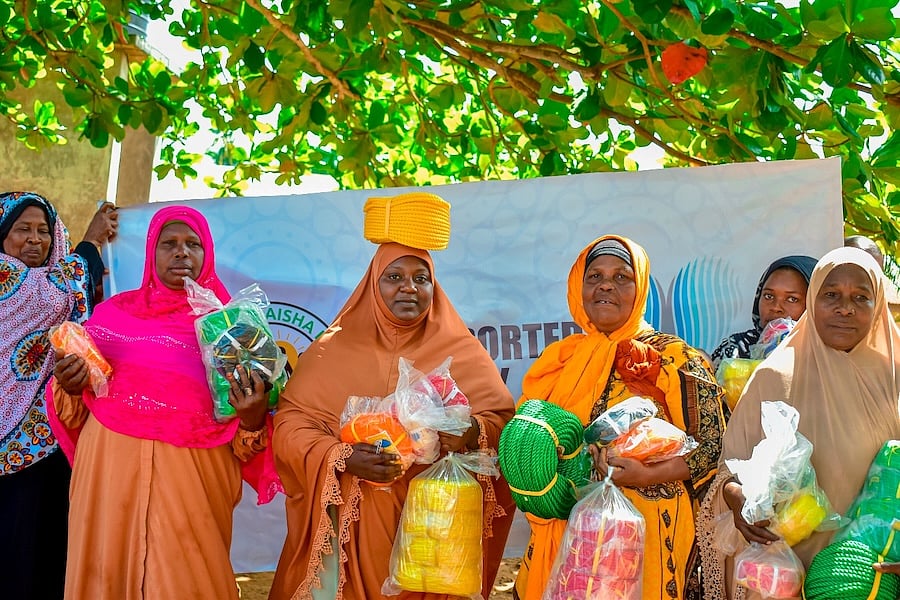
A total of 171 farmers have signed formal production agreements, while 168 have received production inputs to support their farming activity. The distributed materials include nylon ropes sufficient for each participating farmer to establish up to 60 production lines.
The initiative has also deployed 12 community-based extension officers, who provide technical guidance, monitor farm quality and support farmers through production and harvesting.
Together, these measures are designed to address some of the barriers that have traditionally limited the earning potential of seaweed farmers, from access to farming materials and technical knowledge to the uncertainty of finding a buyer after harvest.
A livelihood sustained largely by women
Seaweed farming is an important part of Zanzibar’s coastal economy.
More than 25,000 people depend on the sector, with women accounting for around 80 per cent of those involved.
Yet the sector continues to face challenges including limited access to quality farming equipment, weak market connections, post-harvest losses and declining productivity linked to changing sea temperatures.
For women who rely on the crop as a source of household income, those vulnerabilities can mean months of labour with no guarantee of return.
The TBHF-supported programme seeks to address those pressures across the farming cycle rather than at a single point.
Farmers receive production materials through an interest-free arrangement, alongside training designed to improve cultivation techniques, crop quality and financial management.
The initiative aims to raise productivity by as much as 30 per cent.
But one of the most important changes for farmers such as Nadhifa comes after the crop leaves the water.
Seaweed Social Enterprise Project (SESEP)
From hoping for a buyer to having a market
Under the traditional model, Nadhifa spent weeks drying her seaweed before attempting to sell it.
The process is physically demanding and exposes the harvest to weather, contamination and the risk that a buyer may never appear.
Through the new model, she can sell fresh seaweed at TZS 250 per kilogram, removing much of the lengthy drying process and reducing her exposure to post-harvest losses.
Seaweed loses around 90 per cent of its weight during drying, meaning about 10 kilograms of fresh seaweed results in one kilogram of dried product.
On that basis, the fresh-seaweed price equates to around TZS 2,500 per kilogram of dried seaweed, compared with the TZS 800 per kilogram Nadhifa previously earned.
Combined with improved cultivation techniques and higher productivity, her potential annual earnings from seaweed could reach around TZS 3 million.
For Nadhifa, however, the value of the change goes beyond income.
Selling fresh means less time spent spreading, turning, guarding and transporting seaweed for drying. It means fewer weeks spent watching the sky and hoping the weather holds. And it gives her more time for her children, her household and the next farming cycle.
“Before, I would dry the seaweed for weeks and then pray,” she said. “Now, if I harvest, I will for sure sell. That is the difference between losing everything and keeping everything.”
Building skills that remain in the community
The project’s impact is also being built through knowledge.
Farmers have received classroom and practical training covering seaweed biology, cultivation methods, site selection, environmental considerations, financial literacy, harvesting and post-harvest handling.
Lead farmers and extension officers are being equipped to support others within their own communities, helping technical knowledge continue beyond formal training sessions.
The wider farming system is also being strengthened through improved harvesting equipment, upgraded post-harvest infrastructure and digital tools designed to support farmer monitoring and production records.
The result is an approach that goes beyond providing materials alone.
It is designed to give farmers the tools, knowledge and connections to build stronger livelihoods around work they have already been doing for years.
Seaweed Social Enterprise Project (SESEP)
For The Big Heart Foundation, that means supporting communities in a way that strengthens their ability to create lasting opportunity for themselves.
And in Zanzibar, where women have long stood at the heart of the seaweed industry, that impact is beginning with farmers such as Nadhifa.
The sea itself has not changed.
The tides will still rise and fall. The rain will still come. Farming will still require long days in the water.
What is changing is what those days can lead to.
For a woman who once worked through an entire season without knowing whether anyone would buy her harvest, that shift brings something more valuable than certainty alone.
It brings the possibility of looking towards the next harvest with confidence — and towards a future in which the work she puts into the sea can build something more secure for her family.
Network Links
GN StoreAbout Gulf NewsTerms & ConditionsReach by GNSitemapContact usPrivacy PolicyGN FocusHave your sayWork with usAdvertise with usGulf News epaperPrinting Services
Download our app
© Al Nisr Publishing LLC 2026. All rights reserved.