A drone carrying relief supplies to a flood-affected area is seen in Trishuli, Nepal's Nuwakot district on September 4, 2026.
From family holiday to rescue mission: Abu Dhabi-based Nepali referee recounts flood ordeal
A rare family trip home turned into a desperate effort to help flood-hit communities
Last updated:
6 MIN READ
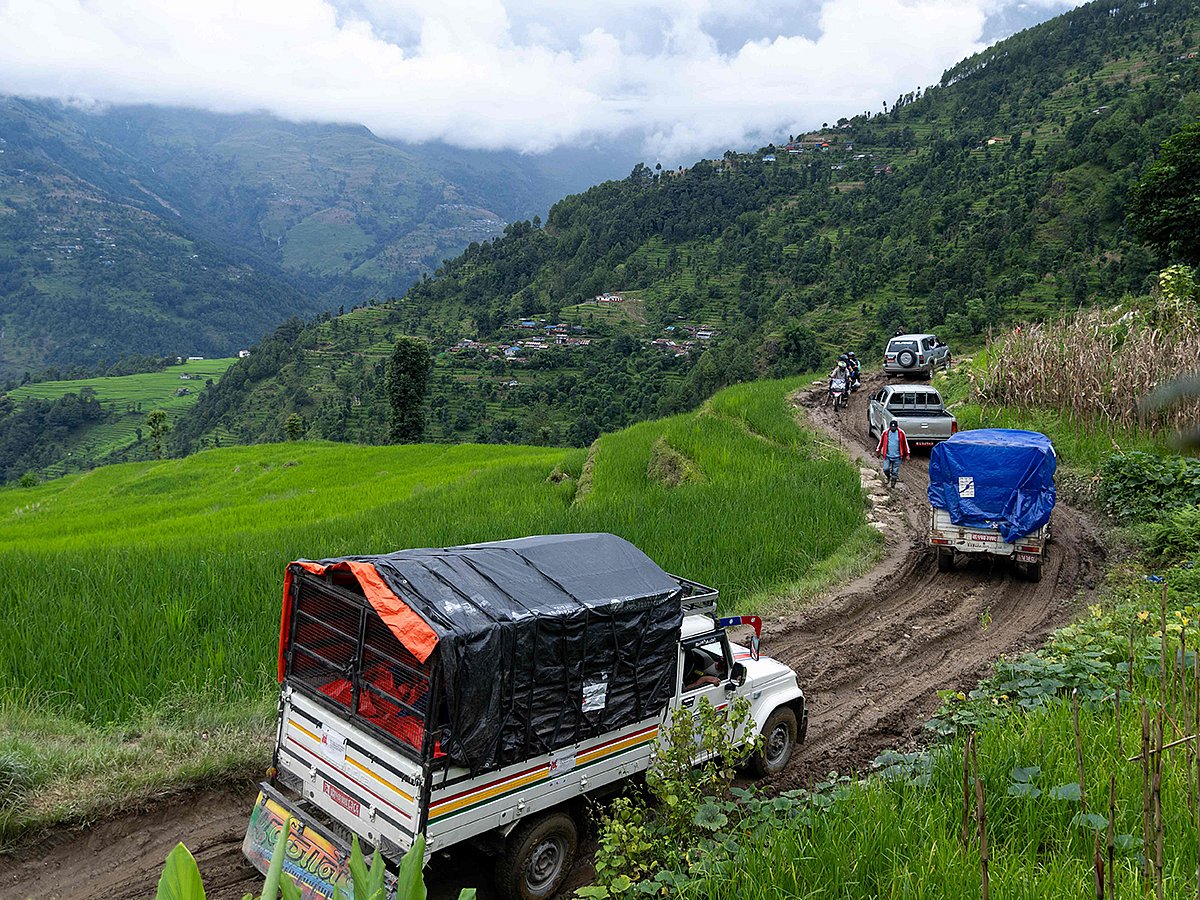
Vehicles carrying food and other essentials make their way through a damaged muddy road leading to Rasuwa in the aftermath of flash floods in Nepal's Nuwakot district on September 4, 2026.
AFP
Dubai: For Jagan Adhikari, the journey to Nepal was supposed to be about family. After more than 13 years in the UAE, opportunities to spend time with his parents and relatives have been rare. This trip has been especially meaningful as Adhikari, his wife, and their two children were travelling towards Trishuli in Nuwakot, where his in-laws live.
Then, on August 26, a phone call has changed everything. A friend has warned Adhikari that a massive flood had struck Rasuwa and that water was rushing towards the Trishuli area. At first, he has struggled to grasp the scale of what he was hearing.
“We were already close to our destination and I wondered whether the situation was really as serious as it sounded,” Adhikari told Gulf News.
Get updated faster and for FREE: Download the Gulf News app now - simply click here.
His wife has been less willing to take the risk. With two young children in the car, she wanted to be cautious.
Then came another call, one that has turned concern into fear. His wife’s sister has received devastating news. Her daughter and in-laws have been caught in the disaster and their home had been swept away. Overcome with shock, she has collapsed and was taken to hospital.
“My wife began to cry. Our seven-year-old daughter, seeing her mother in tears, started crying too.”
Three hours without answers
For the next several hours, the family has tried desperately to reach relatives and friends. The telecommunications network has been badly affected so calls have been difficult to connect.
After about three hours, a small measure of relief has come when updates revealed that their immediate relatives from the affected household were alive. However, their home and land have been lost.
“That was the moment I began to understand the scale of what had happened. This was no longer simply a flood we were hearing about from a distance. Families had lost their homes, people were missing, and entire communities had been changed within minutes,” recalled Adhikari.
By the time the family reached the Battar area, it has been clear that continuing towards Trishuli was unsafe prompting them to stop the trip.
Watching helicopters
From where the family was, Adhikari could see helicopters moving back and forth as security forces evacuated people from areas that could no longer be reached by road.
For him, watching the helicopters brought home the reality that people have been stranded on the other side and he wondered what he could do. He has begun making calls and contacted anyone he thought might be able to assist.
“Eventually, I reached the personal secretary of Nepal’s Minister for Communications and explained the situation. He asked for details about the people who were trapped. Those details were passed on and they were later evacuated by a Nepal army helicopter and taken to safety,” shared Adhikari.
The relief has been enormous but he was quick to put the focus elsewhere.
“I do not claim credit for their rescue. The difficult and dangerous work was done by the security personnel and rescue teams on the ground and in the air. I had simply been able to connect people who needed help with someone who could act.”
He added, “That experience made me realise how important even a phone call could become during a disaster.”
Army personnel carry the body of a flash flood victim outside a temporary relief camp in Trishuli, Nepal's Nuwakot district on September 4, 2026.
Making calls
For the first few days, moving between affected areas has been xtremely difficult. Roads have been damaged and bridges swept away, leaving communities separated from one another.
When people could not physically reach those in need, phones have become their most useful tool. Adhikari and others have tried to establish who needed evacuation, who needed food or clothing, where temporary shelter was available, and who had not yet been heard from.
“Sometimes all I could do was make one call after another and pass information from one person to the next,” explained Adhikari.
Relatives, volunteers, local residents, officials, and members of the security forces have all been trying to help in whatever way they could.
Decisions people make
The stories Adhikari heard from survivors have been harder to forget. Some have noted that they escaped only moments before the water reached them. Others have returned to their homes to collect phones, documents, or other belongings because they believed there was still time.
“When we spend years building a home and collecting possessions, it is natural to want to save them. A phone may contain years of memories. Jewellery may represent a family’s savings. Documents can be difficult to replace. But in a disaster, a few seconds can separate escape from tragedy,” described Adhikari.
Moreover, he has been careful not to judge those who went back.
“Standing safely outside a disaster, it is easy to say what someone should have done. In the confusion and fear of the moment, decisions are harder.”
Ten days after the disaster, the suffering has remained far from over. Some of Adhikari’s relatives and friends are still unaccounted for. Families continue to wait for news of loved ones.
“There is a particularly painful uncertainty. They are caught between hope and grief, unable to move fully towards either.”
Flash flood survivors look for salvageable belongings at Trishuli Bazar in Nepal's Nuwakot district on September 5, 2026.
Lessons from the UAE
Adhikari is a national referee with the UAE Taekwondo Federation and has spent years practising and teaching the sport.
Additionally, he has been involved in community activities through Abu Dhabi Police’s “We Are All Police” initiative. He has never expected the lessons from those experiences to become relevant during a disaster back home.
Taekwondo has taught him discipline, patience, and the importance of remaining calm under pressure, while community volunteering has made him realise that when people need help, contribute whatever you can.
Jagan Adhikari (right), national referee at the UAE Taekwondo Federation
In Nepal, that has meant making calls, sharing information, helping people find shelter, and trying to arrange food and clothing.
Across the affected areas, rescue workers have been entering dangerous places. Soldiers have been carrying out evacuation missions. Medical workers have been treating the injured. Volunteers have been distributing supplies. Ordinary families have been opening their doors to strangers.
“I was simply one person among many trying to help,” stated Adhikari.
‘Nepal is still home’
Over 13 years after leaving Nepal and building his life in the UAE, Adhikari has bared that distance does not change what home means.
“Nepal is still home. Seeing communities devastated and families searching for loved ones reminded me how quickly an ordinary day can become something entirely different,” said Adhikari.
He has known that there are things he cannot do but there are also things that he can.
“I cannot rebuild the homes that disappeared. I cannot take away the grief of families who have lost someone. I cannot bring back those who died. What I can do is help where I am able.”
The trip has been supposed to give his family memories of a holiday and time together. Instead, it has given him memories of loss, fear, courage, and acts of humanity.
“It has left me with a lesson I will carry long after I return to the UAE, possessions can be replaced and homes can be rebuilt, but a human life cannot.”
Network Links
GN StoreAbout Gulf NewsTerms & ConditionsReach by GNSitemapContact usPrivacy PolicyGN FocusHave your sayWork with usAdvertise with usGulf News epaperPrinting Services
Download our app
© Al Nisr Publishing LLC 2026. All rights reserved.