The foster parents are grateful to Dubai authorities for granting permission for Fatima's burial despite her undocumented residency status.
EXCLUSIVE
Nobody’s child: Dubai issues special permission to bury twice-abandoned Filipina girl
Pak-Filipino foster parents for years, who couldn't adopt Fatima, bid farewell to her
Last updated:
5 MIN READ
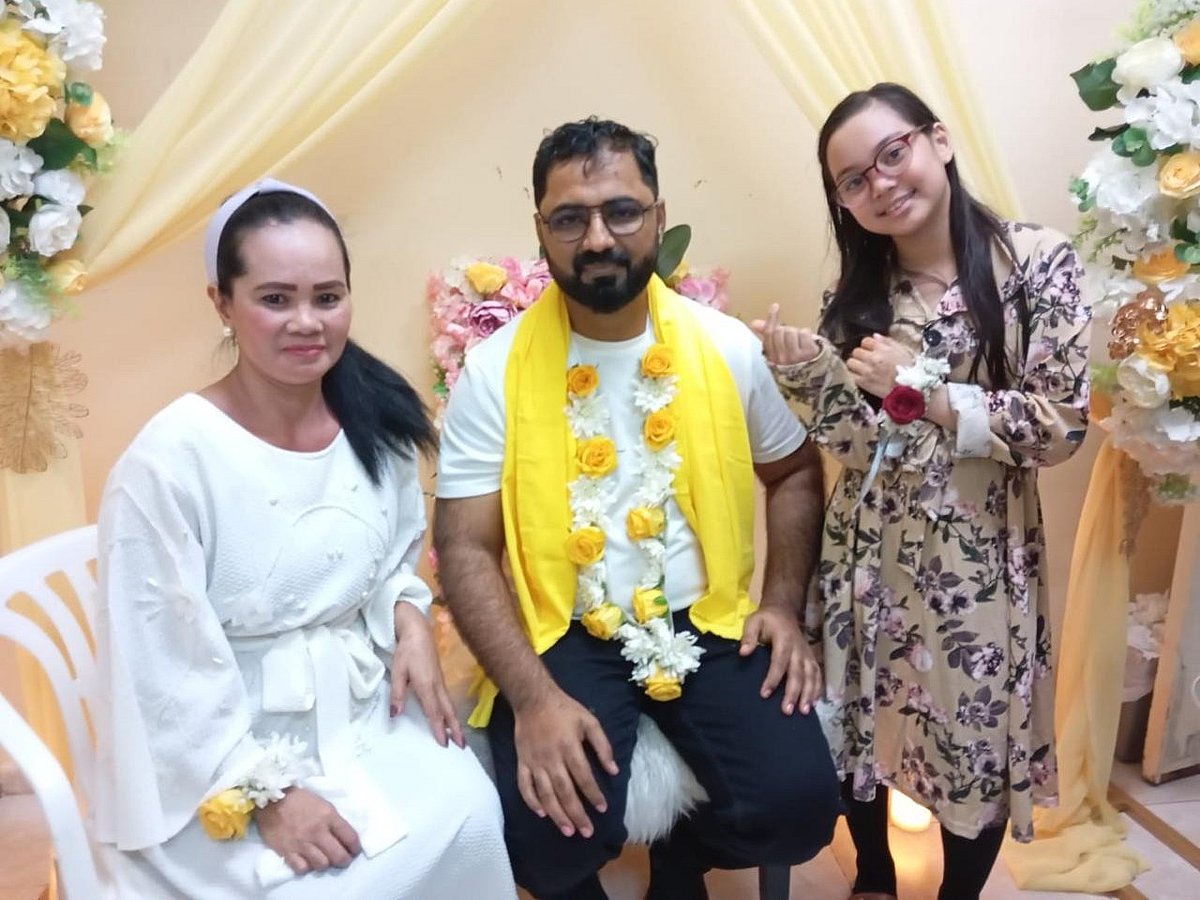
The last happy family photo of Fatima with her foster parents, Syed Ali Moazzam and Muozzama, before she was diagnosed with the autoimmune disease that left her in a vegetative state for over two years.
Supplied
Ajman/Dubai: About 100 people gathered after Maghrib prayers in Dubai on Saturday to say goodbye to Fatima, the 'twice-abandoned' Filipina girl whose short, painful life had moved thousands across the UAE.
Though they never became her legal guardians, her Pakistani foster father, Syed Ali Moazzam, and his Filipino wife, Muozzama, who had spent years caring for her through some of the most gruelling circumstances imaginable, bid emotional farewell to her: grieving, but grateful Fatima was finally at peace.
“Finally, we managed to lay our Fatima to rest in Dubai’s Al Qusais Cemetery,” Moazzam told Gulf News on Sunday.
He said Fatima's biological mother, however, was not there. She could not attend the burial because she was in police custody. She was transferred from Ajman to Dubai, according to one of her friends, with multiple cases involving financial dealings filed against her.
Special permission in Dubai
As reported by Gulf News, Fatima was declared dead after she was found unresponsive at their home in Ajman on Tuesday morning. She was 15.
After Ajman authorities informed the foster parents that she can only be buried in Dubai because she was born there and her biological mother’s last visa was also from there, they had to seek permission from Dubai authorities for the same.
Getting permission to bury Fatima in Dubai was expected to be a long battle, said Moazzam. With no Emirates ID and a complicated legal history, he said he was told they might face a long wait, possibly until after the Eid holidays.
"I didn't have peace. I didn't want her body to stay in cold storage. I wanted to relieve her of all worldly things as soon as possible," he said.
He approached Dubai Municipality and Dubai Police, explaining Fatima's story in full. He said he showed the previous Gulf News reports on Fatima to the officials. Dubai Municipality granted permission following which Dubai Police issued a no-objection certificate for her burial despite her undocumented residency status.
"Alhamdulillah, we got permission. We are thankful to Dubai Municipality and Dubai Police," Moazzam said.
Faces in the crowd
The funeral followed Islamic rites. Fatima's body was brought to a facility beside a mosque at the cemetery, where she was washed and the family and well-wishers were allowed to see her face one last time. The janaza prayer was offered at the mosque, and she was then carried to the graveyard with her coffin borne by Moazzam's former Pakistani colleagues.
Among those who came to pay their respects were neighbours, many of them Filipino, and members of the Pakistani and Arab communities who had followed Fatima's story or known her personally.
Moazzam said he was thankful to everyone who came to pray for Fatima. “I was glad when I saw Dr Tariq, one of the teachers at an Islamic centre in Ajman where Fatima used to attend religious classes with Muozzama.”
He said everyone who knew Fatima loved her. “She was a very inspiring and well-behaved child," Moazzam said.
Get updated faster and for FREE: Download the Gulf News app now - simply click here.
The little girl’s plight
Fatima was born out of wedlock and her father had disappeared, according to her mother who took care of her initially. She then handed over the child to a friend and her partner when Fatima was just a year old. That first set of informal foster parents also eventually gave up on her. It was then that Moazzam and Muozzama stepped in and started homeschooling her.
In 2019, Gulf News published her story and her dream to go to school and helped track down Fatima’s biological mother. She then came forward and helped Fatima secure a passport after confirming their relationship through a DNA test.
Fatima had sent Gulf News a video thanking the newspaper and the reporter who had helped her.
However, the couple could not adopt her legally as she did not secure a visa and Emirates ID as the mother, who faced some cases, disappeared again. Fatima’s dream to continue studying at a school, which she had attended briefly, was not fulfilled due to the absence of her residency documents.
Giving another jolt in her life, she was diagnosed with subcutaneous lupus erythematosus, an autoimmune disease that had left her unconscious and fighting for her life.
What followed was two and a half years of intensive home care that few families, let alone those who took in a child not their own, could have endured.
Trained to care
Fatima had spent her final years on a home ventilator. She could not eat on her own.
She had a tracheostomy tube as well as a nasogastric (NG) tube running from her nose to her stomach, through which she received all her nutrition. The tubes needed to be changed every few months spending thousands.
In her last month, doctors inserted a PEG (Percutaneous Endoscopic Gastrostomy) tube directly into her stomach.
The couple were trained by the hospital to manage her ventilator and keep her airways clear. When her tracheostomy tube became blocked by secretions, they had to clean and reinsert it themselves.
They learned how to feed her through the NG tube, how to reposition her body regularly to prevent bedsores, and how to carry out physiotherapy at home.
"We were trained by the hospital to take care of her machines. We learned how to use the ventilator, how to handle the tracheostomy," Moazzam said.
During emergency admissions to government hospitals in Ajman and Sharjah, the management waived Fatima's bills, which ran into hundreds of thousands of dirhams at times, once they understood her story.
The couple approached multiple charities for support, but none were able to help. Without an Emirates ID, Fatima did not qualify. They said they were immensely grateful for the support from the government hospitals.
Small signs, great pain
In the first three months, Fatima was in a full coma. She did not respond to anything. Slowly, something changed, Moazzam recalled.
She began to open her eyes. She could move her head. She became responsive to light.
"The only improvement was that she could hold her head and move it and open her eyes. She was responsive to light, but doctors said what she was seeing did not create any image in her mind,” Moazzam said.
Her body remained largely still. One arm and one leg could not be bent. When she was injected or in pain, she could not cry out. But her expression changed, and sometimes, she would shed tears.
Doctors had warned early on that the brain damage from lupus and the subsequent oedema meant her chances of meaningful recovery were very low. Whatever recovery was going to happen, they said, would occur in the first six months.
"It happened exactly like that," Moazzam recounted.
In her final weeks, doctors had discussed a possible brain surgery to drain fluid but eventually decided on the PEG tube insertion instead. She never made it to any further intervention.
Muozzama's grief
Of the two, it was Muozzama who felt the loss most acutely, said Moazzam.
"Both of us were taking care of Fatima. But she was more attached to Fatima than me. Muozzama is definitely heartbroken. I am trying to stay strong,” he said.
For two and a half years, the couple had kept Fatima alive in their home, suctioning her tubes, adjusting her position, feeding her through day and night, and holding on to the possibility that she might one day improve. She did not. But they never stopped.
"We took care of her when she was healthy and when she fell sick also," Moazzam had said when Fatima passed. "No child should go through what our Fatima has gone through. We hope she is in a better place."
Also Read
Twice-abandoned Filipina girl in UAE dies after two years in vegetative stateFilipina girl, 13, fights for life in UAE hospitalNetwork Links
GN StoreAbout Gulf NewsTerms & ConditionsReach by GNSitemapContact usPrivacy PolicyGN FocusHave your sayWork with usAdvertise with usGulf News epaperPrinting Services
Download our app
© Al Nisr Publishing LLC 2026. All rights reserved.