Dubai A Patient Charter launched Thursday at the World Congress of Cardiology plans to get 1.7 million signatures to make irregular heartbeats a high priority for governments.
"We are the patients' voice," said Trudie Lobban, director of the Atrial Fibrillation Association, noting that every ten seconds someone around the world suffers a stroke because of irregular heartbeats or AF.
The director said many doctors do not recognise AF and that its side-effects are "devastating". An irregular heart beat is thought to be an ailment of the elderly, but now many younger people are suffering from its after-effects, such as stroke, she said.
Blood clots
Atrial fibrillation is when the heart starts quivering and beating irregularly. The heart then cannot pump properly and blood clots form and travel to the brain, causing a stroke.
The Patient Charter has been endorsed by 68 medical and patient organisations from 39 countries. It is estimated that almost 1.3 million people in the Middle East and North Africa live with AF.
Stress factor
Lobban said there were many factors for irregular heartbeats. "It could be genetic, a virus, or brought about brought on by stress. Each of us have a one in four chance in developing it in our lifetime," she said.
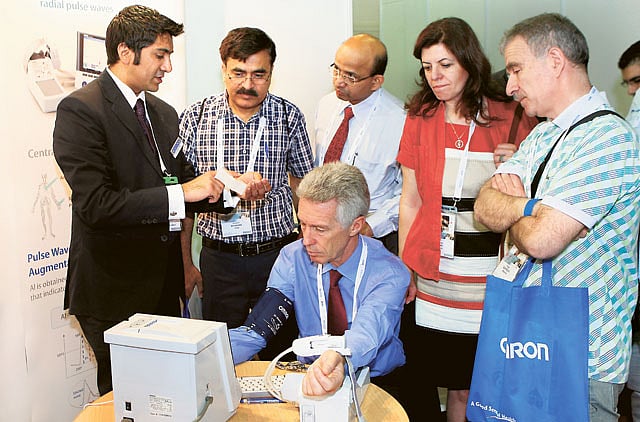
The director said there are usually no signs other than an irregular pulse. She said blood pressure monitors do not tell the correct picture.
"The monitors will tell you what the pulse rate is but won't tell you it's irregular," she said.
The only way to check it is manually, she added. The normal pulse rate is between 60 to 100 beats per minute.
Looban said a new anti-coagulant will be on the market soon, but reiterated that AF needed to be first diagnosed and then treated.
"Alarmingly, throughout the Middle East medical need for stroke prevention in AF patients is still not met," said Dr Wael Abdul Rahman Al Mahmeed, former president of the Emirates Cardiac Society. The deaths due to irregular heartbeats are expected to nearly double by 2030.
Meanwhile, cardiologists from Dubai Health Authority (DHA) heart team performed two heart surgeries yesterday which were transmitted live at the Congress.
Live surgeries
The cardiologists performed the surgeries at Dubai Hospital and hundreds of delegates view the ‘live' streaming of the surgeries.
Dr Fahad Baslaib, president of the Emirates Cardiac Society, and Dr Talib K Majwal, director of interventional cardiology at the Heart Centre in Dubai Hospital, performed the latest procedure known as Transcatheter Aortic Valve Implantation (TAVI) for a 74-year-old female Iraqi patient.
Dr Baslaib said this procedure was particularly helpful for elderly patients who often developed a narrow aortic valve. This technology has been developed for those patients who cannot tolerate open heart surgery and or run a high risk with surgical procedures, he said.
The second live surgery was performed on a patient who needed the Absorb treatment. Dubai is the first city in the Middle East and only the fifth in the world to introduce Absorb, a procedure to treat coronary heart disease with a self-absorbing "scaffold" which dissolves in the body over time and yet manages to keep blocked arteries open.
Sign up for the Daily Briefing
Get the latest news and updates straight to your inbox
Network Links
GN StoreDownload our app
© Al Nisr Publishing LLC 2026. All rights reserved.