Global Village gives artisans their best chance
Stalls displaying live work environments highlight intricacies of fading handicrafts
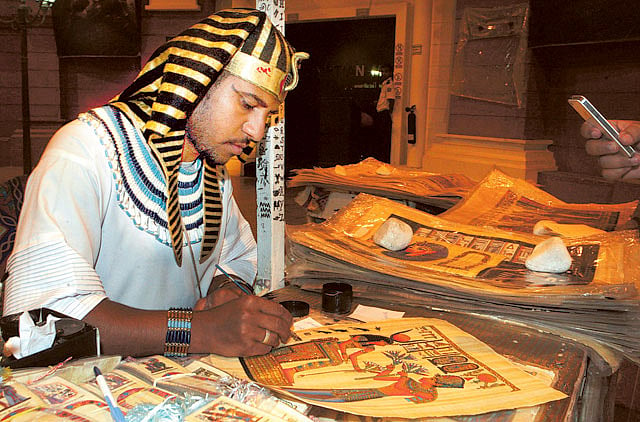
With 36 pavillions representing 65 countries, Global Village exhibits hundreds of thousands of products from all over the world, but it’s not often that we think about the people behind these unique creations.
This year, Global Village visitors got the chance to witness in person artisans from far and wide showing off their beautiful skills.
Gulf News embarked on a ‘world tour’ of sorts keeping out an eye for artisans giving live demonstrations. The first stop was the Indian pavilion where jeweller Mohammad Salman, 27, demonstrated a 700-year-old craft.
“I am a fourth-generation Bidri jeweller, which is a dying ancient craft with only four families left who practice it in Hyderabad,” Salman said.
Bidri work, according to Salman, includes jewellery or display items made of copper and zinc with fine engravings that are embellished with silver. “This is the first time that this art is demonstrated in the UAE. Bidri work is dying because silver and metal is expensive. I am glad that I got the opportunity to exhibit my work in Global Village and I am really appreciative to the Indian pavilion because it gave me a free stall to share my country’s art with the world.”
The Tunisia stall attracted our attention next. Hechmi Owertani, 62, demonstrated an art he fell in love with as a teenager — engraving people’s names on copper plates and trays using only a hammer. “I learned my craft in the Old City in Tunisia. I etch people’s names employing Arabic calligraphy on copper plates and trays, which is an old Tunisian craft practiced since 1911.”
At the African pavilion, Abdullah Camara, 33, who is from the Senegal, was carving wooden figurines, African tribal masks and animal statuettes. “I started learning this craft in 1994 and it took me five years to master. All these figures are of animals and tribes inspired from African culture,” he said.
At the Yemeni pavilion, precious stone collectors Mohammad Ali Jaber and jeweller Adel Qussai Sharhan were busy fashioning rings. “We Yemenis are famous for our silver and precious-stones jewellery. Around 3,000 years ago, the Jews living in Yemen made silver work famous; as for the precious stones, they are only found in certain areas of Yemen and one of the most sought-after stones is the ‘Aqiq’ that comes in different colours — red being the most famous.”
Jaber told Gulf News that traditional jewellery for women would weigh three to four kilograms but modern influences have led them to design lighter accessories to appeal to young women.
Live craft demonstrations have become a big attraction for Global Village visitors especially those on the lookout for customised items or simply eager to witness a piece of art come to life.
Saudi sisters Sara, 19 and Mariam, 22, simply loved the experience. “It is nice to have them work in front of us because we get to have customised goods with our names engraved on it. I really hope to see more live handicraft shows next year,” they said.
— Noor Nazzal is at trainee at Gulf News
Sign up for the Daily Briefing
Get the latest news and updates straight to your inbox
Network Links
GN StoreDownload our app
© Al Nisr Publishing LLC 2026. All rights reserved.