War against the red date palm weevil enters next phase
Pheromones and light traps part of ammunition to kill pests
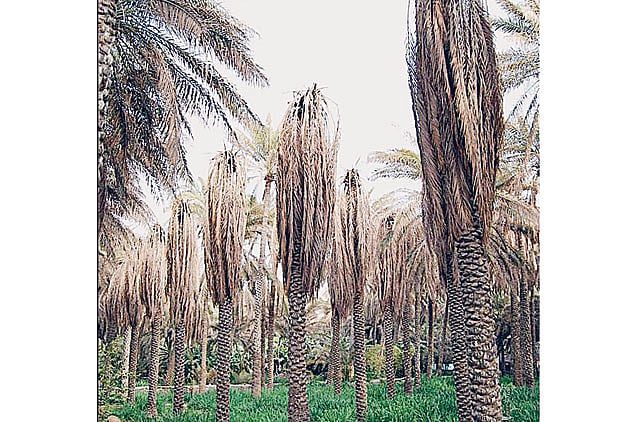
Abu Dhabi: The Ministry of Environment and Water has just entered phase two of its war against the red date palm weevil, by distributing more traps for the destructive insects.
The ministry has just reviewed the results of the first six months of its intensive three-year national campaign it started in October.
The campaign was launched under the direction of Shaikh Mansour Bin Zayed Al Nahyan, Deputy Prime Minister and Minister of Presidential Affairs.
The campaign is designed to raise the level of bio-security and food safety.
The ministry has established a general strategy for the national campaign.
Obaid Mohammad Juma Al Matroushi, Director General of the ministry and acting chief of the Supreme Council of the campaign, said all necessary preventive measures had been taken by coordinating with senior officials of various ministries. "We have distributed 30,000 pheromone-baited traps and 4,000 light traps covering an estimated 2.5 million palm trees in farms in all three areas, in addition to offices," Al Matroushi said.
"The campaign has completed the first phase, which took around six months," said Al Matroushi.
"At present, we have received reports of 12,240 palm trees infected with the red palm weevil.
"Successful treatment has been completed on 4,347 trees by using aluminium phosphate tablets, and 7,443 have been treated with insecticides.
"At the same time, we have removed approximately 430 trees which were heavily infested.
"This phase will cover a total of 63 per cent of the palm trees in these areas and offices."
"The first phase of the campaign, which lasted until the end of March 2010, has been completed by taking the necessary preventive procedures," said Al Matroushi.
"In this phase, we covered around 54,287 palm trees with 1,484 pheromone traps in those areas, in addition to some municipal areas.
"We have also deployed 2,323 light traps for the Oryctes beetles, covering 914,250 trees in total," he added.
Saeed Hassan Al Bagham, the campaign's coordinator, clarified how the traps worked.
"A pheromone trap is netting that is distributed on the outer forms of the trees and the edges of the farm, surrounding around 100 trees, depending on the level of infestation," he said.
"The other is a light trap, and they are hung from the branches of the tree in a light tube that is topped with a metal cover. The light attracts all flying insects at night, and eliminates them," he said.
Uninvited guest: The pest in the past
The red palm weevil, Rhynchophorus ferrugineus, invaded the Gulf states in the mid-1980s, and has caused havoc with date plantations ever since.
The beetle-like weevil is widely found in southern Asia and Melanesia where it is a well known threat to coconut plantations as well as date palms.
The weevil expanded its territory westwards very rapidly.
The pest was recorded for the first time in the United Arab Emirates in 1986, Saudi Arabia in 1987 and in Iran in 1992. It crossed the Red Sea into North Africa and by 1995 it had infested over 10,000 farms across Arabia.
In infested plantations, yields have been estimated to have dropped from 10 tonnes to 0.7 tonnes per hectare, according to the Food and Agricultural Organisation (FAO).
— Gulf News Report
Sign up for the Daily Briefing
Get the latest news and updates straight to your inbox
Network Links
GN StoreDownload our app
© Al Nisr Publishing LLC 2026. All rights reserved.