Johana Alexzander, who is in Grade 12, GIIS in Dubai.
UAE teens embrace final school year with dreams of fashion, pickleball, and astrophysics
UAE teens balance exams, big dreams and the messy leap into adulthood
Last updated:
11 MIN READ
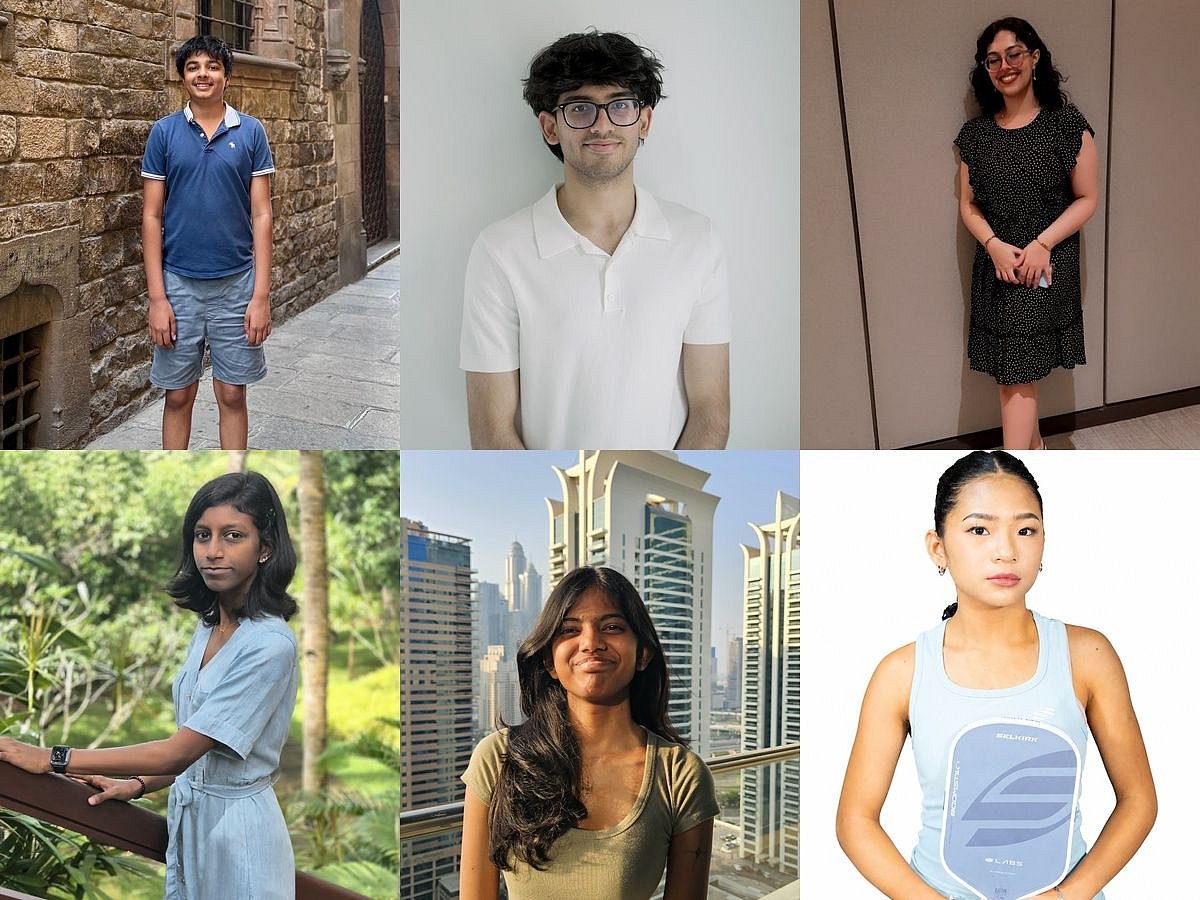
From left: Aifaan Asrar, Dhruv Sharma, Amatullah Arsiwalla, Ritika Regin, Johana Alexzander and Rain Isabella Astano.
What do you mean the school life I've basically grown up with is coming to an end so soon?
It's the final year of school for Johana Alexzander, who is in Grade 12, GIIS in Dubai. "It's a little scary every time I realise that," she says frankly. Alexzander, who moved to Dubai in Grade 6, during COVID, looks back at the montage of the past six years: Going from a shy, scared Indian child who just moved countries, to gaining confidence and winning MUNs, inter-school competitions and serving as the Deputy Head of Media for TEDxYouth 2025.
As the curtain falls on her school years, she is determined to make the most of everything and create as many memories as she can, even though the board examinations are looming. "I know this year is going to have a lot of 'lasts', so I just want to be there for all of them."
And as she wades through school academics, she is also clear-eyed about the future: Fashion, fashion and fashion, she emphatically says. The passion bloomed after watching Emma Stone's costumes in Cruella (down to the trash bag!), and Anne Hathaway's transformation from Cerulean sweaters to classy boots, coats and jewellery. "I don't want to simply throw fabric onto a mannequin, call it a day and hope it becomes a million-dollar idea. I want to create clothes where the details matter where an embroidery, a stitch or even the choice of fabric has a reason behind it. I want to look back at something I've created one day and be able to say, 'I made this.'"
Her dream destination is Milan, with Istituto Marangoni's Milan campus high on her list.
Yet Alexzander is also keeping an open mind. Dubai remains an option, while Japan is another country she would like to explore.
The stage is set, the lights are flashing, and the teenagers are ready to go, as they reach the bend in the road. Fashion designers, psychologists, or anything they choose to believe in: UAE's youngsters are brimming with much hope.
17-year-old Ritika Regin is especially drawn to organisational psychology.
'I'm looking forward to pickleball this year'
Dubai-based Rain Isabella Astano is looking forward to improving both in school and in pickleball this year. "I want to become a better athlete while also keeping up with my academics. Since I’m homeschooled, I have more flexibility to balance my training and schoolwork, which I’m really looking forward to using to my advantage."
As she explains, a few years ago, she imagined herself using tennis to get a college scholarship in the Philippines, studying there, and eventually starting her own business. However, as she admits, her plans have changed a lot since then. "Now, I play pickleball and I’m hoping to pursue it professionally. I’ve also become interested in Sports Science, so I can see myself studying that in college while continuing to compete in pickleball."
Rain Isabella Astano.
Life is a lot more than just grades
17-year-old Ritika Regin at The Winchester school Jebal Ali, is also about recognising that the school years are finite. As she says, her father always tells her to enjoy school life as the years won't come back. His philosophy: School isn't only about studies and grades; it's about becoming a better human being. "I understand that more than ever. I'm excited to make the most of this year, finish school and start a new chapter of my life."
So, what does she see for herself in the future? Regin imagines herself attending university and choosing a subject that is connected with psychology, business or a blend of the two. "I am especially drawn to organisational psychology, since it brings together my interest in people and my interest in business and the way organisations work."
Currently, she sees herself being involved in work that deals with people, understanding the way that they think and behave, and helping organisations to improve.
Staying in the UAE, studying abroad and finding space for creativity
The plans are many, as are the ambitions. For now, she would prefer to study at a university in the UAE. However, she hasn't ruled out the possibility of spending a semester or a year abroad.
And in her case, there's always room for creativity, which includes making crafts. "I believe it is important to have interests outside of school as they provide me with a sense of relaxation and comfort," she says.
Aifaan Asrar, currently in Grade 10, the transition back to school is marked by something much more immediate: The football pitch. As he says, he is excited to readopt a sporting routine again.
Football, economics and data
Eight months into 2026, it has been a long year. The unprecedented war in March led to distance learning, and then the summer months followed later. And so, for Aifaan Asrar, currently in Grade 10, the transition back to school is marked by something much more immediate: The football pitch. As he says, he is excited to readopt a sporting routine again.
His plate is full with ambitions: Mathematics, economics and data. "After school is finished, I would like to go to university and study something related to maths and economics, this thought has evolved as I had a passion for physics, but now I find data and analysis far more interesting," he says.
University, for him, means the UK, preferably London, with economics and potentially data science at the centre of his plans. He also wants this year to be about becoming a better footballer, while improving his organisation and time management.
17-year-old Dhruv Sharma wants to further scale his own initiative: UniAbilities, where he teaches STEM courses to underprivileged students in India.
Looking to the stars
17-year-old Dhruv Sharma finds the magic in physics. Even his words reverberate with joy as he recounts his final year plans and what lies ahead: He wishes to develop his passion for physics, mentor students from the junior year group at Dubai College, on some of the fascinating aspects of the universe. "As a head of astronomy club and deputy head of physics society, I want to build a strong program by mixing hands-on activities with fun physics lab and focus on core topics like orbital mechanics, cosmology and optics," he says.
It's a strong intersection of physics, education and technology. "A few years ago, I didn't really have such a clear idea of what I wanted to do," adds Sharma, mentioning that he had always been riveted by science and especially by questions about space and the universe. "What attracts me to studying abroad is the opportunity to learn from people with different ideas and experiences," he says, adding that he wishes to become better at leadership.
But that's not all, for the starry-eyed teen. He wants to further scale his own initiative: UniAbilities, where he teaches STEM courses to underprivileged students in India. The initiative has already reached around 8,750 students in India, and this year he wishes for the number to touch 14,000.
Amatullah Arsiwalla, in her final year.
A doctor's certificate and real cooking
Meanwhile, for Amatullah Arsiwalla, at Al Diyafah High School, the excitement of the final year is refreshingly simple. "Honestly? Senior privileges and not having classes on all days!" she says. Still, she isn't in a hurry to let go of it. "I want to stay around and experience this last year more than ever."
Her path ahead has shifted before, and she's honest that it could shift again. "Medical, changed a few years back and might change even at the end of the year, but at the moment the focus is on being able to do my parents proud with a doctor's certificate." The pull toward medicine, she says, comes from an unusual fascination: "I've had a weird obsession of studying human bodies. No idea why, I just think it would be cool to be able to know every organ in detail."
This year, her goals are more practical than lofty. "Learn to manage my time so I'm not doing essays at 1am," she says. And away from academics entirely, she's set her sights on the kitchen. "Cooking. Real cooking, not just cereal and toast. I refuse to be a college kid who only eats instant ramen."
The pressure of being 17
With more dreams, comes more pressures. And as Alexzander sees, teenagers are trying to deal with too many things at once, including procrastination, mood swings, motivation, academics, extracurricular activities, friendships, expectations for the future and the pressure to somehow balance everything perfectly.
Recalling from her own experience, she says that she, too, cannot get herself to work unless there's a deadline hanging over her head like a sword, which obviously adds to the stress. However, she also pushes back against the idea that procrastination is simply laziness. "Procrastination isn't always as simple as being lazy. Sometimes someone is overwhelmed, scared of failing or simply doesn't know where to begin."
And sometimes, the pressure comes from trying to hold together schoolwork, friendships, personal life and expectations about the future. Regin explains, "One of the main difficulties, that teenagers have to cope with is the pressure they experience as they attempt to balance their schoolwork, personal life, their friendships, and the expectations regarding their future."
As she realises, it is not necessary to have all the answers right away.
Meanwhile, Asrar sees another challenge emerging from the technology teenagers have grown up with. It's difficult to stay focused, he admits, as there's such easy access to the internet and AI, that makes acquiring information easy, reducing research skills and critical thinking.
For Arsiwalla, the challenge has a name: Comparison. "Probably the pressure to have your whole life figured out at 17 while also being compared to everyone online," she says. Her way of dealing with it is straightforward. "I deal with it by muting people who stress me out and reminding myself nobody actually has it together, they're just better at posting."
Astano provides her own perspective: "I think one of the biggest challenges is the pressure of not knowing what you want to do with your future."
As she says, there are so many choices, and sometimes it feels like you’re supposed to already know what you want to be. "I’m trying not to stress too much about it because I believe that eventually you’ll find something you really love and enjoy."
The teenagers paint the messy, confusing picture of adulthood. There's the splotch of examination pressures, blending untidily with managing expectations, and the emerging colours of the future. How does one stay focused in a world of endless information and figuring out who you are, when everyone just keeps asking who you will become?
So, how can parents help through the messiness of university applications, gap years and what not?
It is an emotionally stimulating time, and the children need a comforting, firm and reassuring voice around them to guide them to adulthood.
Dr Sneha John, a clinical psychologist breaks it down for parents: You don't need to be a helicopter parent. It is natural the children will push to the end of the deadline, when it comes down to applications. "So, you need to create that safe space. It is a high-stakes time."
Moreover, she says, in all the stress of hunting down universities and mulling over the future, the child needs to know that the university doesn't define their self worth. And, this is also the time for rejection too, and it will sting. "This might also be one of the first rejections, too," she says, explaining why the children need to learn that rejection doesn't mean that they failed.
And if they wish to take a gap year? A discussion is needed, as parents also need to understand what their child intends, from a psychological aspect. "It can be a valuable time to explore their interests, and could be fruitful. Parents can ask, what do you hope to gain from this?"
Here's a quick list.
Create a safe space, not a pressure cooker: Let your child talk openly about applications, deadlines and anxieties without fearing criticism. Offer help when needed, but avoid constantly checking on their progress.
Agree on a plan for deadlines: Sit down together to map out application deadlines, required documents and next steps. Agree on check-ins rather than repeatedly asking if they have completed everything.
Separate self-worth from university admissions: Remind your child that getting into a particular university does not determine their intelligence, potential or future success.
Prepare them for rejection: Acknowledge that rejection can hurt, especially if it is their first experience of it. Give them time to process disappointment before encouraging them to explore other options.
Focus on options, not comparisons: Avoid comparing your child with friends, classmates or siblings who have received offers. Help them consider alternative universities, courses or pathways that align with their interests.
Discuss a gap year with curiosity, not judgment: If your child wants to take a gap year, ask what they hope to gain from it. Explore how they might use the time to develop skills, gain experience or understand their interests better.
Balance support with independence: Let your child take ownership of decisions and applications, while making it clear that you are available to help them work through challenges.
You don't need to be a helicopter parent. It is natural the children will push to the end of the deadline, when it comes down to applications. So, you need to create that safe space. It is a high-stakes time....
Dr Sneha John Specialist Psychologist at Medcare Camali Clinic in Dubai
'Live fully': What the teens would tell themselves before stepping into adulthood
Perhaps the most telling answers come when the teenagers look beyond the immediate pressure and imagine speaking to themselves at 18. Alexzander would tell herself to stop worrying so much about other people's opinions. "So I would tell my 18-year-old self: live fully. Stop spending so much time worrying about what someone might think or say. Be yourself, be happy, respect other people and, just as importantly, respect yourself."
Or maybe, trust your own abilities, as Regin would say. "I should remind myself that it is all right to make mistakes or to try new things; most important of all, I should tell myself to continue working towards creating a future which I truly want and to make choices that make me happy and proud of the person I become."
Asrar wants to protect the interests and individuality that make him who he is. "To my 18 year old self, I would say that it is very important to maintain hobbies that make you happy and it is vital to stay unique and not to change yourself just to fit in."
And Sharma wants to remember that significant change does not necessarily begin with something enormous. Every small step does lead somewhere. "I would tell myself not to underestimate the impact of small actions. I would remind myself to stay curious, keep learning and not be afraid to start something just because it seems small."
Arsiwalla, for her part, would keep it simple. "Relax. You're going to be fine. Stop doom scrolling college decision threads at midnight."
And Astano? "I would tell myself not to worry too much about the future, just enjoy what is happening in the present. Things can change, and that’s okay. Just keep doing what you love and work hard for what you want."
Network Links
GN StoreAbout Gulf NewsTerms & ConditionsReach by GNSitemapContact usPrivacy PolicyGN FocusHave your sayWork with usAdvertise with usGulf News epaperPrinting Services
Download our app
© Al Nisr Publishing LLC 2026. All rights reserved.