Clockwise: Dr Ram Shankar, Rashmi Nandkeolyar, Dr Pramod Mahajan, Salih Muhammad Safeer, Ananya Krishnan A and Yatish Karthik
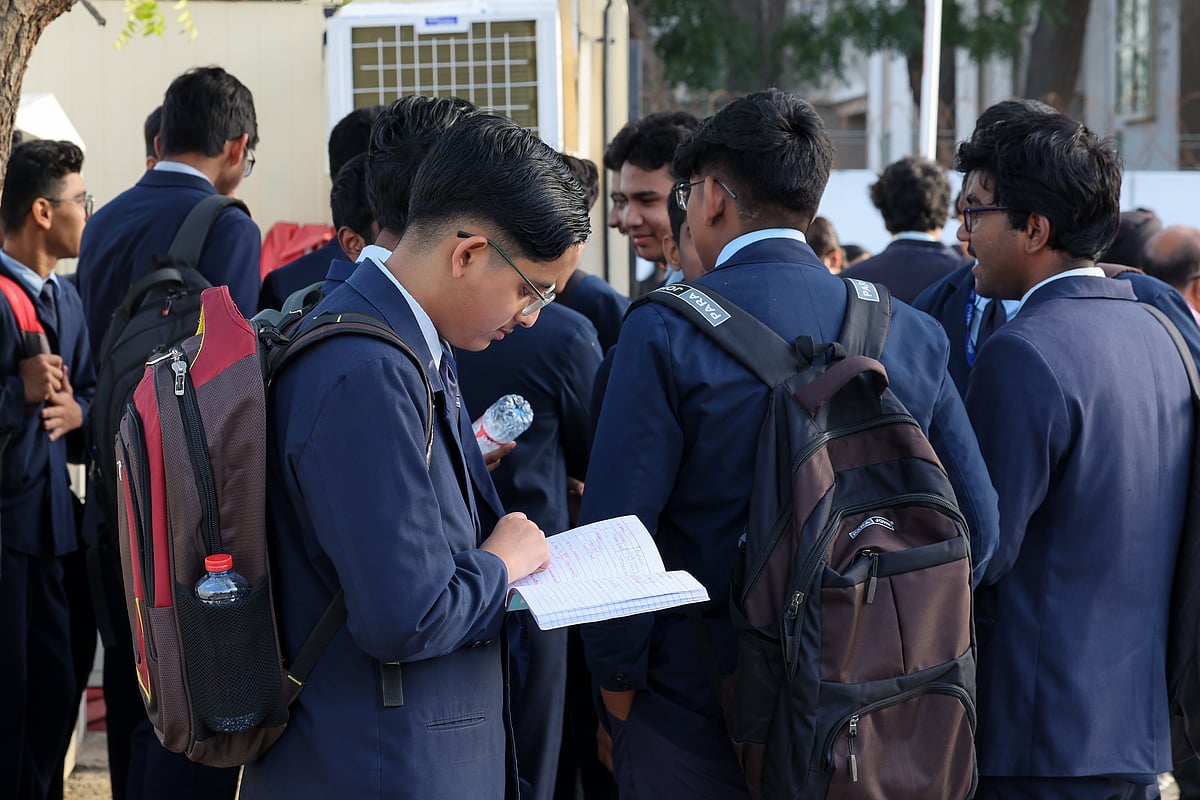
Dubai: More than 13,500 Grade 10 CBSE students in the UAE are navigating an unprecedented academic situation, and many have expressed interest in sitting improvement examinations to score better in their board exams.
On Wednesday, India's Central Board of Secondary Education (CBSE) unveiled a special assessment scheme for Middle East students whose board exams were partially cancelled due to the ongoing US-Israel-Iran war.
After a critical review of the situation across Bahrain, Iran, Kuwait, Oman, Qatar, Saudi Arabia, and the UAE, the board announced a category-wise formula for calculating results depending on how many exams each student managed to sit.
Only the examinations conducted between February 17 and February 28 were completed successfully, covering 44 papers in total — six academic subjects including Mathematics, English and Science, 16 language papers, and 22 skill-based subjects.
Students who appeared for all exams will receive results based on actual performance. For those who attended fewer, missing subject marks will be calculated using averages: best three of four, best two of three, or the average of two subjects applied to remaining papers. CBSE confirmed that Middle East results will be declared alongside the rest of the student cohort.
Second exam explained
With the scheme in place, attention is now shifting to the improvement examinations. A second board exam to boost scores is an opportunity introduced by CBSE from 2026 for Class 10 students in India and abroad, designed to help students prepare better and perform well if they wish to reappear.
It is worth clarifying that several students had already expressed interest in sitting the second exam well before the current conflict began. The dual-exam policy is entirely unrelated to the war that led to the cancellation of Class 10 exams from March 2 in the region.
Mixed numbers
However, the figures vary sharply by emirate. Dr Pramod Mahajan, Director-Principal of Sharjah Indian School and CBSE City Coordinator for schools in Sharjah, Fujairah and Ras Al Khaimah, told Gulf News that around 40 to 55 per cent of students in the northern emirates had shown interest in reappearing for improvement exams.
"The Board had asked for tentative numbers, and we did a survey to make arrangements accordingly," he said.
In some Dubai schools, however, the numbers are expected to be considerably lower. Rashmi Nandkeolyar, Principal and Director of Delhi Private School (DPS) Dubai, said only about 30 per cent of students at her school had shown interest in reappearing, and she does not expect that figure to change. "Before this crisis, about 30% of our students were projected to take the improvement exam in one or two subjects. I doubt if the numbers will change," she said.
How it works
Under the board's dual exam policy, students will be allowed to improve their performance in up to three subjects, with only one language permitted among them and no option to take a sixth subject. "Students can choose either two core subjects and one language, or all three as core subjects," Dr Mahajan explained.
Students are typically given five days after results are declared to submit their List of Candidates (LOC) forms and pay the required fees and subject choices can only be finalised after reviewing the results.
Provisional results under the new scheme are expected within a fortnight and will be released through DigiLocker. "The final results, however, will only be declared after the improvement exams, which are likely to be held in May," Dr Mahajan clarified.
Same centre rule
One key logistical detail: students must appear at the same examination centres as before. "So, if there are students moving back to India, who want to write the improvement exam, they will have to return to the original centre here," Dr Mahajan explained.
Schools in the Middle East are already managing the overlap with the new academic session, where Grade 11 classes typically begin in April, well before Grade 10 final board results are out. "We have that system in place and we will support students with remedial and enrichment classes if they opt for improvement exams that will take place after their Grade 11 classes begin," he added.
Agile in a VUCA world
Dr Ram Shankar, Professor and Director of the CBSE Regional Office and Centre of Excellence in Dubai, noted that 13,669 students had enrolled for the Grade 10 exams in the UAE alone.
He said the board took decisions in "record time" following detailed deliberations, in a move aimed at providing relief to students, teachers, and other stakeholders through a coordinated effort involving regulators, governments, and institutions.
Nandkeolyar described the scheme as "an agile response in difficult circumstances," adding: "Obviously, some students will be disappointed as they may have been waiting for the remaining subjects to prove their mettle. But many students will be relieved that the uncertainty is over, and they also have a chance to improve their scores. In a VUCA world (Volatile, Uncertain, Complex and Ambiguous), we have to find creative solutions, and I think CBSE has done that."
Students speak out
For the students themselves, the experience has been a mix of confusion, concern, and ultimately, acceptance.
Ananya Krishnan A, a Grade 10 student in Ajman, said she had initially expected her score to be based on actual marks from her four exams and model exam marks for the two she missed.
"However, after reading the circular, I feel this may be the best option available to CBSE, taking the average of the best three scores from the four exams attended, along with providing an additional opportunity through a second board exam in May for those who need it," she said.
Though initially disappointed, she said she now considers it a fair approach, also thanking UAE authorities and CBSE "for taking timely and appropriate decisions, prioritising student safety in the current situation while also considering their future."
Resilience over results
Yatish Karthik, a Grade 10 student in Dubai, described the cancellation as sudden and confusing, noting that peer reactions ranged from worry to relief. After the new assessment scheme was announced, he said reactions among his peers have been mixed: some worried, others slightly relieved, and many already thinking about improvement exams.
"Personally, I feel this year has taught us important life skills like adaptability and resilience," he said.
Fellow Dubai student Salih Muhammad Safeer echoed that sentiment. "While many of us were initially surprised about exam cancellation, there is also a sense of relief, and we understand the reasoning behind the decision. This will not negatively impact our future; instead, it has taught us resilience, adaptability, and how to stay strong during uncertainty."
Safeer added that he does not feel the need to apply for improvement. "I believe exams are just the final step of a year-long learning process, and I trust that the evaluation will be fair," he said, also thanking his school, teachers, and parents for their support through the disruption.
Sign up for the Daily Briefing
Get the latest news and updates straight to your inbox
Network Links
GN StoreAbout Gulf NewsTerms & ConditionsReach by GNSitemapContact usPrivacy PolicyGN FocusHave your sayWork with usAdvertise with usGulf News epaperPrinting Services
Download our app
© Al Nisr Publishing LLC 2026. All rights reserved.