Malak Halabi as a toddler playing in the park in Abu Dhabi.
Abu Dhabi: There is a moment on the road into Abu Dhabi that most travelers never notice. The desert gives way, and a green fence rises on either side of the highway, a ribbon of living color against the sand and the sky. To most, it is scenery.
To 23-year-old Malak Halabi, it is a signal sent directly to the body.
"The moment I start seeing it, my nervous system calms down, and I know I'm home."
She was born in Abu Dhabi, at, the Corniche hospital where her own mother was born. It is a place she said nearly everyone in the city seems to have started their life, a shared reference point that turns strangers into neighbors. "Fun fact: my mom was born in it, and I was born in it," she said.
"I'm a third-generation resident." In a country where most families arrived within living memory, that makes her a rare thing: a third-generation Abu Dhabi girl.
"Abu Dhabi is the first home I have ever recognised," she said. "I don't feel like a resident. I belong here, and this is my country as well."
An engineer in the service of her home
Malak is an electrical engineer. She studied in the UAE, in Fujairah, and specialized in power and renewable energy, a field that quietly shapes what the country will look like in the decades ahead. It was this path that opened the door to something larger than herself.
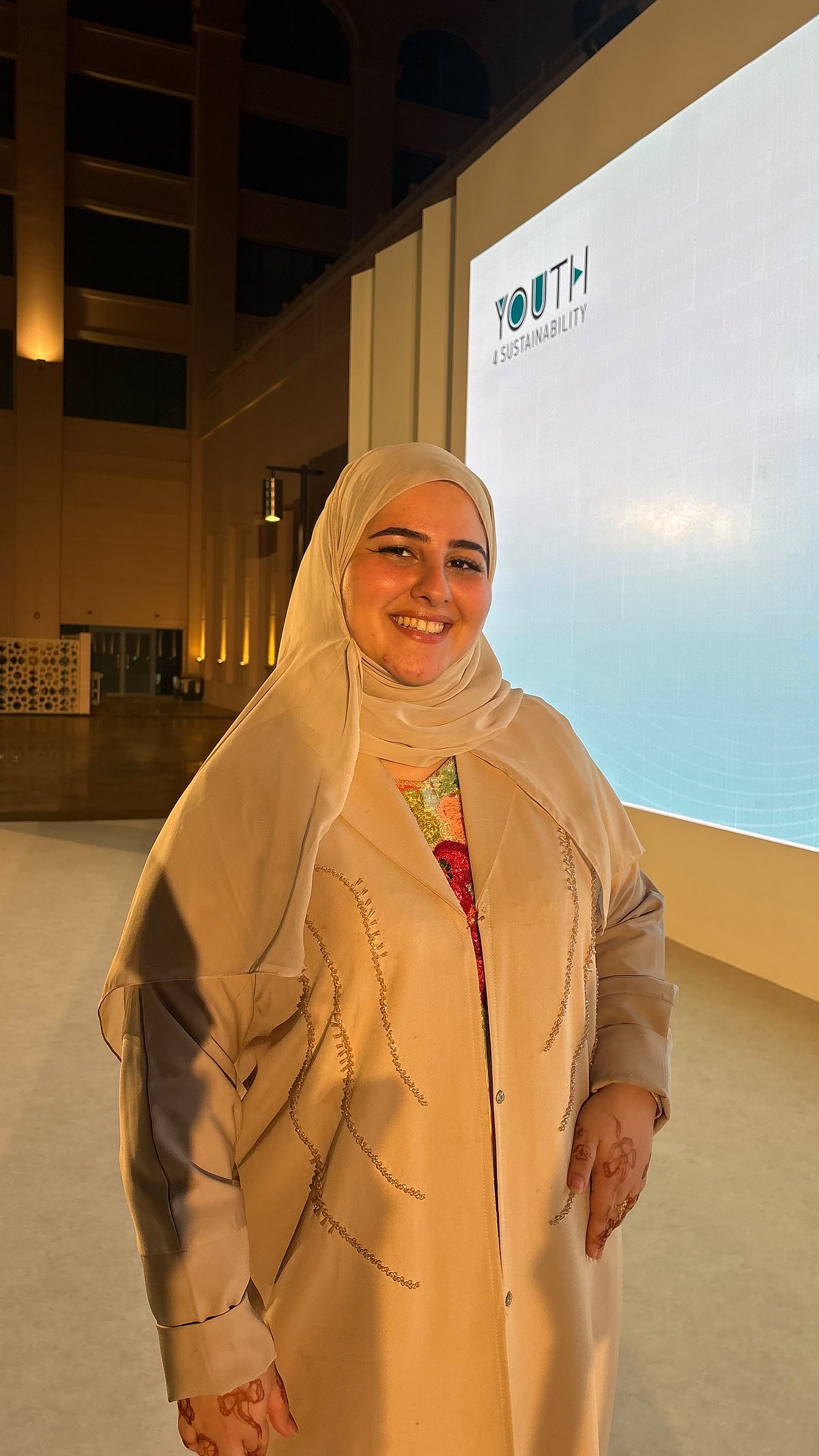
Through Masdar's youth and sustainability program, she became a youth delegate in the movement toward net zero and took part in the youth engagement around COP28, the global climate summit hosted in her own country. Today she is a youth delegate for IRENA, the International Renewable Energy Agency, whose headquarters stand in her own city, as well as for Masdar and IEEE. She is also an ambassador with the Arabic Congress. She does not tell the story as a personal triumph. She tells it as proof of something she believes deeply.
“In the UAE, everyone gets opportunities. Whoever moves here will definitely fit in, because there is space for everyone.”
Sustainability Week is one of her favorite seasons of the year. There she moderates sessions and panel discussions, a young woman from the city’s own soil guiding conversations about its future.
Sustainability Week is one of her favorite seasons of the year. There she moderates sessions and panel discussions, a young woman from the city’s own soil guiding conversations about its future. And she turns every opportunity into a second kind of service. Each time a visiting delegate or curious guest arrives, she uses the moment to tell them about the culture and heritage of the place she calls home. “Being a youth delegate created the perfect space for me to share more about our culture and heritage every time someone new came to visit.”
Over the years, she has taken between 20 and 40 visitors around Abu Dhabi, showing them its culture and heritage, always different people, from many nationalities.
She became a youth delegate in the movement toward net zero and took part in the youth engagement around COP28, the global climate summit hosted in her own country.
The girl who grew up in the city's parks is now helping to power its future, and she is telling its story to the world while she does it.
The roots: the homeland she never visited
Every home has a story that began somewhere else, and Malak's begins with a longing she inherited rather than lived.
Her family is Palestinian, from Haifa and Akka, the old coastal cities of the Mediterranean, places she has never once stood in. She speaks of them the way one speaks of a song remembered from someone else's lips.
Her grandparents came to Abu Dhabi from Lebanon in 1969, two years before the United Arab Emirates existed as a nation. They arrived in a city of sea and sand, a fishing town on the cusp of becoming something else entirely. Her grandfather found work at the Abu Dhabi ports, in the finance department, and there he watched the city's early ships arrive. In those days, every emirate issued its own passport, and he carried one that read Abu Dhabi, a document from a country-before-the-country.
"He remembers the first ships, and how the processes went," Malak said. "And he remembers how simple life was."
Her grandmother speaks of fabric. In that era, you waited for cloth to arrive from far-off places, then carried it to the tailor and had it made into the clothes you would wear. They went to Madinat Zayed, the old market, to buy gold and fabric both. Malak still flips through her mother's dresses from the eighties and nineties, marveling at the cut and color.
Her parents are both university lecturers, and both began their careers in Abu Dhabi, at the first branch of Ajman University opened in the capital. Her mother went to school here, too, and when she remembers those years, one name rises through every memory: Sheikh Zayed.
"Whenever she mentions him, she gets emotional, because she loves him so much. He's also her father. He's everyone's father."
It is a belief the whole family carries. Her grandparents taught her what Sheikh Zayed believed: that a person without a past has no future, and that roots must be planted in the soil before anything can grow. He made sure that whether you were a local, a resident or a stranger, you were given the foundations of a dignified life: education, food, security, she explained.
Her earliest memories are made of light and play.
She grew up near Hadiqat Al Khalidiya and in neighborhoods ringed with parks, the kind of childhood where the day belongs entirely to you.
"I would wake up and go to the park, and we would play all day long. Then we'd go home before Maghrib, eat and sleep. That's how it was as a child."
The playgrounds of Al Khalidiya, she remembers, were so wonderful that no amount of time could exhaust them. On weekends, her family went to Souk Al Mina to buy fruit and vegetables, then to Action Zone, the arcade that has long since closed but still glows in the memory of an entire generation. "The OG kids all went there," she said, laughing. Afterward came the trampolines.
Malak Halabi spent most of her childhoods in Abu Dhabi's parks.
At her grandparents' house, the world was gentler still. They grew things. There was a swing. For a time, there were chickens. It was a small farm tucked inside a growing city.
The mosque, the rain, and the quiet
If Malak has a sanctuary, it is the Sheikh Zayed Grand Mosque.
For visitors, it is a wonder, a vision of white marble that stops you in your tracks. For her, it is something quieter: a place she returns to again and again, long after the astonishment fades into belonging. "For people who see it for the first time, it's spectacular. But for the people who live here, we keep going."
During Ramadan, Malak and her family prays Tarawih there.
During Ramadan, her family prays Tarawih there. This year, as they prayed beneath the open sky, it began to rain.
"It was so magical."
Rain in the desert, in the middle of prayer, falling over a courtyard of white stone. She mentions it almost in passing, but you can tell she carries it with her, one of those rare moments when the world seems to lean in and bless you.
Friday begins with manakish
Ask for her perfect weekend, and she describes something that sounds like a love letter written in the form of a schedule. And the first line of that letter is bread.
Friday mornings begin with manakish, the warm flatbreads of the Levant that her grandparents' generation carried with them to the Gulf. Hers is za'atar: dough pulled soft and blistered at the edges, brushed with olive oil and a thick spread of dried thyme, sesame and sumac, still steaming when it is folded into paper.
She collects the bread, and then she collects her grandparents. Together they drive to the Al Kaser area, near Heritage Village and Marina Mall, where the old city and the new one meet. They sit, they unwrap the manakish, and they eat breakfast together in the soft light of a Friday morning, with no rush in it at all. Only afterward does she drive back to the work week, carried by it.
The day continues on Saadiyat Island, wandering through the Zayed National Museum and the Natural History Museum. "You walk around and look at the discoveries and think, wow, all of this happened here."
And then there are the small loyalties, the ones that stitch a person to a city. There is a little shawarma shop near Madinat Zayed that has fed her at every age. Mualiim Hassan is the name.
"They've seen me every year of my life," she said. "As a seven-year-old, as a fourteen-year-old, and now as a twenty-three-year-old. They've seen me at all stages of life." She orders what she has always ordered. It tastes, she said, like childhood.
Giving Back, in Bloom
There is a second way Malak gives back, and it blooms.
In 2024, as she was finishing university, she founded Lu Flora, a business built around sustainable floral arrangement workshops. It has no storefront. It lives wherever people gather.
"It's community-based. Wherever the community exists, I exist with it. Whenever I'm needed, I'm there."
Malak also has her own flower business where where she teaches people how to make bouquets.
Her workshops welcome all ages. Guests arrive as strangers to the craft and leave carrying something made by their own hands: a living piece of art for their homes. "Whatever you make, you take with you," she said. "It creates a bond between the flowers, which are natural, from the environment, and something that becomes an art piece in your house. It's integrating art, sustainability, creativity, and a space for you to express yourself."
Her workshops welcome all ages. Guests arrive as strangers to the craft and leave carrying something made by their own hands.
It is the same conviction that drives her engineering, in a gentler form. Everything is designed so that giving back does no harm and benefits the economy and the environment alike. And beneath it all lies a simple, human wish: "I just wanted to make something of my own, so I could keep it forever.
A city with many languages
Growing up in Abu Dhabi, Malak said, gave her something no classroom could: a world of languages within a single city.
“Because of the cultural diversity in the UAE, a person becomes bilingual, or even a person with lots of languages, because everyone is in the same place.”
Beyond Arabic and English, she speaks Turkish and Urdu, learned simply by growing up among friends from every corner of the world, Turkish friends among them.
A piece of Abu Dhabi, wherever she goes
Malak has traveled. She has stood in other cities, admired them, and enjoyed them. But she never really leaves Abu Dhabi behind. It travels with her, folded into the way she sees everything else.
"Abu Dhabi and the UAE set a standard for your expectations of other places you visit, because of the quality of life."
Wherever she lands, she carries the measure of home: the safety of streets where a family can grow without fear, the ease of a city that makes room for everyone, the feeling of being rooted. Abu Dhabi, she said, is a city where you are grounded in roots, and a person grounded that way carries the ground with her.
Asked to describe Abu Dhabi in three words, she began with "home", then paused and corrected herself.
"My favorite city in the world. The best place ever."
Sign up for the Daily Briefing
Get the latest news and updates straight to your inbox
Network Links
GN StoreAbout Gulf NewsTerms & ConditionsReach by GNSitemapContact usPrivacy PolicyGN FocusHave your sayWork with usAdvertise with usGulf News epaperPrinting Services
Download our app
© Al Nisr Publishing LLC 2026. All rights reserved.