Bruno Mars tribute at Etihad Arena
Inside an Abu Dhabi landmark built to change shape from concerts to sports
How Etihad Arena redefines Abu Dhabi's entertainment landscape
Last updated:
4 MIN READ
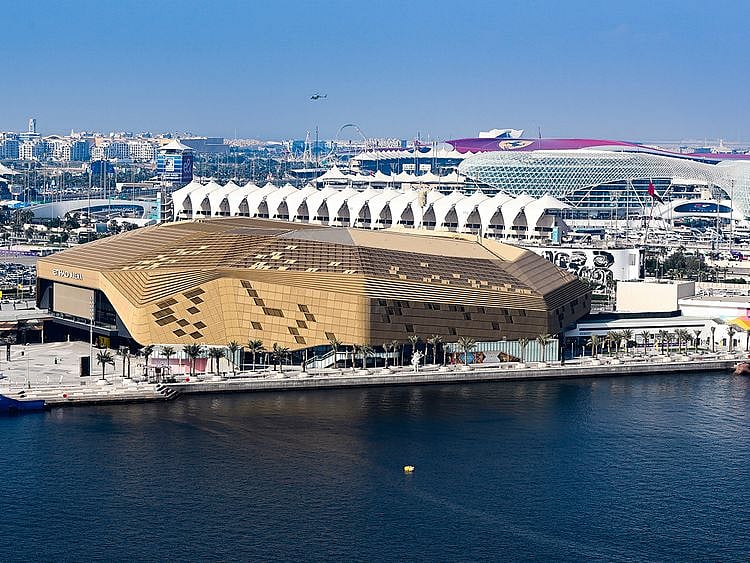
Abu Dhabi's ever changing and flexible landmark that mirrors the Capital's ability accommodate the needs of the city.
Supplied/Etihad Arena
Abu Dhabi: On the Yas Bay waterfront, a building that can hold 18,000 spectators can also contract into a 500-seat theatre. The shift is more than a technical feature of Etihad Arena: it offers a window into how Abu Dhabi is shaping a new generation of landmarks around changing public uses.
Designed by architects HOK and design firm Pascall+Watson, the indoor venue can move from an in-the-round arena to a smaller theatre, adapting its layout to events of very different scales. That ability places the building within a wider story of Abu Dhabi’s growth as a host city for international sport and entertainment.
Previously known as Yas Arena, the Miral-developed building sits within the expanding Yas Bay district. Its significance is not only in the events it stages, but in how one large structure is repeatedly reconfigured — and experienced differently by the people who enter it.
“One of my earliest memories of attending a concert of that magnitude on Yas Island was seeing Bruno Mars perform on New Year’s Eve in 2018 starting 2019 with a bang,” said Abu Dhabi resident and a strategic operations lead, Yara Roshdy.
“I first visited Etihad Arena on October 19, 2023, during UFC 294 Abu Dhabi Showdown Week,” said Aser Ahmad, an alumnus of Abu Dhabi University in Al Ain.
One landmark, different public experiences
The building changes according to the crowd it is asked to hold. A sporting contest concentrates attention on the arena floor; a concert introduces a stage, lighting rigs and a different pattern of movement through the venue. Those physical changes can also alter how crowded, intimate or accessible the space feels.
“My experience at the venue was quite different depending on the event. I attended both sporting events and concerts, and I noticed a huge difference between the two,” said Heba Aljuneibi, an Emirati digital executive based in Abu Dhabi.
Ahmad was struck by the building itself. “The building is impressive, especially at night when its curved facade lights up. Inside, the stage lighting, the giant screens and the scale of the arena made it feel like a world-class venue.”
Sport, concerts, musicals and stand-up comedy have all occupied the same interior. The contrast between them shows how the arena functions less as a fixed hall than as a piece of civic-scale infrastructure whose character changes with its audience.
For AlJuneibi, the spacious layout was especially effective for sport. “For sporting events, the venue was amazing. It could accommodate a large number of people without making you feel like the place was overcrowded, simply because of how spacious it was,” she added.
Inside UFC 333 set for Abu Dhabi’s Etihad Arena on October 24
That flexibility was visible when Cirque du Soleil’s Corteo made its Abu Dhabi debut in June, running from 12 to 21 June. The production used a two-sided configuration, with the stage at the centre and audience members seated facing one another. A 117-member cast and crew travelled with the show, which featured live musicians on stage. The arrangement turned the large arena into a more contained performance space.
Yas Bay expands around the arena
The arena’s scale and position make it a visible marker of Yas Bay’s development, while its design responds to the practical demands of the local climate. It was named Sustainable Building Design of the Year at the 2018 MENA Green Building Awards, with its designers citing shading, natural daylight and building-envelope measures intended to reduce energy use in the region’s heat.
Around it, restaurants, shops and hotels have extended the waterfront into a broader leisure district. The arena is therefore both an event venue and part of a larger change in how this section of the capital is used after dark and during major public occasions.
Roshdy said the same flexibility changes the atmosphere inside. “What I particularly love about Etihad Arena is its versatility. It can host these incredible, high-energy performances while also creating a more intimate and relaxed atmosphere where you can really appreciate the music,” she added.
What the landmark feels like from inside
UFC cards, NBA games and international championship competitions have brought large sporting crowds into the building. Concerts and touring productions have tested the same space in different ways, making visitor accounts an important counterpoint to its architectural promise.
For Ahmad, UFC 294 was particularly memorable because he watched his favourite fighter, Khamzat Chimaev. “My latest visit was for UFC 294, and it was unforgettable.”
“Everything was well organised, from the parking to my seat, and the fan zone outside was full of activities. Nothing felt uncomfortable; the atmosphere was amazing from start to finish,” he added.
Roshdy is already looking ahead to Hans Zimmer’s next live performance. His work, she said, has an ‘incredible ability to transport the listeners to a different world’.
“I’m already wondering how they’ll bring a performance of that magnitude to life inside Etihad Arena. Between the orchestra, the lighting, the acoustics and the cinematic atmosphere, I have a feeling it’ll be nothing short of spectacular,” Roshdy added.
But the landmark is not experienced uniformly. Its capacity to absorb crowds can be an advantage at sporting events and a source of pressure at concerts, depending on seating, circulation and the size of the audience.
Al Juneibi said concerts could feel very different from sporting events. “The venue felt much more crowded. I tried both VIP and regular seating, and honestly, I think the VIP experience was disappointing.”
In that contrast lies the arena’s further importance to Abu Dhabi. Etihad Arena reflects how the capital is building large public venues to accommodate sport, live entertainment and smaller productions under one roof, not merely to define its skyline, but to serve an increasingly varied public life.
Sign up for the Daily Briefing
Get the latest news and updates straight to your inbox
Network Links
GN StoreAbout Gulf NewsTerms & ConditionsReach by GNSitemapContact usPrivacy PolicyGN FocusHave your sayWork with usAdvertise with usGulf News epaperPrinting Services
Download our app
© Al Nisr Publishing LLC 2026. All rights reserved.