Ricky D’Souza, Presales - Product and Engineering sharing Space42’s satellite communications capabilities during a media visit to the facility in Abu Dhabi. Photo: Virendra Saklani/Gulf News
Your next phone upgrade could include a satellite connection
Satellite-to-phone tech promises full coverage beyond mobile networks
Last updated:
3 MIN READ
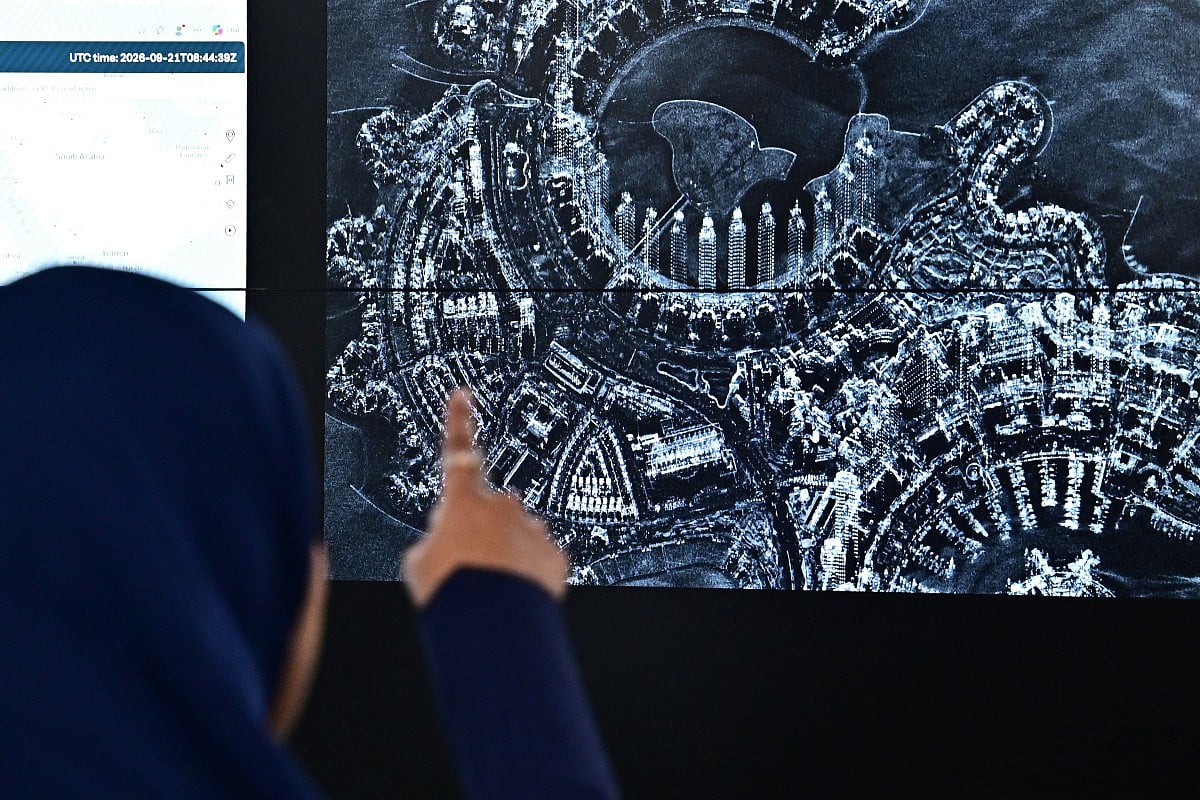
An employee displays a microwave satellite image during a media tour at the facility of Space42, a UAE-based AI-powered SpaceTech company that integrates satellite communications, geospatial analytics and AI capabilities, in Abu Dhabi on September 21, 2026.
AFP-GIUSEPPE CACACE
Before you picture streaming Netflix from the middle of the empty quarter, here's the new picture of connectivity in dead zones. Oceans, deserts, and mountain ranges, make up most of the earth’s surface, yet the people and assets moving through them remain outside the network.
Equatys is a new venture that Space42, the UAE's space tech company, and Viasat, a global leader in satellite and secure communications, are building together to support the extension of mobile coverage in places terrestrial networks cannot serve — backed by up to $1 billion.
“What is truly revolutionizing about this is the envisioned ability to be able to connect to satellites and to have connectivity through your completely regular, unmodified cell phone,” said Viktor Stoyanov, Chief Operating Officer of Smart Solutions at Space42.
This product of the future caters to whatever the conventional mobile networks fall short of, with Direct to Device (D2D) connectivity supported by security and resilience.
What this looks like in practice
Normally, phones communicate to the nearest cell tower. This technology lets it talk to a satellite instead, using the same chip and SIM already present inside your phone, and the satellite acts as a tower floating in space.
“The traditional communication industry, when it comes to satellites, is you would always need to procure these bulky phones where you have the massive antenna coming out," Stoyanov said. "Now, this is the next step. It's a regular device, regular antenna."
According to official reports, Space42 and satellite partner Skylo successfully sent two-way texts and SOS alerts from a standard Android phone with no special hardware, via Space42's Thuraya-4 satellite, over the UAE.
Equatys as a shared infrastructure
‘Equatys’, the name comes from the term Equity, underpinning the vision of a ‘shared infrastructure’ according to Nermeen Negm, Vice President of Communications, Space42, where satellite operators pool spectrum and satellite assets to provide D2D connectivity.
She said, “When we say direct to device, a lot of people think you know ‘this is what we do: the satellites communicating directly with the device’. But true D2D, in the sense that the industry understands that language, is an unmodified device, which has not happened yet. And it's something that Space 42 is very actively working on.”
Thuraya-4, a satellite Space42 already has in orbit, is where they showed how the underlying concept can work
Satellite phones
Ricky D’Souza, Presales - Product and Engineering, Space42 spoke to media about the company’s satellite communications capabilities. The company already sells dedicated satellite phones under the Thuraya brand with the Thuraya-4 satellite alone powers 16 new products across government and enterprise customers.
“It's like the Mike Tyson of satellite connectivity,” he says, calling it dependable for its flexible connectivity unlike other frequency bands.
D’Souza demonstrated their satellite model of smartphone, from a simple Android phone to a satellite smartphone only using a built-in antenna, at the Space42 HQ, “But when you are outside the coverage area, then you can just flip it up, and then you get the satellite mode as well.”
Demand for D2D
Consumer research puts the threshold squarely within reach. A GSMA Intelligence survey of 10,468 mobile users across 10 countries found 67% interested in D2D services, more than 55% willing to pay extra for them, and 90% wanting full coverage wherever they go. “That is a narrow window on price, and it dictates almost every architectural decision we make,” Adnan Al Muhairi, Chief Technology Officer, Space42 said in a statement.
Full satellite coverage for calls and data, anywhere, built on a constellation of up to 2,800 satellites: This is what UAE is preparing for, with Space42’s targets for 2029- a small step toward the day dead zones stops existing at all.
Sign up for the Daily Briefing
Get the latest news and updates straight to your inbox
Network Links
GN StoreAbout Gulf NewsTerms & ConditionsReach by GNSitemapContact usPrivacy PolicyGN FocusHave your sayWork with usAdvertise with usGulf News epaperPrinting Services
Download our app
© Al Nisr Publishing LLC 2026. All rights reserved.