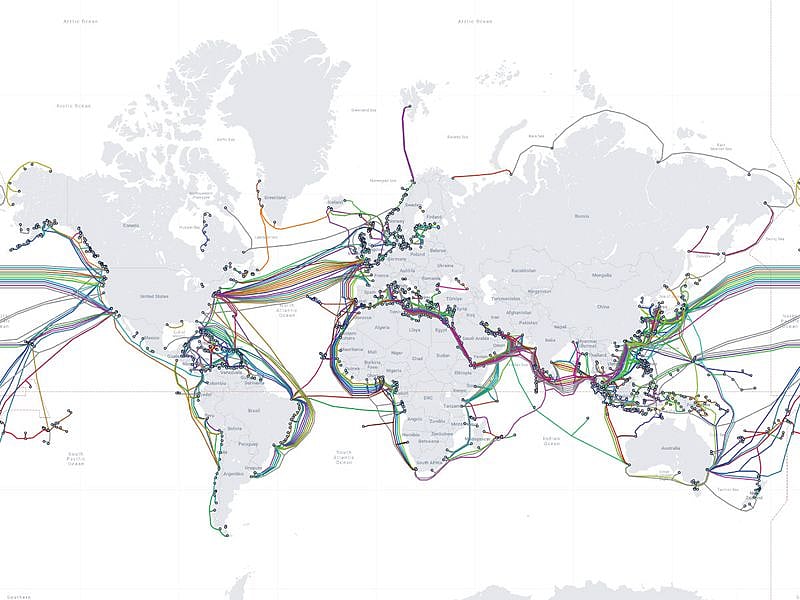
There are 1.7 million kilometres of global data and internet cables. Each year, up to 200 submarine cable cut incidents reported, as per ICPC. Photo for illustrative purpose only.
Starlink vs submarine cables: Can satellites keep the internet running when cables break?
What happens when an undersea cable is cut?
Last updated:
5 MIN READ
Can satellites save the internet when cables snap? Could Starlink step in and keep the world connected? The short answer: Yes, Starlink can provide a vital backup. But it cannot replace submarine cables at global scale.
Gulf News
A submarine cable is severed, international internet traffic is disrupted, and millions of people struggle to access online services.
It's a big question today: Iran has threatened to cut submarine cables if attacked. The IRGC has attacked and continues to threaten its neighbours.
Can satellites save the internet when cables snap?
Could Starlink step in and keep the world connected?
The short answer: Yes, Starlink can provide a vital backup. But it cannot replace submarine cables at a global scale.
Essential comminications
Satellite networks can help restore essential communications when undersea cables fail, particularly in remote communities, disaster zones and areas with damaged terrestrial infrastructure.
However, the two technologies serve different purposes.
Submarine fibre-optic cables carry the overwhelming majority of international data traffic today, providing enormous capacity at relatively low cost per unit of data.
Satellite networks offer an alternative route that can bypass damaged infrastructure, but their available capacity is limited relative to the world's total internet demand.
The maths: Why satellites cannot replace undersea cables
The scale difference is substantial.
Consider a simplified illustration using a hypothetical submarine cable route with 20 terabits per second (Tbps) of usable capacity and a satellite backup link with 1 gigabit per second (Gbps).
Since 1 Tbps equals 1,000 Gbps:
Submarine cable: 20 Tbps = 20,000 Gbps.
Satellite backup: 1 Gbps.
Capacity difference: 20,000 to 1, or 20,000 times.
Share of cable capacity replaced: 0.005%.
In this example, a 1 Gbps satellite connection could replace just 0.005% of the cable route's capacity.
To match a 20 Tbps cable route using 1 Gbps satellite links, operators would need 20,000 such links running simultaneously at their full rated capacity.
Get it: Fast, verified news for FREE ... download the Gulf News app — simply click here
That is a mathematical illustration, not a measurement of Starlink Mobile's actual capacity.
Real submarine cables and satellite systems vary considerably in capacity, and a satellite network's usable throughput depends on spectrum, satellite design, gateway availability, geographic coverage and how many users share the network.
SpaceX, Elon Musk's aerospace company, seeks to expand Starlink's mobile ambitions, initially in the United States. A "Starlink Mini" kit (left), and a Starlink Standard Kit Gen 3 bundle portable and residential satellite internet system (right).
Nevertheless, the calculation illustrates why satellites are better suited to targeted backup connectivity than replacing an entire high-capacity international cable system.
What happens when an undersea cable is cut?
A cable failure does not necessarily disconnect an entire country. Internet traffic can often be rerouted through other cables, provided alternative routes have sufficient spare capacity.
The real danger arises when multiple cables fail, when a country depends heavily on a small number of international links, or when remaining routes become congested.
The International Telecommunication Union says submarine cables carry more than 99% of international data traffic. It also identifies physical damage, geographical concentration and lengthy repair times as major resilience challenges.
Satellite connectivity can provide an additional route while engineers locate and repair damaged cables.
Depending on the damage, weather, vessel availability and operating conditions, repairs can take days or weeks.
This screen grab from a SpaceX live webcast shows SpaceX’s Starship Flight 14 deploying Starlink V3 satellites into orbit on March 6, 2025.
However, satellite capacity must be available where it is needed, and users must have compatible equipment and a working connection to the wider internet. A satellite signal alone does not guarantee access to every website, cloud service or payment system.
What Starlink can—and cannot—do
Where satellites can help:
Emergency communications, messaging and limited data access.
Disaster response when mobile towers, power supplies or terrestrial backhaul are damaged.
Connectivity for remote islands, ships, aircraft and isolated communities.
Essential business operations, including selected government services and limited financial transactions.
A temporary alternative route for selected traffic during cable outages.
Where satellites face limitations:
High-volume video streaming and other bandwidth-intensive applications across entire populations.
Large-scale cloud computing and data transfers.
Financial and enterprise systems requiring consistently low latency and high reliability.
Replacing the aggregate capacity of multiple submarine cables serving major cities and data centres.
Satellite performance also varies by technology.
Starlink vs e& and du: Satellite internet is set to add another connectivity option in the UAE, alongside the fibre and 5G services already offered by local telecom operators.
Low-Earth orbit
Low-Earth-orbit networks such as Starlink generally offer lower latency than traditional geostationary satellites, but they still face limits involving shared bandwidth, spectrum, ground infrastructure and network congestion.
Direct-to-cell services have another constraint: connecting an ordinary mobile phone to a satellite is not the same as delivering fibre-like broadband to every household.
Initial services may prioritise messaging and selected data applications, with performance depending on the satellites, spectrum and service configuration.
Why is Starlink targeting 80,000 cell sites? Bloomberg has reported that SpaceX is negotiating with telecommunications tower operators, including Crown Castle, for access to at least 80,000 US cell sites. The arrangements could be worth billions of dollars. If completed, the expansion could help Starlink Mobile develop into a nationwide mobile carrier competing with AT&T, Verizon and T-Mobile. SpaceX has also agreed to acquire up to 14 megahertz of paired spectrum in the 800 MHz band from Grain Management, subject to regulatory approval. Low-band spectrum is valuable because it can travel farther and penetrate buildings more effectively than higher-frequency signals, helping mobile networks extend coverage.
Why satellites matter to the internet
A damaged submarine cable can disrupt international connectivity. Satellite links can help emergency responders, local governments, hospitals and businesses maintain communications when conventional infrastructure fails.
But satellite backup tend to complement — not replace — investment in submarine cables.
In general, countries would benefit from diversifying cable landing points and international routes, improving fibre connectivity, strengthening terrestrial network redundancy and establishing satellite backup arrangements for critical facilities.
The objective should be to prevent a single failure from becoming a nationwide digital emergency.
What's next?
Bloomberg reported on October 22 that SpaceX was negotiating access to at least 80,000 US cell sites, potentially strengthening its bid to become a nationwide mobile carrier.
The broader lesson: internet resilience will depend on combining technologies: submarine cables for enormous volumes of international traffic, terrestrial fibre and mobile networks for everyday access, and satellites for additional reach and redundancy.
Starlink could help keep essential communications alive when undersea cables fail. But replacing the global submarine cable network would require satellite capacity on a vastly greater scale.
The practical solution is not satellites instead of cables — it is satellites, cables and terrestrial networks working together.
Network Links
GN StoreAbout Gulf NewsTerms & ConditionsReach by GNSitemapContact usPrivacy PolicyGN FocusHave your sayWork with usAdvertise with usGulf News epaperPrinting Services
Download our app
© Al Nisr Publishing LLC 2026. All rights reserved.