Over-the-top video is catching on
Increasing volume of online content forcing telecom operators to adopt idea
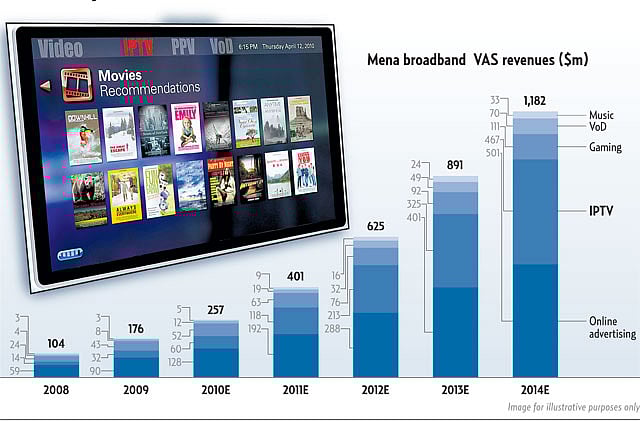
Dubai: The disruptive evolution of home networks will create new markets for telecommunications operators in the Middle East. The past decade witnessed the convergence of telecommunications and the internet, the next decade will witness the convergence of broadcast content and the internet.
The emergence and evolution of over-the-top (OTT) video delivery has an unprecedented opportunity for operators to surpass traditional telecommunications and expand into exciting new horizons.
With the rapid uptake of web-based video and dramatic improvements in the quality of online video delivery, it was inevitable that innovative companies would look beyond the PC and instead turn their attention to delivering online video directly to the living room television. With a broadband connection to the television, consumers will have access to the growing array of online video services today enjoyed on a PC monitor.
Unmanaged networks
"Basically, OTT is an opportunity for service providers, broadcasters and content providers to deliver their products over unmanaged networks. Before, we were seeing only managed networks, IPTV, as the biggest position. Now the opportunity is getting bigger and bigger because the telcos can expand beyond their network. You are offering a set-top box with some channels over it, video-on-demand, value-added services like widgets, applications over the internet to gather more customers," Gerry Ornito, Systems Engineer, Minerva Networks, EMEA, told Gulf News.
He said this does not mean that channels can be seen only on TV. It is a multi-device strategy. Broadcasts can be seen on PCs, smartphones and tablets. The accent is on targeting multiple customers outside one's network and targeting multiple devices.
OTT is fast gaining ground, Hadi Raad, Principal, Booz & Company, said, adding that OTT over PCs is already established. Anybody can access Hulu or Netflix and watch video-on-demand. The hype around this trend now is that it is reaching televisions. Apple TV is available in the Middle East. More service providers will be offering OTT in this region. The question is how telecom operators are going to react to that?
"To deploy OTT service, you don't need large investment and infrastructure like you do for managed service like IPTV," acknowledged Jamal Ahmad Abdullah Haji Bnari, Engineer, IT Development, Central Marketing, etisalat.
He said more people are watching online content, even prime-time viewing. Now prime time is more personalised with people watching content when they want. After coming home and unwinding, people are not so keen on watching Pay TV services; they are going online to watch content.
"You have to give customers the content they want, otherwise they are getting it through illegal ways. People like to watch live sports. So catch-up sports is a good business to be in. OTT can offer that more. A good strategy is to offer IPTV with OTT content. People do not want multiple set-top boxes and multiple remote controls, they want it simple," Bnari said.
US trend
In the US, people have switched to VoIP (voice over internet protocol) instead of fixed landline and cut cords of their cable companies and switched online for videos.
"We have a strategy in etisalat to incorporate OTT into IP platform. For example, MBC uses our OTT platform to offer shahid.net portal, a free video-on-demand online TV service for MBC programmes. It is a success. Every IPTV platform has some element of OTT in it, which is called closed OTT environment," Bnari said.
Etisalat is expected to launch this facility next year. Du is the first in the region to launch OTT service.
OTT is an opportunity for telecom operators, Ornito said, adding that it is more a strategic move. Being a cloud concept, OTT will bring in more revenues for those looking to expand their business provided OTT is made available on the IP platform.
What is driving OTT? Raad said that, firstly, it is the high broadband acceleration. Broadband is growing at a phenomenal pace. Increasingly sophisticated customers make for the second factor. Customers want more interactive services and they are not satisfied with the parcel service they are used to. Thirdly, it is availability of devices that are enabling OTT video viewership on TV sets. Adoption is going to increase in the years to come.
Online viewership
Online video viewership increased last year by more than 30 per cent while traditional viewership is dropping. About 40 per cent of online video viewership comes from YouTube.
"Telcos can see OTT as a threat, but they can also view OTT as a complementary value proposition to IPTV offering. There are limitations for OTT. IPTV will continue to have advantages. IPTV operators are channelling much premium content where as OTT is best effort based service. There could be quality challenges when offering OTT. Quality depends on the broadband quality. What telcos need is to offer OTT over IPTV platform," Raad said.
Verizon and Orange offer OTT applications over IP platform. There is interest in the region as well. There will be early adopters but the mass market will take around 3 to 4 years.
Raad said that OTT is going to transform the media delivery value chain. IPTV operators will have to find the right business model to monetise OTT. It could take several attempts. Telecom operators should position OTT complementary to IP services. They should open up their interfaces. They should form revenue-sharing agreements. They should allow customers to leverage the power of the internet.
OTT is simply the delivery of video and audio, via the internet, directly to users' connected devices. It allows access to services anywhere, anytime and on any device. Now that so much video is available online, the industry is asking if future TV programming will be mainly delivered over the internet.
Connected television devices such as Blu-ray players, game consoles, smartphones, and TV sets are swamping the market. TV programmes have come to the internet. Now, the internet is coming back to TV.
In IPTV, the quality of service is guaranteed. One knows the bandwidth available from one point to the other. On OTT, one can statistically know the bandwidth available; the technology is called adaptive streaming since the content is delivered to the TV in keeping with the available bandwidth.
OTT provides variety and is cheap. Content can come from anywhere and can be offered to a wider customer base. In IPTV, standard bandwidth is 4-6Mbps and high-definition is 8Mbps. OTT would need still less — just about a million bytes per second.
Concept : Access on any device, anywhere, anytime
Sign up for the Daily Briefing
Get the latest news and updates straight to your inbox
Network Links
GN StoreDownload our app
© Al Nisr Publishing LLC 2026. All rights reserved.