Power unleashed: Nvidia's Blackwell GPU redefines performance and AI innovation for the next generation.
Nvidia’s RTX 50 series GPUs: All you need to know
'Beast of 4K gaming, AI, video editing': New package offers a leap into the future
Last updated:
3 MIN READ
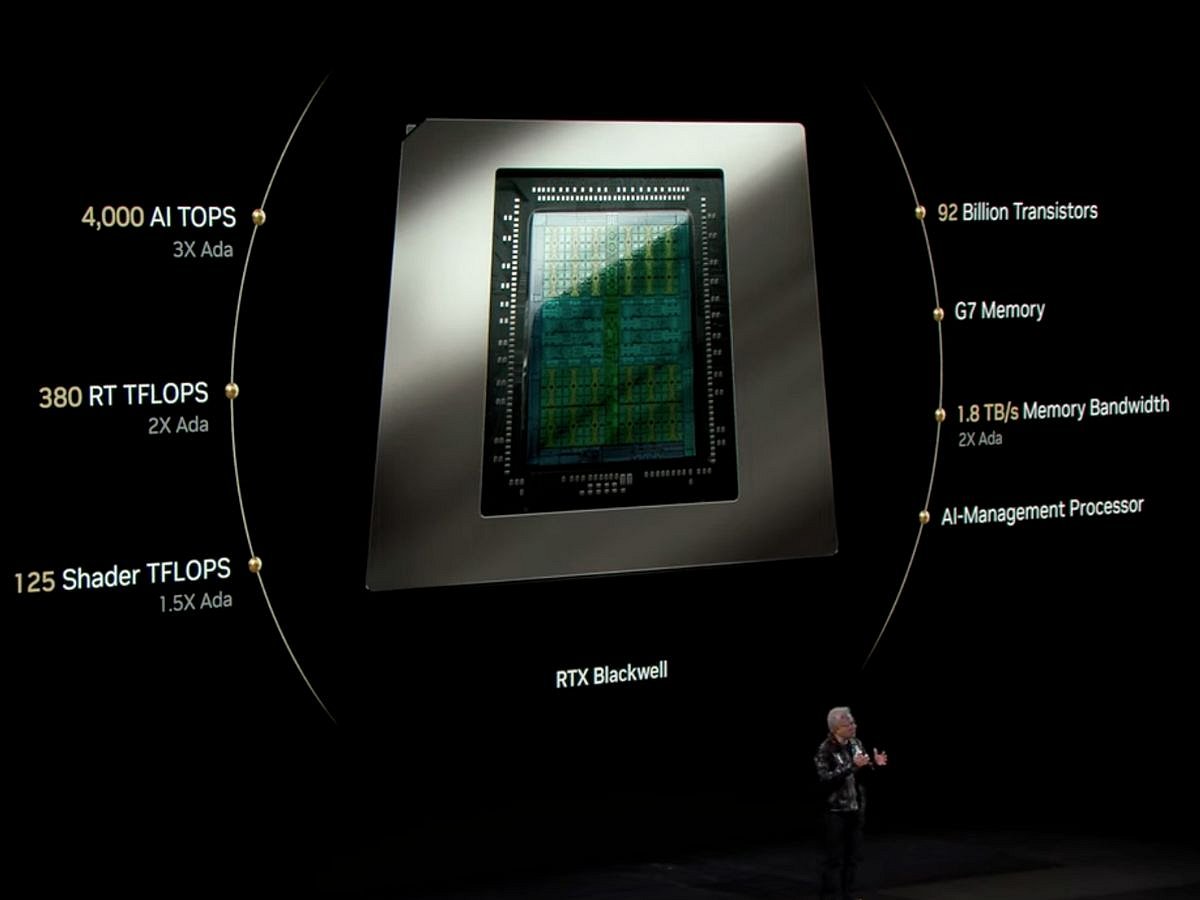
Caption: Nvidia’s latest powerhouse, the RTX 50 series, has arrived, marking a new chapter in the world of GPUs. Jensen Huang, Nvidia CEO, unveiled the groundbreaking RTX 50 series graphics processing units (GPUs) at International CES 2025, which runs in Las Vegas from January 7-10, 2025.
CES 2025 | Nvidia | Screengrab
Jensen Huang, the rockstar CEO of Nvidia, unveiled on Tuesday the groundbreaking RTX 50 series graphics processing units (GPUs) at International CES 2025, the most powerful tech jamboree in the world.
During the Las Vegas event, which runs until January 10, the tech billionaire shared advancements in AI and accelerated computing.
The RTX 5070, at the lower end of the series, is a beast. It represents a significant leap in performance.
Huang promised that it would not only take gaming rigs to a higher pitch but also turbocharge video edits, and AI projects.
“The future of computer graphics is neural rendering – the fusion of AI and computer graphics,” declared Huang during his keynote, whose net worth jumped by $76 billion in 2024, bringing his total to $117 billion (as per Bloomberg Billionaires Index).
Benchmarks
Benchmarks reveal it can handle 4K gaming at 120 frames per second (FPS) with ray tracing enabled, outperforming the current RTX 4070 by 30-40 per cent.
At CES, he made a bold prediction: industrial digitalisation, led by Nvidia, will transform every industry, not just gaming.
The RTX 50 series is powered by its "Blackwell" architecture.
Gamers
RTX 5070, priced at $549, is the basic unit of the RTX 50 family unveiled Tuesday. The more powerful RTX 5090, dubbed as "thrice more powerful" than the RTX 5070, is priced at $1,999.
Packed with advanced features and next-gen architecture, the RTX 50 series is designed to deliver top-tier performance for gamers, content creators (think video editors), and AI enthusiasts alike, said Huang.
Here’s everything you need to know about this revolutionary graphics card.
The Ada Lovelace 2.0 Architecture
At the heart of the RTX 5070 is Nvidia’s Ada Lovelace 2.0 architecture, a refined version of its predecessor. This architecture boasts:
Enhanced efficiency: Built on the TSMC 3nm process, reducing power consumption while increasing performance.
More CUDA cores: Over 8,192 CUDA cores, ensuring exceptional parallel processing power for gaming and AI workloads.
3rd-gen RT Cores: Advanced ray tracing capabilities for hyper-realistic lighting and reflections.
5th-gen Tensor Cores: Up to 2x AI performance, powering features like DLSS 4.0.
Performance: A beast in disguise
The RTX 5070 promises a significant leap in performance:
Gaming: Benchmarks reveal it can handle 4K gaming at 120 FPS with ray tracing enabled, outperforming the RTX 4070 by 30-40 per cent.
AI Applications: Its improved Tensor Cores make it ideal for AI model training and inferencing, competing with entry-level workstation GPUs.
Content creation: Support for Nvidia Studio enhances video editing, 3D rendering, and graphic design with faster workflows.
Upscaling
The RTX 5070 features Deep Learning Super Sampling 4.0 (DLSS 4.0), Nvidia’s AI-powered upscaling technology. Key improvements include:
Frame Generation 2.0: Smooths gameplay with AI-predicted frames.
Expanded Game Support: Compatibility with more titles and engines at launch.
Real-Time Learning: Adaptive algorithms that optimise visual quality dynamically.
Cooling and design
The RTX 5070 debuts with an improved dual-axial cooling system, featuring:
Vapor chamber technology for even heat distribution.
Quiet operation even under heavy loads.
A compact design fits most mid-tower cases.
AI at the core
Huang made the case that tThe RTX 5070 isn’t just for gamers — but also for AI enthusiasts.
With 5th-gen Tensor Cores, it excels in AI tasks such as:
Stable diffusion: Faster rendering of AI-generated images.
AI training: Handles larger datasets with reduced training times.
Real-time applications: Improved performance for AI-driven tools like ChatGPT or Copilot.
Pricing and availability:
The Nvidia RTX 5070 launched at an MSRP of $549, striking a balance between performance and affordability.
With widespread availability expected in Q1 2025, it aims to dominate the mid-range GPU market.
Competition
The RTX 5070 faces competition from AMD’s Radeon RX 7800 XT and Intel’s Arc Battlemage GPUs. However, Nvidia’s superior software ecosystem — like GeForce Experience and Reflex — gives it an edge in real-world usability.
Fact file: What is a CUDA Core?
CUDA stands for Compute Unified Device Architecture, which is Nvidia's proprietary parallel computing platform and programming model.
A CUDA core is a processing unit within Nvidia GPUs (Graphics Processing Units) designed to handle parallel tasks.
In essence, CUDA cores are the building blocks that enable GPUs to perform complex computations efficiently. They function like tiny processors that work together to execute thousands of operations simultaneously.
Sign up for the Daily Briefing
Get the latest news and updates straight to your inbox
Network Links
GN StoreAbout Gulf NewsTerms & ConditionsReach by GNSitemapContact usPrivacy PolicyGN FocusHave your sayWork with usAdvertise with usGulf News epaperPrinting Services
Download our app
© Al Nisr Publishing LLC 2026. All rights reserved.