Deputy Ombudsman Arthur Carandang was removed by ex-President Rodrigo Duterte in September 2017 for supposedly “leaking” to reporters bank documents showing deposits of Duterte and daughter Sara Duterte-Carpio, then Davao City mayor, in BPI and other banks in the "hundreds of millions". The reporters were checking on the progress of the plunder case filed by then-Sen. Antonio Trillanes IV with the Office of the Ombudsman in May 2016.
Philippines: SC voiding Duterte’s ouster of deputy ombudsman exposes chilling effect on corruption probes
Court's ruling on May 4 exposes abuse of power, delays that poison watchdogs
Last updated:
9 MIN READ
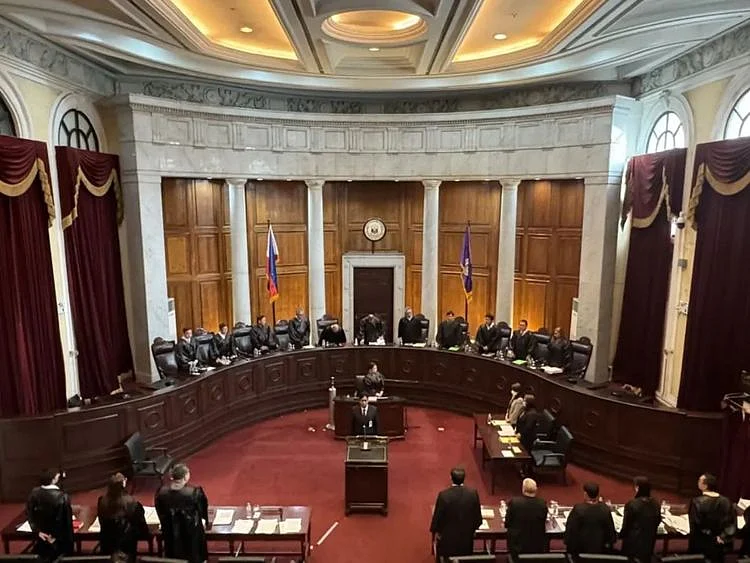
The Philippine Supreme Court in session. In a 2013 ruling, the Philippine Supreme Court declared the Priority Development Assistance Fund (PDAF), commonly known as the "pork barrel" fund, unconstitutional.
The Philippine Supreme Court
Talk is cheap.
And that's how Filipinos were led to the gallows. We watched institutions bend, public discourse coarsen, and the rule of law tested in ways Filipinos had not seen in decades.
We remember the loudest promises: solving drugs and corruption in "3 to 6 months".
We recall the most chilling chapters: the thousands killed in the name of the drug war, the grieving families, the international scrutiny, the moral scars that remain unhealed.
But there is another injustice — quieter, less visceral, buried under years of noise — that many of us nearly forgot.
We remembered it only because the Supreme Court (SC) of the Philippines finally ruled on it.
Not swiftly. Not when it mattered most.
But eventually. On May 4, 2026, the SC affirmed that the president has no power to remove Deputy Ombudsman.
And that delay is part of the story.
What am I referring to?
Let's backtrack: In 2017, then-President Rodrigo Duterte suddenly removed Melchor Arthur Carandang.
He was then the Deputy Ombudsman, a decent man who was simply doing his job. Carandang served as Overall Deputy Ombudsman since 2013, among the key officials tasked to oversee corruption probes at the Office of the Ombudsman.
On September 27, 2017, Carandang said in a media interview that his office had obtained bank transaction records from the Anti-Money Laundering Council (AMLC) as part of an investigation of a plunder complaint from former Sen. Antonio Trillanes IV against Duterte and members of his family.
Duterte removed him from office.
As president, under the Constitution, Duterte had no authority to interfere with, discipline, or remove a member of an independent constitutional body like the Office of the Ombudsman.
And the reason Carandang was removed was simple: he did his job.
Probing Duterte’s alleged unexplained wealth
For investigating Duterte’s alleged unexplained wealth, he was deprived of retirement benefits.
Now, more than 8 years later, the Supreme Court has ruled that Duterte's removal of Carandang was void.
That is vindication.
It affirms the Constitution — and the truth — even if belatedly.
This is especially relevant if you also heard the recent vindication of Sonny Trillanes IV, coup plotter(vs Gloria Arroyo)-turned-senator in the House impeachment hearings.
For the longest time, Trillanes had been maligned by the pro-Duterte trolls, understandable given the stakes involved, and the deep-seated tribalism in Philippine politics.
File: Former Philippines' President Rodrigo Duterte (L) and his daughter, Vice President Sara Duterte. File photo taken April 10, 2018. During the 2026 House impeachment hearing on Vice President Sara Duterte, it emerged that the hundreds of millions in their bank deposits were way more than the amount disclosed by the two in their Statement of Assets, Liabilities and Net Worth (SALN) when they were Davao City mayor and vice mayor, respectively.
Trillanes, a "lone wolf", alleged that millions of pesos in deposits were traced to the Duterte family from a supposed drug lord from Davao.
He's the same ex-Navy officer who, as a Senator (2020-2019), drove the passage of laws to raise the salaries of Filipino men and women in uniform (through Salary Standardisation Law IV, the AFP Modernisation Act [RA 10349], and Senate Joint Resolution No. 5 (which raised the daily subsistence allowance of military and uniformed personnel, effective January 1, 2015).
But ask any Filipino police officer or military today: They thank Duterte for their improved paycheck. Duterte, in effect, grabbed credit for the cause Trillanes championed.
Here's why the SC is significant
The case must be understood in context.
During Duterte's six-year watch (2016 to 2022), the Ombudsman was Conchita Carpio Morales. Because she was related by affinity to the Dutertes through the Carpio clan (lawyer Mans Carpio, her nephew, is VP Sara Duterte's husband), she recused herself.
Arthur Carandang took over as acting overall deputy ombudsman.
Carandang had a long career in the Ombudsman’s office. He was expected to do his job properly, which is exactly what he did.
He had to take charge of the investigation because there was a complaint filed by Trillanes, supported by Anti-Money Laundering Council (AMLC) reports showing many transactions and unexplained wealth involving ex-president Rodrigo Duterte.
Carandang confirmed receiving those AMLC reports. Since it is the Ombudsman’s job to investigate the highest officials of the land, he drove the investigation.
There was just one problem: once he said he was initiating the probe, he was "preventively suspended" and then dismissed by the very office whose actions he was investigating.
Under the Philippine Constitution, that makes no sense.
THE OFFICE OF THE OMBUDSMAN is known as "Tanggapan ng Tanodbayan". The office is an independent body, established by the 1987 Constitution, and serves as the nation's "watchdog" against graft and corruption. It investigates and prosecutes illegal, unjust, or inefficient acts of public officials and employees. Key roles/functions include investigating complaints against government employees and officials (except those impeachable), files cases in the Sandiganbayan (anti-graft court) and other courts, determines the causes of inefficiency, red tape, and mismanagement in government, providing recommendations for reform, disciplines public officials through administrative proceedings. The Ombudsman is appointed by the President from a list prepared by the Judicial and Bar Council, serving a non-renewable seven-year term. It has the power to place erring officials under preventive suspension.
The framers of the 1987 Charter never intended that the Office of the President could discipline an independent constitutional body like the Ombudsman.
Fast forward to May 2026: The Supreme Court’s ruling is well written, and it affirms the earlier Gonzalez doctrine.
Under “stare decisis” (Latin for "to stand by things decided"), legal interpretation must remain consistent unless there is a compelling reason to overturn precedent.
That means once the Supreme Court has ruled on a matter, that ruling becomes binding.
Why the delay matters
A fair question is: why did it take eight years for a case with such a clear legal basis?
While the ruling is good, but with all due respect to the Supreme Court and the entire justice system, the delay is a serious problem.
The case had already reached the Court of Appeals, which in 2021 had already said Duterte’s action was not allowed. Duterte was still in power then (his presidency ended on June 30, 2022).
But the Solicitor General filed a "motion for reconsideration", and the matter eventually went to the Supreme Court in 2022.
At one point, Ombudsman Samuel Martirez immediately implemented the dismissal order from the Office of the President.
That was striking: Martinez was the Ombudsman and was supposed to be standing up to a president whose office his own institution was investigating.
To backtrack a bit: There was already a 2014 ruling saying the president could not discipline deputy ombudsmen. Stare decisis shows Rodrigo Duterte overstepped the bounds of his authority.
Yet it happened anyway: Carandang was hit by Duterte's "preventive suspension".
The practical effect was severe: Carandang was removed, the investigation was stopped, and a chilling effect spread across institutions. He was deprived of his pension rights.
Payback for challenging Duterte
People read the sign: If you challenged Rodrigo Duterte, even as part of an independent constitutional body, you're fair game.
This was also a time of daily killings, the imprisonment of then-Senator (now Rep) Leila de Lima, and efforts to investigate the drug war and corruption.
Another institution tried to stop abuses, and again, it was weakened.
So while the SC decision is legally correct, the practical effect was that Duterte still won at that time.
He was able to prevent Carandang from doing his job. The investigation was halted, fear spread, and institutions were unable to respond quickly enough.
On justice system delays
This case raises a bigger issue: why do Philippines courts sometimes take so long to decide cases? At the trial court level, a judge may have limited staff and a heavy workload.
But at the Court of Appeals and Supreme Court, there are more lawyers, researchers, and support staff. That is why delays at the highest levels are difficult to understand.
The justice system must be faster. There's a legal maxim: "iustitia dilata est iustitia negata" (Latin for “justice delayed is justice denied”).
If courts take too long, the victims suffer while the abusive officials lord it over. That is why the Carandang case, while a vindication, is frustrating.
The ruling is correct, but it came too late to stop the damage.
Attacks on institutions
Under Duterte’s rule, the Supreme Court itself was under attack.
Chief Justice (CJ) Maria Lourdes Sereno (CJ during early part of Duterte presidency) was removed in an unprecedented manner, even though the accepted view in law is that a sitting Supreme Court justice, especially the CJ, should only be removed through impeachment.
The environment had become deeply politicised.
Duterte openly declared Sereno an "enemy" as he threatened Martial Law.
On May 11, 2018, the Supreme Court of the Philippines voted 8-6 to oust Sereno through a quo warranto petition filed by then-Solicitor General Jose Calida.
The same pattern was repeated with the Ombudsman, the legislature, the Commission on Human Rights, and other independent institutions.
All of them were under pressure from one president, and many of these institutions failed to resist in time.
That is the larger point: the Ombudsman was attacked, the Supreme Court was attacked, the legislature was attacked, and the institutions of accountability were weakened.
On Martirez and accountability
Should Ombudsman Samuel Martirez (who served until 2025) be held accountable now?
Yes, he should be examined and possibly charged for his failures.
He failed to fulfill his mandate, and instead of being a watchdog, the Ombudsman under his leadership appeared to enable corruption.
The AMLC should also be questioned. If suspicious transactions were visible, why was there no investigation?
If the bank records and money flows were already there, why did they not act?
They are mandated by law to investigate suspicious transactions and money laundering.
The facts suggest that massive amounts of money were moving around, but those tasked to flag them, or call them out, were negligent at the very least, or sleeping on the job at the very nmost.
That failure should not be ignored.
The same applies to the Office of the President and to the official who dismissed Carandang. There was grave abuse of discretion, and there was no constitutional basis for what was done.
On the impeachment issue
This also connects to the impeachment case involving Vice President Sara Duterte. During the Sereno case, they raised the standard for SALN (Statement of Assets, Liabilities and Net Worth) declarations very high. Now, that same standard may come back to haunt them.
If the transactions and cash flows in VP Sara Duterte’s case are examined carefully, they raise many questions. There are declarations of cash on hand and cash in bank that appear inconsistent.
There are also explanations that do not fully add up, especially when items were previously declared separately and later shifted into vague categories like “others.”
The truth is that the public cannot simply ignore the numbers.
If there are billions of pesos in suspicious transactions, those issues need to be explained. Accountability cannot depend on personality or political allegiance, or tribal loyalties.
Due process
No matter our political leanings, we must adhere to the rule of law and to our common truth, — and that common truth is the Constitution.
When the law is twisted against one group, it will eventually be twisted against everyone.
If due process was abused before, then it should not be abused again now. Truth and justice can never be defined according to who is in power.
That is why this ruling matters. It strengthens the Ombudsman and restores at least some faith in accountability.
It may not erase the damage done, but it may help future investigators act more freely.
Now that the Court has ruled, the country faces a choice: treat the decision as a footnote to a turbulent era, or as a warning about how easily rights and safeguards can be sidelined when attention is elsewhere.
Because if we only remember the loud promises, and ignore the injustices, we miss out on what truly holds us together as a people.
This injustice did not unfold in back alleys or police reports. It did not produce viral images. But it altered the balance between the state and the people in ways that were just as consequential.
For years, it sat in the background — contested by lawyers, debated by academics, and largely ignored by a public overwhelmed by daily controversies.
It became technical. Procedural. Easy to tune out.
Until the country's top court spoke.
When it did, the ruling was less a revelation than a reminder: something fundamental had gone wrong, and it had taken far too long to say so.
By the time the decision arrived, the damage had already seeped into practice, precedent, and public expectation.
What should have been checked early had already shaped behaviour. What should have been prevented had already normalised.
This is the quiet danger: an institutional "drift".
Not every injustice shocks. Some simply settle in, unchallenged long enough to feel ordinary.
The tragedy is not only that the injustice happened. It is that we allowed ourselves to ignore it while it was happening.
One hopes that there may be some healing in this. The real hope is that the healing endures — that our institutions, taught by experience, grow sturdy enough to resist abuse.
That we relearn a hard truth: talk is cheap.
What builds a nation worthy of respect is the quiet, relentless work of honesty and the unwavering promise that the law applies to all.
Or it means nothing at all.
Sign up for the Daily Briefing
Get the latest news and updates straight to your inbox
Network Links
GN StoreAbout Gulf NewsTerms & ConditionsReach by GNSitemapContact usPrivacy PolicyGN FocusHave your sayWork with usAdvertise with usGulf News epaperPrinting Services
Download our app
© Al Nisr Publishing LLC 2026. All rights reserved.