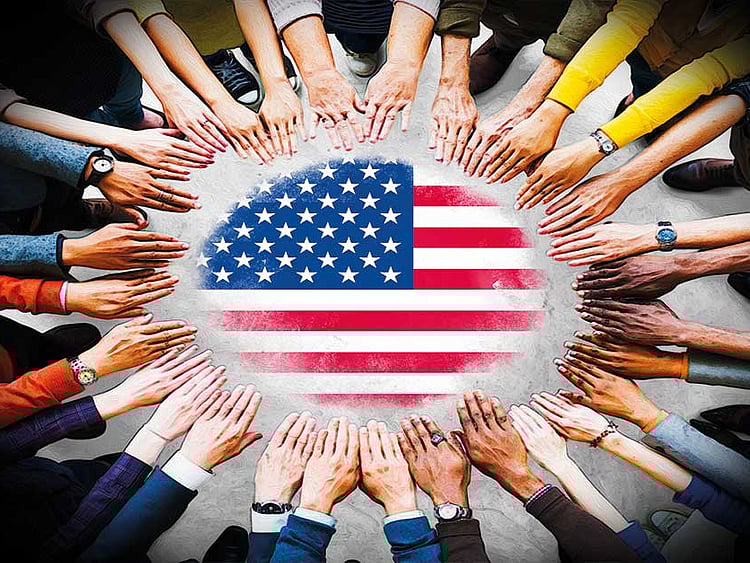
The idea of the supremacy of the pale race is not only an immoral, but also a historically obsolete, proposition in contemporary America. Nostalgia, including its hateful cast, emerges only when the past is just about over. California is already a majority-minority state. By 2044, the entire United States will follow suit. And obviously, the world as a whole has long been there.
The future, in the US and elsewhere, will more likely resemble what Jos Vasconcelos, the philosopher and former education minister of Mexico, in 1925 called “la raza csmica” (The Cosmic Race). He believed that, one day, the whole world would merge into one mestizo race of hybrid ethnicities.
When the literary journalist, Ryszard Kapuscinski, visited Los Angeles in 1987, he saw the city, with its diverse population of Mexicans, Koreans, Chinese and others, as a premonition of the future Vasconcelos envisioned.
“Traditional history has been a history of nations,” Kapuscinski reflected. “But here, for the first time since the Roman Empire, there is the possibility of creating the history of a civilisation. Now is the first chance on a new basis with new technologies to create a civilisation of unprecedented openness and pluralism. A civilisation of the polycentric mind. A civilisation that leaves behind forever the ethnocentric, tribal mentality, the mentality of destruction.”
For me, an acute observer of events who reported for decades on the post-colonial revolutions across the Third World, “la raza csmica” is being born in Los Angeles in the cultural if not anthropological sense. “A vast mosaic of different races, cultures, religions and moral habits are working together towards one common aim [of improving their lives]. From the perspective of a world submerged in religious, ethnic and racial conflict, this harmonious cooperation is something unbelievable. It is truly striking,” said Kapuscinski.
‘Ethnic designation’
In this, he concurred with the great Mexican poet and Nobel laureate Octavio Paz, who called the US “the Republic of the Future”. In better times, the US’ political leaders have seen this exceptional quality as the country’s greatest strength. On the Right, former secretary of state Condoleezza Rice has extolled the US as a place without “a religious or ethnic designation” where what matters is where you are going, not where you came from, as she once told me. That openness, she observes, stands behind the US’ innovative culture.
In a recent conversation with former president Bill Clinton, he put it best. “We know from the human genome that all people are 99.5 per cent the same,” he pointed out. “Some people seem to spend 99 per cent of their time worrying about the .5 percent that is different. That is a big mistake. We should focus on what we have in common. And focus on what is common. We make better decisions in diverse societies than in homogeneous ones. America’s great advantage is that we are an idea, not a place. We are not an ethnicity or a uniform culture.”
Of the nativist politics that has lately surfaced, Clinton warned that “we are playing Russian roulette with our biggest ticket to the future. Even if you believe we are headed towards the first big change since the Industrial Revolution, with robots and digital technology that will kill more jobs than it creates, we are still going to need diversity. We are going to need creative cooperation.
“To do that we need some fair back and forth with others not like us. Resentment-based divisive politics is a mistake.” He concluded by expressing a faith in the future rooted in the wisdom of experience: “This is just the latest chapter in the oldest drama of human history: Us vs Them. But sooner or later, we mix and move on.”
Kapuscinski shared Clinton’s perspective on the future. “The world is growing up,” he wrote. “And in the world, we have more of everything — more people, more goods, more communications. This growth of everything demands more cultural space and will destroy whatever does not accept this reality. That makes systems that don’t accept plurality obsolete.” That includes the ugly nativist politics we see around us today. It will surely pass, the last hurrah of bygone times.
— Washington Post
Nathan Gardels is co-founder of the Berggruen Institute and editor in chief of its publication, the WorldPost
Sign up for the Daily Briefing
Get the latest news and updates straight to your inbox
Network Links
GN StoreDownload our app
© Al Nisr Publishing LLC 2026. All rights reserved.