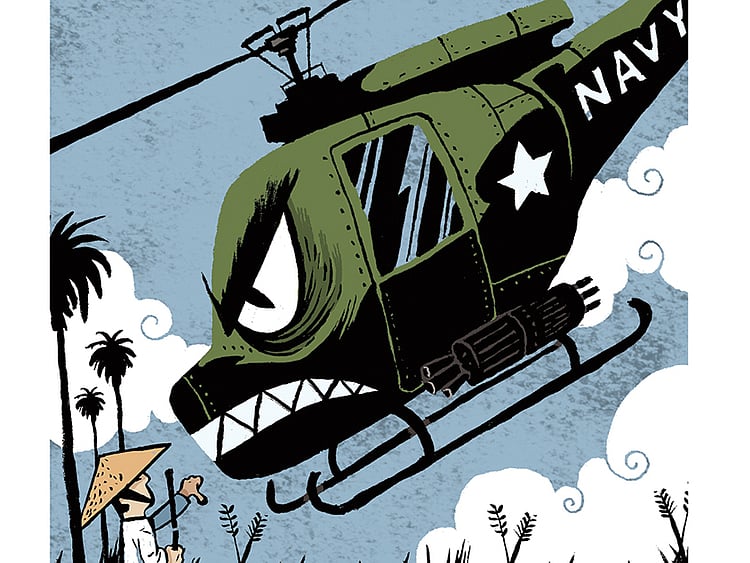
This month marks the 50th anniversary of a pivotal moment in the escalation of the Vietnam War: The launch of the Operation ‘Rolling Thunder’ bombing campaign, and also the commitment of the first US ground troops. Fresh from his landslide re-election in November 1964, US president Lyndon Johnson ramped up US military involvement in the Southeast Asian country in what was to prove one of the worst ever US foreign policy debacles.
One key legacy of Vietnam was growth of anti-Americanism across much of the world, undercutting US prestige and soft power. Far from being a historical artefact, this legacy is of importance for US policy today as the country continues to recover from the international unpopularity of the Iraq War and wider perceptions of excessive US power, unilateralism and over-reliance on military might.
More than a decade on from the Iraq invasion, it is clear that the controversial intervention helped fuel a sea-change in international opinion towards the US, which is the most significant since Vietnam. Favourability towards the US, which had spiked upwards in many countries after 9/11, went into a free fall and has only partially recovered.
For instance, in a sizeable number of allies surveyed in both 2002 and 2014 by Pew Global Attitudes Project, significantly fewer people now think favourably of the US. This includes Ukraine (down 23 percentage points), Jordan (down 13 percentage points), Turkey (down 11 percentage points), Germany and United Kingdom (both down 9 percentage points), Japan (down 8 percentage points), and Poland (down 6 percentage points).
In absolute terms, however, the problem of anti-Americanism remains most clear cut in Muslim-majority countries. This includes Egypt, Jordan, Pakistan and Turkey where only 10 per cent, 12 per cent, 14 per cent and 19 per cent of the populations, respectively, had positive favourability towards the US in 2014. This and the accompanying rise of anti-Americanism are important, primarily, because they have undercut US soft power again. And this has reduced Washington’s ability to promote and secure its interests overseas. History underlines the role soft-power has played in obtaining favourable outcomes for Washington.
For example, successive US administrations used soft resources skilfully after Second World War to encourage other countries into a system of alliances and institutions, such as Nato, the International Monetary Fund, World Bank and the United Nations. The Cold War was subsequently won by a strategy that combined soft and hard power.
To be sure, the election of Barack Obama, who is more personally popular with foreign publics than his predecessor George W. Bush, prompted an immediate increase in favourability towards the US almost across the board internationally. However, there has since been a fall-off in numerous countries, partly because Obama has become less popular for reasons including National Security Agency spying allegations to concerns over growth in US reliance on drone strikes in the campaign against terrorism.
Vietnam, like other historical episodes that had triggered rise in anti-Americanism, underlines that sizeable decline in international favourability towards the US and it is not unprecedented. Some, therefore, argue that as the country fully recovered from these previous episodes, the same will happen again.
While this may prove true, there is at least one key difference now. Previous major rises in anti-Americanism occurred during the Cold War, in which many countries regarded the Soviet Union as by far the greater danger and tended to give Washington the benefit of the doubt. Now that the bipolar US-Soviet rivalry has ended, however, the world is more fluid and uncertain.
In the coming years, whether the US fully recovers from the international opinion legacy of Iraq will be shaped, in significant part, by the interplay between two key drivers of sentiment. As well as declining favourability towards the US and related anti-Americanism, there is another key, but conflicting trend at work in public opinion. Especially since 2008, there has been a perceived relative decline of the US. This largely reflects widespread international assessments of the impact of the global financial crisis, which is commonly perceived to have accelerated the rise of China and other emerging markets, especially in Asia-Pacific.
Thus, in some 26 of 44 countries surveyed by Pew in 2014, majority say that the so-called Middle Kingdom has or will eventually replace the US as the world’s leading power. This represents a significant change compared to only a few years ago before the international economic crisis.
However, China’s growing prominence has aroused mixed international reactions: In some cases, there is considerable anxiety, but elsewhere, the shift in the global balance of power has been welcomed. Interestingly, many Muslim-majority states are among those who view the Middle Kingdom’s perceived rise positively.
In coming years, it is unclear which of these two opinion meta-narratives — that of excessive US power or US decline — will predominate. If China’s rise is viewed to continue unabated, with perceived relative decline of the US continuing, then the international tide of anti-Americanism may generally recede. However, if the US stages a strong economic recovery and wider resurgence — as it did following the recessions in the early-1980s and early-1990s, when there was a debate on the country’s perceived decline — international concern about US power could resurface. This may be especially likely if a Republican candidate is elected president in 2016, who adopts a more strident, unilateralist foreign policy than Obama.
While it is unclear which way this international opinion dynamic will play out next, one thing is sure: Barring another major disruption, akin to the Vietnam or Iraq conflicts, it is unlikely that in the coming years, there will be such a significant shift in global sentiment towards the US as the one witnessed in recent years.
Andrew Hammond is an Associate at LSE Ideas at the London School of Economics and a former UK Government Special Adviser.
Sign up for the Daily Briefing
Get the latest news and updates straight to your inbox
Network Links
GN StoreDownload our app
© Al Nisr Publishing LLC 2026. All rights reserved.