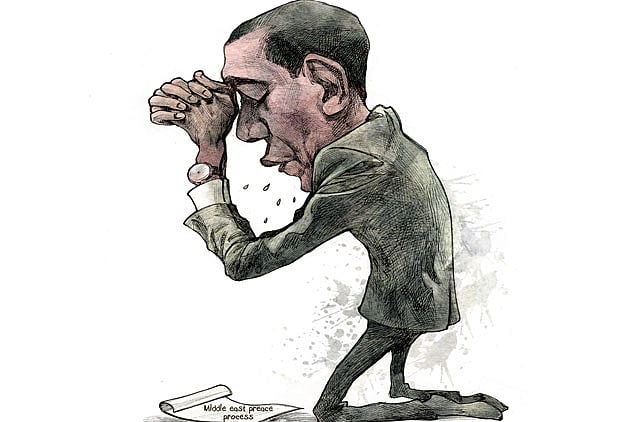
US President Barack Obama's failure to stand up to Israel's land-hungry Prime Minister Benjamin Netanyahu has bitterly disappointed opinion in the Arab and Muslim world. It has confirmed the belief that Washington has sold out to Israeli interests.
Heralded as an attempt to extend a hand of friendship to the democratic wave in the Arab world, Obama's speech on May 19 was met in the region with indifference or derision. The Arab-Israeli peace process is now thought to be all but dead.
Obama's weak-kneed approach has alarmed some European leaders. They now have to consider whether it is time for Europe, in defence of its own security interests, to break ranks with Washington and adopt a tougher stance towards Israel. One can only wonder what David Cameron, Britain's Prime Minister, said to Obama on this subject when the latter visited the UK this week.
In his speech, Obama threw a bone to the Palestinians by saying that the borders between Israel and Palestine ‘should be based on the 1967 lines with mutually agreed swaps.' But when Netanyahu made furious objection, he snatched the bone back. Addressing AIPAC, the pro-Israeli lobby, last Sunday, Obama sought to correct what he complained was a wrong interpretation of his words. ‘Mutually agreed swaps', he said, meant ‘that the parties themselves — Israelis and Palestinians— will negotiate a border that is different than the one that existed on June 4, 1967.' In other words, the drawing of the border was to be left to a negotiation between a lion and a mouse.
There was no hint in his speech of any US action to implement the vision of two states, Israeli and Palestinian, living side by side in peace and security. Instead his remarks were widely seen as a further demonstration, if one were needed, of the way pro-Israeli interests have taken control of America's Middle East policy.
It is now clear to most independent observers that Netanyahu wants land, not peace. He and like-minded Greater Israel ideologues will not yield to persuasion. Only serious pressure — even a threat of sanctions — might yield results. Over 500,000 Israeli colonists already live beyond the 1967 borders, and colony construction in the Occupied Territories is proceeding apace. On the very eve of Netanyahu's visit to Washington, Israel defiantly announced the construction of 1,500 new homes for Jewish colonist in Occupied East Jerusalem.
But, as he campaigns for re-election next year, Obama has evidently decided that he cannot expend hard-won political capital on the unpopular cause of Palestine. The Congress is overwhelmingly pro-Israeli, AIPAC and The Washington Institute, its sister organisation, are powerful pressure groups, and American Jews are major contributors to Democratic Party campaign funds.
Cairo was the only Arab capital where Obama's speech attracted some favourable comment because of his offer to Egypt of $1billion (Dh3.67 billion) in debt relief and an additional $1 billion in loan guarantees. But as Saudi Arabia's English-language Arab News commented on May 20: ‘If Obama wants our trust and friendship, then he must work on the one area where he has failed so disgracefully to deliver — Palestine... We do not want American bribes. He can keep his cash. The US economy needs it more than we do'.
Commitments
Consider what Obama actually said in his May 19 speech. To Israel, he offered the following important commitments:
- ‘No peace can be imposed,' he said. This is familiar short-hand for saying that Israel will face no US pressure to allow the emergence of a Palestinian state.
- ‘Symbolic actions to isolate Israel at the United Nations won't create an independent state... efforts to delegitimise Israel will end in failure.' With these words he announced his opposition to the Palestinians' plan to seek recognition for their sovereign state at next September's meeting of the UN General Assembly. By saying that the US would ‘stand against attempts to single [Israel] out for criticism in international forums' he indicated that the US would continue to use its veto in Israel's favour — as it did astonishingly last February, when it vetoed a Security Council resolution condemning colony expansion, the very policy the US had itself favoured until that moment!
- In his speech to AIPAC, Obama described the Fatah-Hamas agreement as ‘an enormous obstacle to peace.' Adopting Israel's objections as his own, he said that ‘No country can be expected to negotiate with a terrorist organisation sworn to its destruction.' Needless to say, he made no mention of the fact that Israel had tried to destroy Hamas when it invaded Gaza in 2008-9, leaving 1,400 Palestinians dead.
- Obama repeated the mantra that ‘our commitment to Israel's security is unshakeable.' To AIPAC, he repeated the US commitment to guarantee Israel's Qualitative Military Edge (QME) — that is to say its ability to confront and defeat any Arab threat. He made no mention of security for the Palestinians or indeed for Lebanon, which has suffered repeated Israeli aggressions and invasions. Any future Palestinian state, he said, should be ‘non-militarised'. Clearly, in Obama's vision, none of Israel's neighbours has the right to defend itself.
- On the subject of Iran, Obama reaffirmed America's opposition to Iran's ‘illicit nuclear programme and its sponsorship of terror' — remarks straight out of Israel's propaganda book.
Obama listed what he described as America's ‘core interests' in the Middle East as follows: ‘Countering terrorism.' (Together with its backing for Israel, America's brutal interventions in Iraq, Afghanistan, Pakistan and Yemen are the main causes of terrorism.) ‘Stopping the spread of nuclear weapons.' (This is a pledge which Arabs will see as maintaining Israel's regional monopoly of nuclear weapons. The Israeli daily Haaretz has reported that the US has secretly pledged to enhance Israel's nuclear arsenal.) ‘Securing the free flow of commerce, and safe-guarding the security of the region.' (Arabs and Iranians will ask who, apart from Israel, might threaten the security of the region.) ‘Standing up for Israel's security.' (This is clearly an overriding American interest.) ‘Pursuing Arab-Israeli peace.' (This has so far been a total US failure.)
Addressing the Arab world, Obama declared that ‘we know that our own future is bound to this region by the forces of economics and security, history and faith.' But there was nothing in his remarks that offered Arabs and Muslims the slightest assurance of America's good intentions.
On Iraq, he said that ‘we have ended our combat mission', but he made no mention of the troops he plans to leave behind. On Afghanistan, he claimed that ‘we have broken the Taliban's momentum.' But the Taliban's ever more lethal attacks suggest that nothing is less certain. He took pride in the killing of Osama Bin Laden — a ‘mass murderer' who was engaged in the ‘slaughter of innocents'. But he failed to recognise that the innocent victims of America's wars — and indeed of Israel's as well — are infinitely more numerous than the men and women Al Qaida has killed. If Obama truly wants a better relationship with the young men and women driving the ‘Arab Spring' he had better think again.
Patrick Seale is a commentator and author of several books on Middle East affairs.
Sign up for the Daily Briefing
Get the latest news and updates straight to your inbox
Network Links
GN StoreDownload our app
© Al Nisr Publishing LLC 2026. All rights reserved.