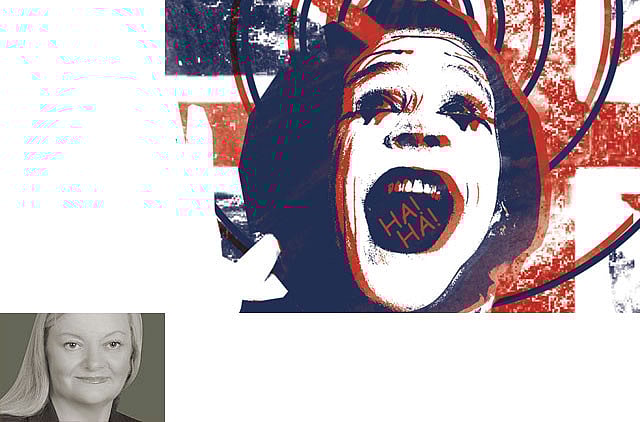
What happened to never speak ill of the dead? Okay, so we’re only human and Margaret Thatcher was a divisive figure when she ruled No 10 like an old-fashioned school ma’am whipping those starchy public school boys in her cabinet into shape. But it is worth remembering that she was the UK’s longest-serving prime minister who was voted into office three times. In other words, she couldn’t have been hated by the majority of Britons when she was at the helm. And quite right, too!
I’m of the camp that believes the Iron Lady was the greatest prime minister in post-Second World War history. I’m convinced she saved Britain’s ‘Great’ prefix.
I’m old enough to remember those dark pre-Thatcher days when unions held the country by the throat causing bodies to pile up in morgues, mountains of garbage in the streets and commuters held hostage to idle trains.
The UK economy was bleeding thanks to antiquated socialist policies, the sterling was in the doldrums and my homeland was beginning to carry little international sway. Then along came a straitlaced grocer’s daughter who battled her way to the top in an era when women politicians weren’t taken seriously and set about renewing a nation that had lost its way. She was a trailblazer who smashed a glass ceiling keeping women from top jobs.
She wasn’t a woman easily described as ‘nice’, true. She was tough, focused and sometimes blinkered, tackling her objectives like a dog with a bone. She had a grating high pitched voice that had to be toned down and was known for her withering glances and condescending attitudes; she wasn’t big on humour either and hated to admit she was wrong.
She was proud to say “the Lady’s not for turning” which was both strength and a weakness. Her stubborn tenaciousness broke the back of the mighty unions and was a boon for the Falkland islanders in whose name she took on Argentina.
Her determination and ability to win the argument was a major factor in the fall of the Soviet Union and her special friendship with president Ronald Reagan cemented the US-UK so called special relationship permitting London to punch above its weight. Perhaps she got too big for her boots. Her unpopular and deeply unfair poll tax led to angry street riots; they were ultimately the cause of her undoing.
That’s my take for what it’s worth and I know that many of my compatriots don’t agree which is their prerogative. Indeed, the prevailing clash of opinions about the death of a frail old lady whose mind wasn’t as incisive as it once was is deterring some Britons from open discussion on her legacy with friends and family fearing the topic could spark argument.
I must admit that I am flabbergasted that the death and funeral of someone who has had no say in government and has only rarely been in public sight over the past two decades has emerged as a hot button issue even with youth, many of whom knew little about her until now, if they’d heard of her at all.
Suddenly, she’s being held up as a poster child for all that’s wrong with a failing capitalist, free market economy society and the widening gap between the haves and have-nots. Her detractors’ memories are short. It wasn’t that long ago that Britons had never had it so good; that was before the 2008 global economic downturn affecting the UK along with the rest of the world, a catastrophe that certainly wasn’t of her doing.
I suppose the miners’ gripe that her policies destroyed communities is valid through their eyes, but when one looks at the big picture, she did the right thing by closing mines when international demand for expensive British coal had dwindled and people were rejecting polluting coal fires in favour of central heating.
In any event, the earth’s bowels were unhealthy, leaving miners with silicosis and susceptible to tuberculosis and lung cancer. If she failed in injecting local economies with alternative industries, her successors are as much to blame.
What sickens me most is that a sector of Britain is vulgarly dancing on her grave, holding street parties celebrating “the wicked witch is dead” — a disrespectful sentiment that’s been turned into a song heading for number one in the charts and is even on the playlist of the BBC.
She wasn’t a cruel torturer or a brutal dictator or a rampant warmonger, so where is all this hatred coming from? Is today’s Britain entirely devoid of national pride? Such venom from the mouths of pea-brained, drunken louts is one thing, but when ministers refuse to attend her funeral to be held on Wednesday and voice objection to her statue being erected in Trafalgar Square one cannot but help think there is something rotten in the state of Britain.
And unlike those suppurating glee over her demise, she was a person who devoted her every waking minute to bettering her country and even though she wasn’t always right, nobody can deny that she gave it her all.
May she rest in peace!
Linda S. Heard is a specialist writer on Middle East affairs. She can be contacted at lheard@gulfnews.com
Sign up for the Daily Briefing
Get the latest news and updates straight to your inbox
Network Links
GN StoreDownload our app
© Al Nisr Publishing LLC 2026. All rights reserved.