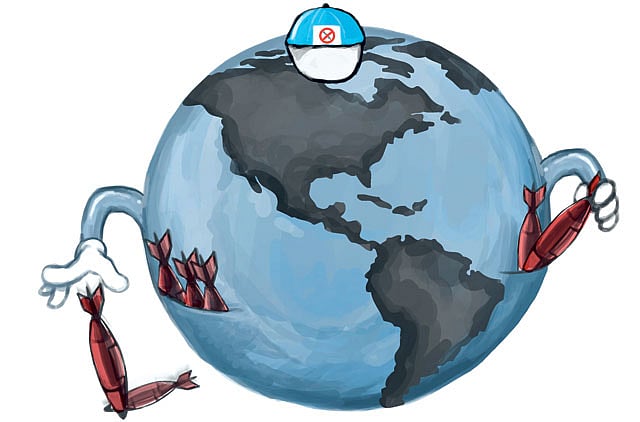
Ridding the world of nuclear weapons has long been a cause of the pacifist left. But in the past few years mainstream politicians, retired military leaders and academic strategists have begun to share the same goal, albeit with a very different idea of how to get there. That is partly thanks to a campaigning body called Global Zero, which is holding its third annual ‘summit' in London this week.
Global Zero got going in late 2006. Its two founders were Bruce Blair, a former Minuteman ballistic-missile launch-control officer and fellow of Brookings Institution who had set up the World Security Institute, a think-tank in Washington, DC, a few years earlier and Matt Brown, who had served as a youthful secretary of state for Rhode Island.
In January 2007 a seminal article appeared in the Wall Street Journal. The authors, who became known as the ‘four horsemen of the apocalypse', were Henry Kissinger, Bill Perry, George Shultz and Sam Nunn.
All were veterans of America's cold-war security establishment with impeccable credentials as believers in nuclear deterrence. They now asserted that far from making the world safer, nuclear weapons had become a source of intolerable risk.
The risk of accidents, misjudgments or unauthorised launches, they argued, was growing more acute in a world of rivalries between relatively new nuclear states that lacked the security safeguards developed over many years by America and the Soviet Union. The emergence of pariah states, such as North Korea (possibly soon to be joined by Iran), armed with nuclear weapons was adding to the fear as was the declared ambition of terrorists to steal, buy or build a nuclear device. Only by a concerted effort to free the world of nuclear weapons could the terrifying trend be reversed.
Suddenly, Global Zero was able to recruit people who were a far cry from the old ‘ban the bomb' crowd. Taking his cue from the ‘four horsemen', Blair emphasised that Global Zero had to advocate the kind of pragmatic actions that mainstream politicians and foreign-policy experts could endorse, while preserving, as a destination, a goal that seemed inspiring.
‘Zero' was a catchier slogan than the arcane incrementalism that had come to characterise old-time arms control. By putting the dangers of proliferation and nuclear-armed terrorism at the forefront of its concerns, Global Zero would puncture the public's post-cold-war complacency over nuclear weapons. Above all, Global Zero had to stand for a realistic process that was phased, multilateral, universal and backed by hard-nosed verification.
Global Zero announced itself with a meeting in December 2008 that drew together more than 100 international political, diplomatic, military and academic bigwigs. They agreed to set up a commission that would draw up a practical, step-by-step plan. They also sent a jointly signed letter to President Barack Obama and his Russian counterpart, Dmitry Medvedev, who were about to meet for the first time, urging them to make a commitment to eliminate nuclear weapons and start making further big cuts in their own arsenals.
Four-phased plan
In 2010, Obama and Medvedev signed the New START arms-control treaty, limiting the number of ‘operationally deployed' strategic warheads on each side to 1,550 after seven years.
With wind in its sails, Global Zero met in Paris in February 2010. Bolstered by the presence of another 100 or so famous supporters and messages of encouragement from Obama, Medvedev, the secretary-general of the United Nations, Ban Ki-moon, and the British prime minister, Gordon Brown, it released its four-phase plan for nuclear disarmament. The first phase, intended to run from 2010-13, required America and Russia to negotiate a bilateral accord to reduce their total warheads to 1,000 each from their current inventories of, respectively, 8,500 and 11,000 (the two countries still account for 95 per cent of the world's 20,500 nuclear warheads). Once ratified, every other nuclear-armed country would agree to freeze its own arsenal and pledge to join multilateral talks in the second phase (2014-18). This would see America and Russia each cut their arsenals to 500 warheads each and the other states reduce their inventories proportionately.
Critically, the second phase would depend on universal acceptance of a comprehensive verification and enforcement system accompanied by tighter controls on fissile materials produced by civil-nuclear programmes. The third phase (2019-23) would see the global zero accord legally agreed on and signed by all nuclear-capable states. The final phase (2024-30) would implement that treaty agreement.
Despite its rapid ascent, Global Zero, as it prepares for this week's summit, is facing problems that it may find hard to overcome. Its plan's timeline already looks optimistic. Obama struggled even to get the New START ratified in the Senate. Last year's Non-Proliferation Treaty review conference made little progress on bringing pressure to bear on Iran to mend its ways. For all Medvedev's rhetorical support, Russia's armed forces are intent on becoming more dependent on nuclear weapons, not less. If progress is to be made, it will have to be at a far slower pace than Global Zero is urging.
Sign up for the Daily Briefing
Get the latest news and updates straight to your inbox
Network Links
GN StoreDownload our app
© Al Nisr Publishing LLC 2026. All rights reserved.