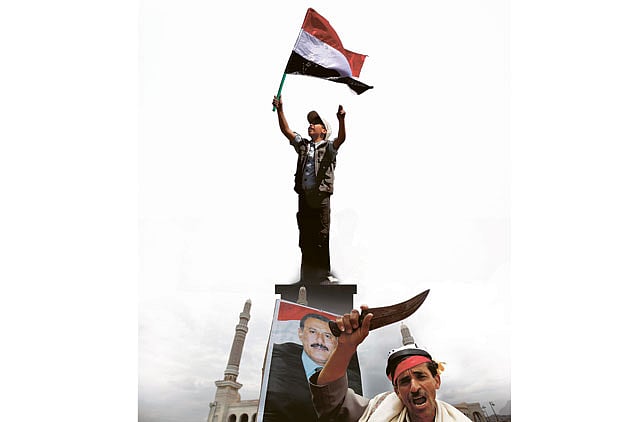
It is clear to those living in Yemen that the graph of the revolution has turned sharply upwards, with a rapid escalation in the past few days when protesters in their tens of thousands marched peacefully beyond barricades that used to limit their movement. For over eight months there were confined to a certain part of the capital, Sana'a, but recently, they decided that it was time to expand whatever the cost.
However, the response by the armed forces loyal to President Ali Abdullah Saleh — who made a surprise return to the country on Friday — was excessively violent. Armed militia fighting with the regime used rocket-propelled grenades, rockets and heavy ammunition against unarmed civilians resulting in gruesome fatalities, many which had to be censored on mainstream media due to their graphic nature. "This has not even been committed by Israelis against Palestinians," said one of the protesters. Another described how he had to collect pieces of shattered flesh of his friends in plastic bags.
Following those attacks, many Yemenis started calling upon the international community to bring Saleh to account by seizing his assets, imposing travel bans, starting an arms embargo, etc. Yet all they got was a statement by United Nations Secretary-General Ban Ki-moon, who criticised the government for using excessive force against civilians.
Ban's condemnation came as the UN Human Rights Council convened in Geneva to discuss the report of a UN fact-finding mission to explore the human rights violations committed in the country.
The report was clear in that there were indeed grave human rights violations and recommended that an international independent probe be launched to investigate those violations so as to bring the perpetrators to justice.
Grip on power
Despite that, violent assaults against protesters continued and resulted in more sympathy for and solidarity with the protest movement not only in Yemen but across the world. This emboldened the protesters to advance strongly and to prove to the world that Yemenis may be poor and may be neglected by the world, but they are no lesser human beings. "Saleh is one person and we are millions. We cannot be defeated," screamed one of the protesters on Sunday in a highly-charged tone.
As with the cases of Tunisia, Egypt, Libya and Syria, the autocratic Saleh still insisted on using force with the illusion that it will be enough to maintain his grip on power. Alas! He appears to have sealed his fate.
Unlike other revolting Arabs, Yemenis found themselves confronting not only one regime.
The alleged foreign support may be the reason why Saleh's forces continued their assault killing in less than a week over 100 civilians including women and children. Seeing little pressure from outside, the regime did not stop with cutting off power, water, fuel and other basic necessities from large portions of the population, but started using tanks against homes and deploying large numbers of snipers to kill anyone who moved in the demonstration areas.
An appeal was issued by residents of the areas where protests have been going on to the international community to have a conscience and act to save them from an imminent calamity due to lack of food, water, utilities and security. They describe gruesome images of corpses of protesters and passers-by lying on the streets because ambulances were prevented from getting in and anyone attempting to come close was in the snipers' crosshairs.
In a few statements, some countries have called for restraint from all sides. But the irony here that many protesters do not understand is the fact that those statements implied that this was a clash between two sides.
The clear truth is that it is an assault by a powerful army equipped with American and Russian advanced weaponry against unarmed civilians. How can one equate the victim with the attacker? The more such statements are made, the more protesters will be convinced that the world is unwilling to help.
In such a situation, Yemenis may end up defending themselves by carrying weapons and follow in the footsteps of the Libyan revolution. In such a situation, a war could erupt resulting in millions of refugees, a fertile ground for Al Qaida to thrive and insecurity to the Bab Al Mandab strait, through which most of the world's oil passes.
Is this what the world wants?
Regardless of what the world does next, Yemenis are not betting on foreign involvement to help their revolution succeed. A revolution can metaphorically be likened to labour signs.
During labour there will be pain and there will be suffering. Yet one thing is for certain: the baby will come out. It may take a few minutes or hours. And some may try in vain to prevent the baby from being born. But eventually, they will realise that no power on earth will prevent this from happening.
Walid Al Saqaf is founder and administrator of YemenPortal.net.
Sign up for the Daily Briefing
Get the latest news and updates straight to your inbox
Network Links
GN StoreDownload our app
© Al Nisr Publishing LLC 2026. All rights reserved.