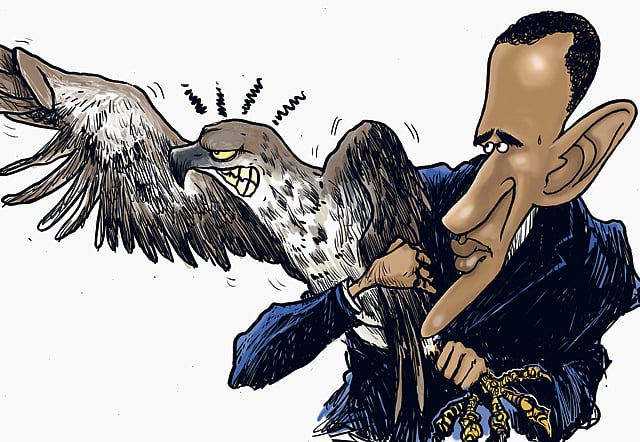
The Obama administration may have a lot more time to work on its plans for Iran than its hawkish opponents would like. The hawks would like to see immediate action over Iran's nuclear programme, and want to impose sanctions as soon as possible, but Barack Obama is looking at how to maintain momentum for the talks that he has always said he wanted to be the core of his approach to Iran.
In Iran, internal pressure from the opposition is mounting on President Mahmoud Ahmadinejad, which means that Iran is too politically divided to allow the president to respond productively to Obama's offer of engagement, even if he wanted to. The opposition Green Movement has surprised many by remaining very active after the fiasco of the summer general elections and many opponents of the regime, including opposition leader and former prime minister Mir Hussain Mousavi, are regularly speaking out against the Ahmadinejad government, and questioning the role of the Supreme Leader.
This political activity in Iran is being claimed as a success by the Obama administration in its struggle against the hawks' simplistic focus on sanctions. In an interesting blog called ‘Strategic Leaking', prominent Iran analyst Gary Sick has argued that the Obama administration is derailing the hawks by claiming that its policy of engagement has succeeded in creating turmoil within Iran's leadership, and that the administration is trying to avoid the general sanctions backed by the hawks in favour of highly targeted sanctions that will hit the Revolutionary Guards rather than the average Iranian citizen.
This means that Obama is probably not too worried about Congress passing Howard Berman's bill that would empower the White House to impose tough new sanctions on Iran over imports of petrol and refined petroleum products. This bill was a top priority for the American Israel Public Affairs Committee and the Israeli lobby, who were determined to define Iran as the US's leading enemy in the Middle East, and to keep up the pressure on Tehran. But since the bill's passage the White House has apparently said to senators that it would prefer that the Senate not take up the House bill, in which case it would be no more than an irritant in US-Iran relations.
The Obama administration is smart enough to understand that it has no real way of confronting Iran, according to Robert Dreyfuss. Writing in The Nation magazine, he argues that military action is unthinkable; that broad economic sanctions aren't going to happen because China and Russia won't participate and other nations such as India, Turkey, and the United Arab Emirates would resist them; and that unilateral US sanctions (such as a petrol embargo) would only backfire.
Therefore, he argues that since the White House cannot do nothing about Iran's defiance, and does not want to go down the route of general sanctions, it has settled on the idea of "targeted" sanctions that would focus on Iran's Revolutionary Guard, formally the Army of the Guardians of the Islamic Revolution.
It is not obvious how substantial the Revolutionary Guard's business and political power has become, with the active backing of the Supreme Leader. In addition to its military role, the Revolutionary Guard also has significant political power on the streets because it controls the paramilitary Basij militia, and a huge commercial empire, with annual revenues estimated at $12 billion (Dh44.1 billion).
The Revolutionary Guard has invested in sectors ranging from oil, gas and petrochemicals to cars, bridges and roads. An illustration of its size and influence is a recent decision by the Guard (reported by the Mehr News Agency on the Inter Press Service) to take $1 billion from the country's Foreign Reserve Fund in order to finish phases 15 and 16 of the huge South Pars gas project.
Another example is the Guard's Khatm Al Anba Construction Company, which is both its most important business operation and also the largest contractor for government projects in Iran. In the past four years alone, Khatm Al Anba has been the contractor for 1,500 of the country's most important government projects.
All this economic activity means that Obama has a very useful target inside Iran for sanctions, which would also foment some political trouble for the leadership. A sanctions programme targeting the Guard would be useful for Obama because he would score political points for taking action, but at the same time be ready to start a dialogue whenever that becomes possible, which a general sanctions programme might not allow.
Sign up for the Daily Briefing
Get the latest news and updates straight to your inbox
Network Links
GN StoreDownload our app
© Al Nisr Publishing LLC 2026. All rights reserved.