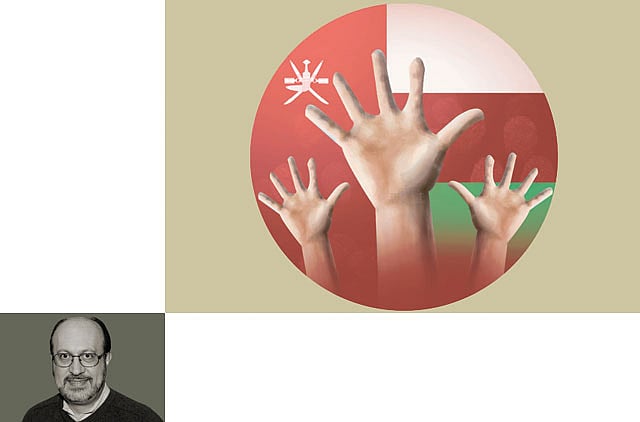
Significant amendments were recently added to the Omani Constitution that, not surprisingly, passed under the radar amidst major developments elsewhere in the Arab world. Yet, when the 84 members of the country’s Consultative Council (Majlis Al Shura) elected 35-year-old Khalid Al Mawali, a businessman who represents Wadi Maawal in the strategic Batinah coast, many observers were outright surprised given the speaker’s age.
Even more epochal were the opening remarks of Sultan Qaboos Bin Saeed to the annual Council of Oman (Majlis Oman), when the monarch addressed sensitive questions like corruption and the super-sensitive issue of free speech. Are these indicators the harbinger of fundamental new reforms?
Admittedly, the most critical changes in the amendments made to the Basic Law of the State, which clarified Article 6, touched on succession matters. While the Royal Family Council was called upon to select a successor to the throne within three days of the throne falling vacant, two civilian officials were added to the group that would join the Defence Council to help reach a felicitous choice, in case the Family Council did not agree on a ruler.
Henceforth the chairmen of the Majlis Al Dawla as well as the Majlis Al Shura, along with members of the Supreme Court and two oldest deputies serving in the elected Consultative Council, “shall confirm the appointment of the person designated by His Majesty, in his letter to the Royal Family Council.”
The fact that two publicly chosen representatives were given such a prominent role in the process meant that Muscat elevated the selection of a monarch to a higher level.
Moreover, and perhaps more important, by granting such privileges to public officials, Qaboos sent multiple signals: to the Family Council to act expeditiously, and to representatives to always select the best and brightest amongst them because these individuals might be called to assume immense new powers.
Furthermore, and as a direct consequence of this hugely relevant amendment, no one should doubt that members of the ruling family will alter their nascent relationships with elected officials, displaying added respect beyond the general courtesies that members of the Omani society practices.
An equally epochal amendment concerned Article 58, whose 45 sub-chapters clarified several points. The most important of these sections, Article 58-22, granted parliamentarians immunity to freely express their opinions. Lest this measure be taken for granted, and except for the Kuwaiti Parliament, it was worth noting that the free speech issue was unprecedented in the GCC region.
In his address last Monday, Sultan Qaboos reiterated that the Basic Law “guaranteed for every Omani the right to express his opinion and participate with his constructive ideas in enhancing the march of progress”.
Notwithstanding this avowal, the Omani monarch underscored that everyone, no matter his station in life, was equal under the law. Freedom of expression, he insisted, did “not mean that any one party has the right to force its opinions on others or suppress the rights of others to express their ideas freely”.
Relying on scriptures, Sultan Qaboos reminded his audiences that “the laws of the modern age” forbid “the monopolisation of opinion and [that] its imposition on others should not be permitted,” while “radicalism and immoderation” ought “not be tolerated.”
In one of the most electrifying moments in the presentation, and measuring his words with utmost care — spelling out every letter with unusual force — the monarch rejected fanaticism and extremism, articulating a vision that was vintage Sultan Qaboos, which focused on innovation with a human face.
The Omani monarch warned his officials of the many temptations of corruption, cautioning those who enjoyed privileges to remain true to their responsibilities, instructing “audit authorities to fulfil their duties resolutely in this regard with the full force of the law, away from doubt and uncertainties, since justice must take its course and become our goal and objective.”
It was critical to note, once again, that Muscat relied on the judiciary to fulfil its duties. Remarkably, the speech was also peppered with references to civilian institutions, which formed the foundations on which society rested. Compared to previous pronouncements, this too was a fresh emphasis, which distinguished the ruler’s attention to essential details.
What is one to make of these qualitative changes in the sultanate and are they indicators of a new direction. Is the sultan embarked on a new path that will gradually transform the country into a constitutional monarchy? Will we see fresh new senior appointments? Will the ruler delegate additional powers into the capable hands of young men and women eager to rise to the occasion? Is the sultan following a meticulous plan that will confirm his vision whereby Omanis who have the wherewithal to assume responsibilities can also add value once given the chance?
Astonishingly, the introduction of fundamental electoral reforms to the Omani Constitution encouraged Qatar Emir Shaikh Hamad Bin Khalifa Al Thani to issue similar calls, promising to hold Majlis Al Shura elections in 2013. This is the kind of legacy that reverberates across borders among GCC states, with Sultan Qaboos showing the way as the innovator he continues to be, and which highlights his farsightedness. Above all else, the monarch’s preferences for massive transformations underscored the man’s core beliefs in his nation, avowing that Omanis can always rely on qualified innovators.
Dr Joseph A. Kechichian is a commentator and author of several books on Gulf affairs.
Sign up for the Daily Briefing
Get the latest news and updates straight to your inbox
Network Links
GN StoreDownload our app
© Al Nisr Publishing LLC 2026. All rights reserved.