Can Kerala become India’s maritime gateway?
Push to attract $1b in investments to reshape economy if execution matches ambition
For decades, Kerala has lived with a contradiction.
It has one of India's most educated workforces, strong human development indicators and a location along one of the world's busiest shipping routes. Yet when large manufacturers looked to expand, the state often lost out because of concerns over land acquisition, labour disputes and lengthy approvals.
The state's ambition to attract ₹10,000 crore (about $1 billion) of investment into its maritime sector marks an attempt to change that. The Kerala government has since clarified that this figure represents the total scale of investment it hopes to attract across multiple projects and investors under its broader maritime strategy, rather than a single project or company.
If that ambition is realised, Kerala could move beyond being known primarily for remittances and services to becoming one of India's most important maritime and industrial economies.
New maritime ambition
The timing is significant. India wants to become a larger player in global manufacturing, logistics and maritime trade. Shipbuilding is one area where it still lags. China dominates the industry, while South Korea and Japan remain global leaders. Despite its long coastline and growing trade volumes, India accounts for only a small share of global shipbuilding. That presents an opportunity.
Modern maritime economies extend far beyond ports. Shipbuilding, ship repair, offshore fabrication, marine engineering, logistics, warehousing and specialised manufacturing all reinforce one another. Countries that dominate global shipping have built integrated ecosystems rather than isolated infrastructure projects. Kerala appears to be pursuing the same model.
The government's Mission Samudra aims to develop the state into one of India's leading maritime economies by attracting investment across multiple segments instead of relying on a single flagship project. Officials have also pointed to ongoing work on a joint venture between Malabar Cements and Artson Engineering, part of the Tata Projects ecosystem, to establish a boat-building facility at Cochin Port as an early step in building that ecosystem. The broader objective is what deserves attention.
Every large maritime cluster creates demand for steel fabrication, heavy engineering, electronics, marine equipment, software, logistics and maintenance services. Thousands of direct and indirect jobs can emerge around these industries, generating economic activity that extends well beyond the coastline. Kerala is also attempting to change its investment narrative.
Chief Minister V.D. Satheesan has emphasised faster approvals, government support for land acquisition and new public-private investment models. He has argued that labour relations have evolved, with unions increasingly focused on productivity and performance incentives rather than prolonged industrial disputes. For investors, such signals matter as much as financial incentives.
Beyond Vizhinjam
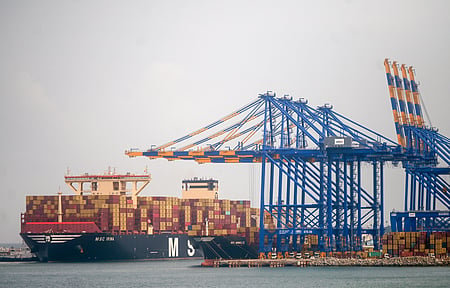
Kerala's maritime ambitions cannot be separated from the rapid rise of Vizhinjam International Seaport, developed and operated by Adani Ports and Special Economic Zone Ltd.
The port is being expanded from 1.6 million TEUs to 5.7 million TEUs, while MSC Mediterranean Shipping Company has proposed investing $1.4 billion for a 49% stake. That transaction remains under review by the Kerala government, though the state has consistently backed the expansion of the port itself.
The larger strategy is becoming clearer. India still relies heavily on overseas hubs such as Colombo, Dubai and Singapore to handle much of its transshipped cargo. Vizhinjam aims to bring more of that business back to Indian shores by accommodating the world's largest container vessels.
Ports alone, though, rarely transform economies. The world's leading maritime hubs combine deepwater ports with shipbuilding, repair yards, logistics parks and manufacturing clusters. Singapore, South Korea and parts of China all followed that path.
If Kerala succeeds in developing complementary industries around Vizhinjam, the state could capture far more value from global trade instead of simply moving cargo through its ports.
Real test is execution
Kerala has long depended on remittances from workers overseas, particularly in the Gulf. Those inflows remain vital, but they also expose the state to external economic cycles. The government has also highlighted the growing impact of reverse remittances as migrant workers employed within Kerala send much of their earnings to other states.
Building high-value maritime industries offers one way to broaden the state's economic base. Plans to expand technology parks alongside maritime infrastructure suggest Kerala is pursuing wider industrial diversification rather than depending on any single sector.
The opportunity is substantial, but so are the challenges. Building a globally competitive maritime ecosystem demands skilled workers, reliable infrastructure, competitive costs and consistent policy support. Global competition remains intense, particularly from China, South Korea and Japan. Success will depend less on ambitious targets than on steady execution.
Still, the direction of travel is difficult to ignore. A world-class transshipment port is expanding. The state is seeking to attract ₹10,000 crore ($1 billion) in maritime investments across multiple projects. Supporting infrastructure is taking shape. The government says it is making Kerala easier to invest in.
Taken together, these are not isolated developments. They represent Kerala's most serious attempt in decades to reposition itself from a remittance-driven economy into a manufacturing and maritime hub. If that strategy succeeds, the real story will not be any single investment. It will be Kerala finally turning its greatest natural advantage—its coastline—into a lasting engine of economic growth.

Sign up for the Daily Briefing
Get the latest news and updates straight to your inbox
Network Links
GN StoreDownload our app
© Al Nisr Publishing LLC 2026. All rights reserved.