France’s Muslim communities are once again being singled out by the country’s authorities. First came a controversial ban on religious symbols in public schools, including the headscarf, a move designed to specifically target Muslim girls, despite a show of impartiality by forbidding crosses and turbans. That was followed up with a ban on the burka, eliciting a storm of protest.
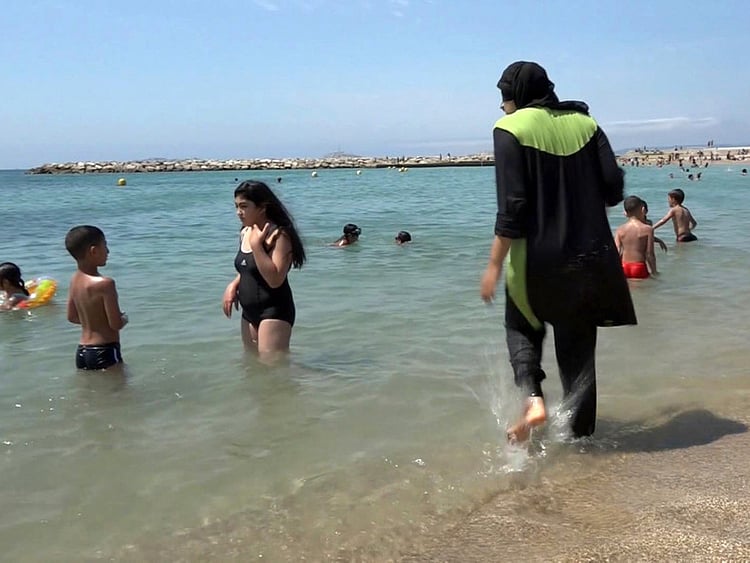
At least six French mayors have now gone beyond the pale with the imposition of fines on women swimming in a burkini — a garment that covers all of the wearer’s body aparts — common throughout the Middle East and North Africa.
Banning the all-encompassing burka that hides the face, ostensibly on security grounds, is one thing, especially after the country has suffered a series of major terrorist attacks as well as robberies carried out by burka-clad thieves. Whether one agrees with that ban or not, there is at least a convincing argument against anything that hides a person’s identity in this ever more dangerous era. Waging war on a certain type of beachwear resembling a diving suit quite another.
Why shouldn’t Muslim women, who adhere to their faith, be able to enjoy a swim just like everybody else? Modest dress is one of Islam’s tenets and before the burkini was invented in Australia, women were destined to be lone figures on the beach or at the pool while their husbands and children splashed in the water or they swam fully clothed, which is hardly pleasurable, is considered by some to be unhygienic and others as donating class.
The burkini is far from being a sign of female enslavement, as a number of French commentators are opining, but rather a garment that’s freed women to become participants instead of onlookers and it’s facilitated young women to engage in competitive beach sports as evidenced by Egypt’s first ever female volleyball team competing in Rio.
I was surprised to hear a guest on Al Jazeera assert that it represents extremism and encourages radicalism. That’s utter nonsense! The burkini which displays curves and the face is frowned upon by radicals. It’s basically a utilitarian swimsuit worn by a very small percentage of France’s women and girls from conservative families. And here it is important to distinguish between conservatism and the kind of radicalism that solicits young people to strap themselves with suicide belts or deprive innocents of their heads.
Worse, Marseille, where more than one-eighth of the city’s residents are Muslims, cancelled a one day female-only event at one of its water parks organised by an Arab women’s association requesting attendees cover the area between their chests and their knees when the occasion was met with an anti-Islamic backlash from high-level politicians characterising the event as being socially divisionary or as an attack on France’s values and culture.
Admittedly, France is notoriously protective of its language and culture against the danger of erosion by the international dominance of English and its cultural expressions that have crept into French society. The usage of words like “supermarket” and “weekend” were at one time discouraged.
That’s understandable. The French are a proud race that holds fast to its traditions and way of life. But the fact remains that France is home to Europe’s largest Muslim minority and in a democratic country where equality is enshrined in its constitution, citizens should be free to abide by their religious beliefs in their way they see fit and wear what they like — provided a garment isn’t embossed with language likely to give offence or, like the burka, has the potential to conceal wrongdoers from the eyes of witnesses and security cameras.
Unrealistic expectations
Expecting French Muslims to fully assimilate with the indigenous population is unrealistic because they will always retain an umbilical cord with the country of their forefathers and will always maintain their religious traditions just like other minorities in France, such as Sikhs, Jews, Cambodians and the children of migrants from sub-Saharan Africa.
Perhaps the most damning case against the mushrooming bans on the burkini is this: The more that French Muslims feel they are being unfairly penalised, the more their feelings of loyalty for their country will be chipped away, rendering the angry and despairing likelier fodder for Daesh (self-proclaimed Islamic State of Iraq and the Levant) recruiters.
Assimilation, even partial assimilation, must go hand-in-hand with acceptance by the other side. Laws and trivial bans smacking of bigotry, which alienate a sector of the society, will do nothing to bring France’s citizenry together; quite the reverse. France should quit making its Muslims — whether first, second or third generations — feel like unwelcome guests and learn to celebrate its multicultural present instead of indulging in nostalgia for a never-to-return unicultural past.
Linda S. Heard is an award-winning British political columnist and guest television commentator with a focus on the Middle East.
Sign up for the Daily Briefing
Get the latest news and updates straight to your inbox
Network Links
GN StoreDownload our app
© Al Nisr Publishing LLC 2026. All rights reserved.