"Oil-Rich Nations Fall Far Short in Haiti Donations" was the headline in an American newspaper one week after the devastating earthquake struck Haiti on January 12, killing and injuring tens of thousands of people and reducing large sections of several cities to ruins. The disaster is estimated to have left up to 1.1 million people homeless. Donations from governments, individuals and the private sector followed immediately after the catastrophe, but some expected donors were missing.
Indeed, many western media criticised Arab countries, especially the oil-rich ones for not doing enough to help Haiti's earthquake victims. Not generous enough, not prompt enough, but above all not in solidarity with non-Muslim victims, were the major accusations directed towards GCC countries.
The European Union, the US and other countries offered generous donations to help the earthquake victims. Meanwhile, mainstream media and blogs reported the absence of Gulf countries from the scene as donors and as humanitarian actors.
However, the harsh criticism faced by Gulf countries should be put into perspective, as these countries are often criticised by their closest neighbours, and indeed the entire Muslim world, for not providing enough support to their less rich counterparts. In this context, it is quite paradoxical to read the recurrent accusations claiming GCC countries are biased towards the Muslim communities.
Charitable giving is emphasised in Islamic Law. It obeys a specific codification. Zakat, one of the five Islamic pillars, is supposed to be directed towards certain categories of people in need. Moreover, it is commonly considered that zakat recipients must be Muslim. Whilst zakat is the most visible charitable tool, it is not the only religious charitable tool existing in the Islamic world. Sadaqa, which is the daily charity, is not restricted to Muslim recipients, and is largely practised. Donations for non-Muslim recipients are possible in the majority of GCC countries through earmarking donations, since many international NGOs are present in the Gulf and support their field operations overseas.
The process of moving to more neutrality and impartiality has been increasing amongst Islamic NGOs. Starting from the 90s, these institutions have been experiencing a process of professionalisation and liberalisation which makes them more and more in phase with international standards.
Also noteworthy is that raising funds in these countries, which enjoy some of the highest per-capita incomes in the world, is strictly monitored and subject to administrative delay. The fact that many NGOs, some of which are called Islamic, were proven to fund terrorist activities has led to fundraising activities being increasingly scrutinised and closely monitored.
Finally, it is worth remembering that Haiti is one of the poorest countries in the world. As such, many international NGOs have been working in Haiti for years. They were already present in the field and could mobilise their staff and their resources immediately after the earthquake, although they also suffered losses in the quake.
Major donors
Lately, countries such as the UAE and Qatar have affirmed their will to become not only major donors, but also major actors in the humanitarian field. Although not reflected correctly by the western media, Gulf countries have been active in the field in Haiti and though late, the Saudi donation has been significant.
It is indeed worth noting that Qatar was relatively fast in sending a rescue team to Haiti immediately after the earthquake. A C-17 cargo plane, transporting 50 tons of relief supplies and a team of 30 people, left Doha only hours after the earthquake struck the area. Team members were well versed in emergency relief, bringing experience from the battlefields of Gaza, Lebanon and Somalia, as well as natural disasters such as the Pakistan earthquake of 2005, and Mauritania's floods in 2007.
Involved in humanitarian and philanthropic activities overseas since its creation, the UAE has undertaken active initiatives in the past years to become an international humanitarian actor and a global donor. Indeed, the country has recently established a co-ordination office in charge of assessing the volume of aid the country has provided in the past, in addition to co-ordinating field activities. The UAE has been the most active Gulf country in the field in Haiti. Besides setting up an air bridge on January 15, the country's largest humanitarian actors participated in the relief effort in Haiti.
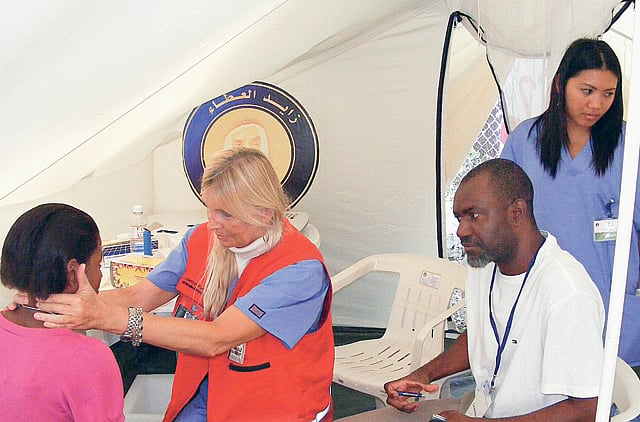
Abu Dhabi-based charity organisations indeed played a significant role in supporting the relief effort in Haiti. The Red Crescent Authority sent relief items, medical equipment and medical personnel. The organisation established a field hospital and contributed financially to the emergency appeal launched by the International Federation of the Red Cross and Red Crescent Societies. The Khalifa Bin Zayed Al Nahyan Foundation's participation is estimated to be worth $3.5 million (Dh12.8 million). It includes relief items, medical equipment, 500 tons of food aid and medical supplies.
From Dubai, Princess Haya Bint Al Hussain travelled to Haiti to oversee a delivery of 90 metric tons of relief supplies provided by the Mohammad Bin Rashid Al Maktoum Humanitarian and Charity Establishment. The total contribution of the UAE is estimated to be $7 million.
Last but not least, in spite of the criticisms, the Saudi donation was one of the most important received. Indeed, Saudi Arabia contributed $50 million to support the United Nations humanitarian response to the earthquake in Haiti.
In closing, the question must be asked whether the participation of Gulf countries has been largely underestimated, and subject to biased perceptions.
(Hanane Cherkaoui is a research associate for the Humanitarian Research Group of INSEAD Social Innovation Centre. Luk N. Van Wassenhove is academic director of the Centre.)
Sign up for the Daily Briefing
Get the latest news and updates straight to your inbox
Network Links
GN StoreDownload our app
© Al Nisr Publishing LLC 2026. All rights reserved.