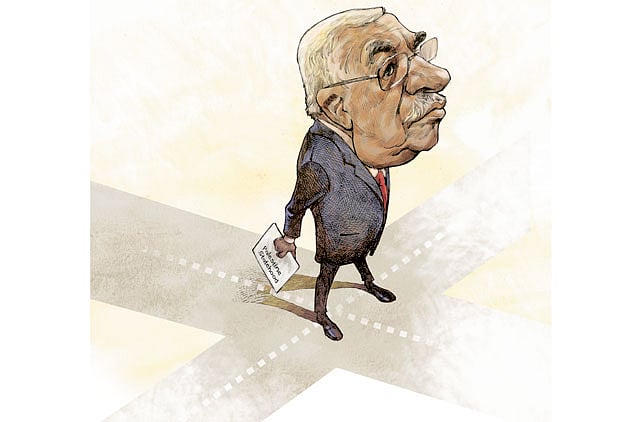
It was as if something momentous was happening in New York on September 23, 2011. Palestine National Authority (PNA) President Mahmoud Abbas, whose term had already ended, handed to United Nations Secretary General Ban Ki-moon an application for full-fledged membership in the world body. The symbolism was powerful: 18 years after the start of the Oslo agreements there was a deep sense that there had been "no improvement".
Abbas' gesture brought hope. The ovation and the majority support of the UN General Assembly were impressive: the Palestinian cause has many friends around the world, not only Arabs and Muslims. For few minutes, we were swept away by hopes and dreams, forgetting, for only those few minutes, the grim realities of history, facts and figures.
When the Israeli Prime Minister Benjamin Netanyahu delivered his speech, dire reality replaced symbolism. Speaking in perfect American English (while Abbas spoke in Arabic), the far right-wing Israeli leader presented another version of the story. The recognition of the new Palestinian state was not to be achieved by a UN summit but through direct negotiations between Israelis and Palestinians.
That is the only way forward and if the ongoing discussions have failed over the last 20 years, it is because of Palestinian unwillingness to understand Israel's legitimate security requirements. The Palestinians were to blame whereas successive Israeli governments have been working tirelessly for mutual recognition and peace.
There was silence in the room as the delegates listened attentively to his surrealistic words. No emotional symbols, no false hopes, no dramatics: the simple Israeli rhetorical truth which, we all know, will eventually be supported by the US and hence by the so-called international community.
The Palestinian request for recognition will be discussed in the coming months. We know already that nothing will happen except — as Netanyahu suggested — a new round of the endless peace talks that have achieved nothing. The Quartet's members met once again and promised to resume the so-called peace process. Here we are, beyond the symbols, to be asked to wait for another 10 years of fine speeches and hypocritical talks.
The facts on the ground tell another story. With or without the UN, with or without the Quartet and the peace process, Gaza faces an inhuman blockade while the Israeli colonies (officially endorsed by the Israeli government) on the West Bank and in occupied East Jerusalem have doubled over the last five years. The truth is that while talking about a two-state solution, successive Israeli governments have made it impossible on the ground by officially colonising Palestinian land. The truth is that with or without UN recognition, Israel does not want peace with an eventual Palestinian state for it does not want such a state to exist. We may be content with symbols and dreams; Israel and the US deal in facts and politics.
Regional dynamic
An Arab awakening is taking place around us — yet it seems clear that nothing will change in the Middle East if no solution to the Palestine-Israel conflict can be found. It is the central issue of our times. The people who are calling for dignity, justice and freedom in Tunisia, Egypt, Libya and Syria and in all the other countries in North Africa and the Middle East (Mena) must understand this. They will not get what they aspire for at the national level without a change in the regional dynamic. The uprisings we are witnessing are still very nationalistic; the democratic trends are not broad enough to address the real challenge. There can be no Arab Spring as long as the Palestinians remain under illegal occupation, as long as they suffer intolerable oppression.
We can blame Israel; we can blame the US and the West. But ultimate responsibility lies with the lack of consistency and courage of the Arab leadership. It is easy to applaud Abbas' speech in New York. But where are the Arab governments in reality? They abandoned the Palestinian cause long ago, paying it only lip service from time to time. They have been divided under dictatorships; divided they seem to remain even as they attempt to liberate themselves. The PNA is split and unable to find common ground. The least we can acknowledge is that Israel's divide-and- rule strategy has been successful due to the endemic weaknesses of the Palestinians bogged down in corruption and petty power struggles.
Arabs and Palestinians must face the new challenges squarely and start to solve their internal problems. Mena as a whole, as well as the Israel-Palestine conflict, require a new mindset, a new vision, and a new commitment to freedom, dignity, justice and pride. We are looking forward not only to political uprisings but also to an intellectual emancipation, an Arab intellectual revolution. This can only happen far from the limelight, the applause and the symbols.
It is a long and laborious process of inviting minds and hearts to examine critically their own failures, to be ready to assess the situation objectively. It is time to wake up. The new generations crying out for freedom, dignity and justice should get it right from the very beginning. Today the Arabs' worst enemies are neither Israel nor the West. They are the Arabs themselves.
Tariq Ramadan is Professor of Contemporary Islamic Studies in the Faculty of Oriental Studies at Oxford University and a visiting Professor at the Faculty of Islamic Studies in Qatar. His new book Islam and the Arab Awakening will be out in November.
Sign up for the Daily Briefing
Get the latest news and updates straight to your inbox
Network Links
GN StoreDownload our app
© Al Nisr Publishing LLC 2026. All rights reserved.