Pax Silica: An artist's conception of the planned Economic Security Zone (ESZ), a flagship project under the US-led Pax Silica initiative, at the New Clark City, in Pampanga, 1 hour by car from Manila.
Filipinos should not fear Pax Silica — Here's why
Pax Silica can power Philippine jobs, clean energy and an AI-ready economy
Last updated:
9 MIN READ
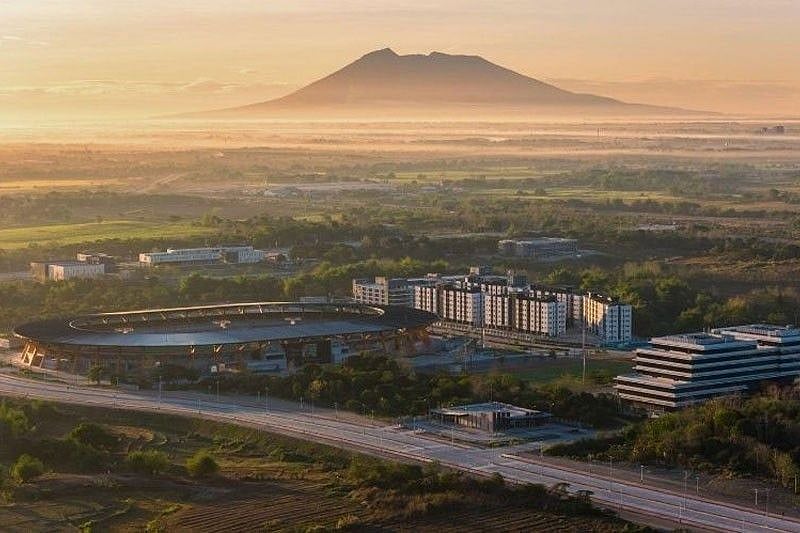
A view of the New Clark City in Tarlac, a former US military base about 1 hour north of Manila, is now being developed to be transformed into an AI, chips and critical minerals processing hub. The governing framework is also being developed as per the Bases Conversion Development Authority (BCDA).
New Clark City | BCDA
Every generation has its defining technology.
Steam power transformed the 19th century. Electricity and internal combustion vehicles reshaped the 20th.
The internet connected the world at the turn of the millennium.
Artificial intelligence (AI) and electrified transport are poised to define the 21st.
That is why Filipinos should see initiatives like "Pax Silica" — a visionary move to attract hyperscale data centres, AI-native infrastructure and advanced digital industries, and jobs created to build and run them — not as a threat, but as an opportunity.
OK, it's a US-led initiative.
And where Uncle Sam looks (imperialism!), trouble follows.
That's the framing of die-hard leftists, bleeding-hearts liberals and many in the self-described "Green" movement who are, unsurprisingly, unhappy about it.
Then again, this crowd seems unhappy with almost everything — except when they succeed in tearing down era-defining ideas, projects or achievements that challenge their rigid view of humanity's very existence.
Through that lens, driven by romantic Marxist class-struggle toxicity, nearly every event is reduced to a binary conflict: rich versus poor, oppressor versus oppressed.
Progress is viewed with suspicion. A blanket rejection of Pax Silica hijacks a a reasoned conversation through tired-old sloganeering.
Success is often recast as "exploitation".
And, therefore, the prescribed response?
"Resistance".
When resistance is the only response to an irresistible force like AI, computing and hyperscale manufacturing, something's gotta give.
Instead of resistance to anything US-led, how about "engagement"?
It's not just about blind obedience: There are very good reasons for Filipinos to get engaged actively with Pax Silica.
Pax Silica signatories: It now counts more than 24 signatories, including key members like the US, India, Japan, South Korea and the Philippines. But it also includes Argentina, Chile, Costa Rica, El Salvador, Panama, Australia, Singapore, Kazakhstan, the UK, Israel, UAE, Qatar, the EU, Germany, Greece, Finland, Sweden, Netherlands, and Norway. Canada, Estonia, Taiwan are "observers" / non-signing partners.
Pax Silica in the Philippines
In the Philippines, the Pax Silica Initiative focuses on AI, semiconductors, critical and rare earth minerals.
Announced by the US State Department and promoted by President Ferdinand Marcos Jr., the project aims to attract an initial $10 billion in investments and generate up to 190,000 jobs.
What's been announced so far:
Location: The proposed Pax Silica project is located in New Clark City, Tarlac
Area: 1,600 hectares (16 sqkm)
AI manufacturing hub: The US-led initiative seeks to develop a 1,600-hectare technology hub that will anchor a global supply chain for:
Artificial intelligence (AI), semiconductors, rare earth minerals.
International interest: More than 30 countries have expressed interest in participating in the project and are currently reviewing its legal framework, requirements and investment opportunities.
Complicance: Compliant with Philippine laws, international regulations and environmental, social and governance (ESG) standards, says BCDA President and CEO Joshua Bingcang.
Investment certainty: Bingcang said the project aims to provide investors with: A clear regulatory framework, policy stability,
predictable investment conditions, compliance with both domestic and international standards.
Green spaces: About 40% of the manufacturing zone will be preserved as open spaces, creating a balanced environment for workers while promoting sustainability and livability.
Strategic significance: Pax Silica is envisioned as a major high-tech manufacturing and innovation hub that could position the Philippines as a regional center for AI infrastructure, semiconductor production and critical minerals processing.
Debate over Pax Silica: Critics vs supporters
In the Philippines, much of the public debate has focused on electricity and water demand.
Critics see data centres as energy-hungry facilities competing with households and industry for power.
They are not wrong that AI requires enormous amounts of electricity — and water.
And large cloud and AI data centres draw between 20 MW and 100+ MW, while some massive sites exceed 650 MW — equal to the power usage of up to 500,000 homes, or a standard nuclear power plant.
Mid-range facilities (regional or medium-sized centres use 5 to 20 MW).
But Pax Silica hub is not even about these hyperscale data centres, of which the Philippines already hosts 40+.
Filipinos work at the assembly line of Taiwan-based Kinpo Electronics' factory in Malvar, Philippines. The industry exports about $50 billion of electronics products and services per year.
However, critics are off kilter on many counts:
High energy consumption does not mean the country should oppose or resist building AI infrastructure altogether.
AI infrastructure is becoming strategic investment (as much as electricity, manufacturing, ports and internet).
Investment draw: countries that host AI infrastructure are more likely to capture investment, innovation and high-value industries.
Economic ecosystems: AI data centres, while they employ relatively few workers directly, have outsized impact from construction,
electrical engineering, cloud computing, cybersecurity, chips manufacturing, maintenance, universities and technical training, startups and supplier industries.
Energy demand should drive new power generation: AI requires substantial electricity. Rather than treating this as a reason to reject data centres, it should be an incentive to build new hydropower, utility-scale solar, wind farms, battery storage, more resilient grid.
Clean energy and AI reinforce each other: Many hyperscale tech companies seek renewable electricity for cost, reliability and corporate climate goals.
The Philippines already exports talent: Thousands of Filipino engineers, programmers and IT professionals work overseas.
Avoiding AI infrastructure could leave the Philippines dependent on foreign providers.
Critical minerals: The Philippines mined and exported approximately 55 million wet metric tons (wMT) of nickel ore, as per PNIA trade data. The country has 36 operating nickel mines. Nickel reserves are estimated at 4.8 million MT, with total deposits valued around $170 billion. Major companies like Nickel Asia drive domestic extraction. Processors in China buy the bulk of the Philippines' nickel exports.
Pax Silica is an ambitious tech, manufacturing and critical minerals hub set to be located next to Clark International Airport about 100km north of Manila. The Philippines is a major producer of natural but critical minerals like nickel, most of it is exported to China where it's processed and re-exported as finished products (EV batteries, stainless steel).
There are other practical realities:
Building an AI ecosystem locally could help retain skilled workers (help families stay together) and create higher-value jobs at home;
New generating capacity from pumped-storage hydropower (opposed by Greens for "ecological" or social reasons) can also improve grid reliability for households and businesses;
If planned well, new demand from AI could support investment in cleaner generation instead of increasing dependence on older fossil-fuel plants.
In short, AI leadership will influence future competitiveness.
History suggests the opposite
Every major tech revolution has demanded more energy, not less.
Factories required power plants.
The internet required fiber-optic cables and telecommunications networks. Smartphones required semiconductor fabs.
AI requires data centres.
Power Efficiency (PUE): Efficiency is measured by Power Usage Effectiveness. Modern efficient centres achieve a PUE near 1.09 to 1.2, meaning only 9% to 20% extra energy goes to cooling and infrastructure overhead.
Delegates at the Pax Silica Summit
The answer has never been to reject new technology because it consumes electricity. The answer has always been to build the infrastructure needed to support it.
The Philippines now faces precisely that challenge.
AI is not another industry
Artificial intelligence is rapidly becoming foundational infrastructure.
Banks use it to detect fraud.
Hospitals use it to assist doctors.
Manufacturers use it to optimize production.
Governments use it for disaster forecasting and traffic management.
Scientists use it to discover new medicines.
Students use it to learn.
Journalists use it to research (i.e. for this article).
Even many of AI's loudest critics rely daily on AI-powered search engines, cloud services, smartphones and social media platforms whose data centers consume enormous amounts of electricity.
The most hard-core among the anti-Pax Silica crowd use some form of digital platform to raise their objections.
The question is no longer whether AI will reshape society. It already is.
The real question is whether the Philippines will help build that future — or simply import it from elsewhere, and continue to export its people to run the very same system "sa ibang bansa" (a sad catch-all for overseas work).
Keep the jobs — and the value chain — at home
Countries that own digital infrastructure tend to capture more of the economic value it creates.
Data centres are often dismissed because they employ relatively few people directly.
That misses the larger picture.
A modern AI ecosystem creates demand for electrical engineers, software developers, cybersecurity professionals, network architects, construction firms, equipment suppliers, cloud specialists, cooling technologies, chip packaging, maintenance contractors and universities that train the next generation of workers.
Around those facilities emerge entire ecosystems of startups and suppliers.
If the Philippines does not develop this infrastructure, those opportunities will migrate elsewhere — Malaysia, Indonesia or Vietnam.
Talent follows investment.
Investment follows infrastructure.
Raw nickel: Global nickel production is dominated by a select few, including the Philippines, Indonesia, Russia and New Caledonia, according to data from the US Geological Survey.
Energy abundance — not scarcity
The legitimate concern is electricity. AI requires massive amounts of it.
But that should not frighten Filipinos, especially in this day and age.
It should motivate us. The Philippines possesses significant untapped renewable resources.
Hydropower can provide reliable baseload electricity. Solar generation costs continue to decline. Wind resources remain underdeveloped.
Battery storage is rapidly improving. It's also bolstering the economics of renewable energy by balancing intermittent generation.
That's to mention nothing about small modular nuclear reactors (SMRs).
Rather than viewing data centres as a burden on power generation and the grid — or as a ball and chain that could saddle Filipino consumers with higher electricity costs — policymakers should see them for what they can be.
One opportunity: they could anchor customers whose enormous demand can justify long-overdue investments in cleaner, more resilient and more reliable power systems.
A view of the Maria Cristina Falls and the adjacent Agus IV hydro-electric powerplant (lower centre). in Mindanao, southern Philippines. The powerplant, first commissioned in 1953, forms part of the Agus-Pulangui hydropower complex (APHC). It is up for a multi-billion refurbishment-operate-maintain concession via public-private partnership deal. The hydropower complex the energy backbone of Mindanao, Philippines, supplying over 50% of the island's total energy consumption.
The objective should not be stuck in an ideological debate, or to choose between AI and clean energy.
It should be using AI demand to accelerate clean energy deployment.
This poses a huge challenge to the Philippine Department of Energy (DoE). Generational challenges like this one, however, should take a whole-of-nation approach to solve. Every Filipino should understand and be involved.
How? By understanding the challenges and opportunities.
Upskill — or fall behind
Every tech revolution disrupts labour markets. Some jobs disappear. Many more evolve.
The "Calesa" did not disappear with cars, they became cultural icons.
The answer has never been to resist technology. A strong resolve to pick up new competencies is key.
Filipino workers have repeatedly demonstrated their ability to adapt — from maritime industries to healthcare, chips, finance, software development and global business services.
AI represents another opportunity to move further up the value chain.
That requires investments in STEM, technical training, cloud computing, cybersecurity, chip design and advanced engineering.
A country that trains its people for tomorrow's economy will always outperform one trying to preserve yesterday's.
Skepticism matters — but so does realism
To be sure, major infrastructure projects deserve scrutiny.
Communities deserve transparency. Environmental standards should be rigorous.
Energy planning must be grounded in sound economics.
Constructive criticism strengthens, not weakens, public policy. All voices need to be heard. But not to the point of paralysing the entire society.
There is also a difference between questioning how a project should be implemented and dismissing the power of disruption itself.
It's useless to insist on using a rotary phone when you can have a 5G device for $130 (the value of 15 Emperador bottles) you can use anywhere?
Throughout history, societies that rejected industrial change rarely became more prosperous.
Those willing to adapt usually did.
The Philippines — where the loudest voices and "Old Boy" networks are often more than the silent majority who simply want to eke out a decent living — has often been late to major technological shifts.
It has an opportunity not to repeat that pattern.
The choice before us
The AI era will not wait for political consensus.
Data centres will be built somewhere.
Engineers will be hired somewhere.
Cloud infrastructure will expand somewhere.
The question is whether Filipino workers, universities and businesses will participate — or simply rent services from countries that did.
Pax Silica should therefore be viewed less as a promise than as a challenge.
Can the Philippines build enough clean electricity?
Can we educate enough engineers?
Can we modernise its grid?
Can we attract investment while protecting communities and the environment?
Those are difficult questions.
But they are the right questions.
Fear vs ambition
The countries that lead the AI century will not necessarily be those with the biggest economies today.
They will be those willing to invest in the infrastructure, skills and power systems that tomorrow's economy demands.
The Philippines has that choice today. It should meet it with confidence rather than run towards hesitation.
Debating is one thing; and talk is cheap.
Fear rarely builds nations. Ambition often does. Hard work does.
Sign up for the Daily Briefing
Get the latest news and updates straight to your inbox
Network Links
GN StoreAbout Gulf NewsTerms & ConditionsReach by GNSitemapContact usPrivacy PolicyGN FocusHave your sayWork with usAdvertise with usGulf News epaperPrinting Services
Download our app
© Al Nisr Publishing LLC 2026. All rights reserved.