Dubai-Sharjah traffic
Phantom traffic jams: Why UAE roads can grind to a halt without an accident
How tiny braking errors can trigger big slowdowns on UAE’s busiest highways
Last updated:
5 MIN READ
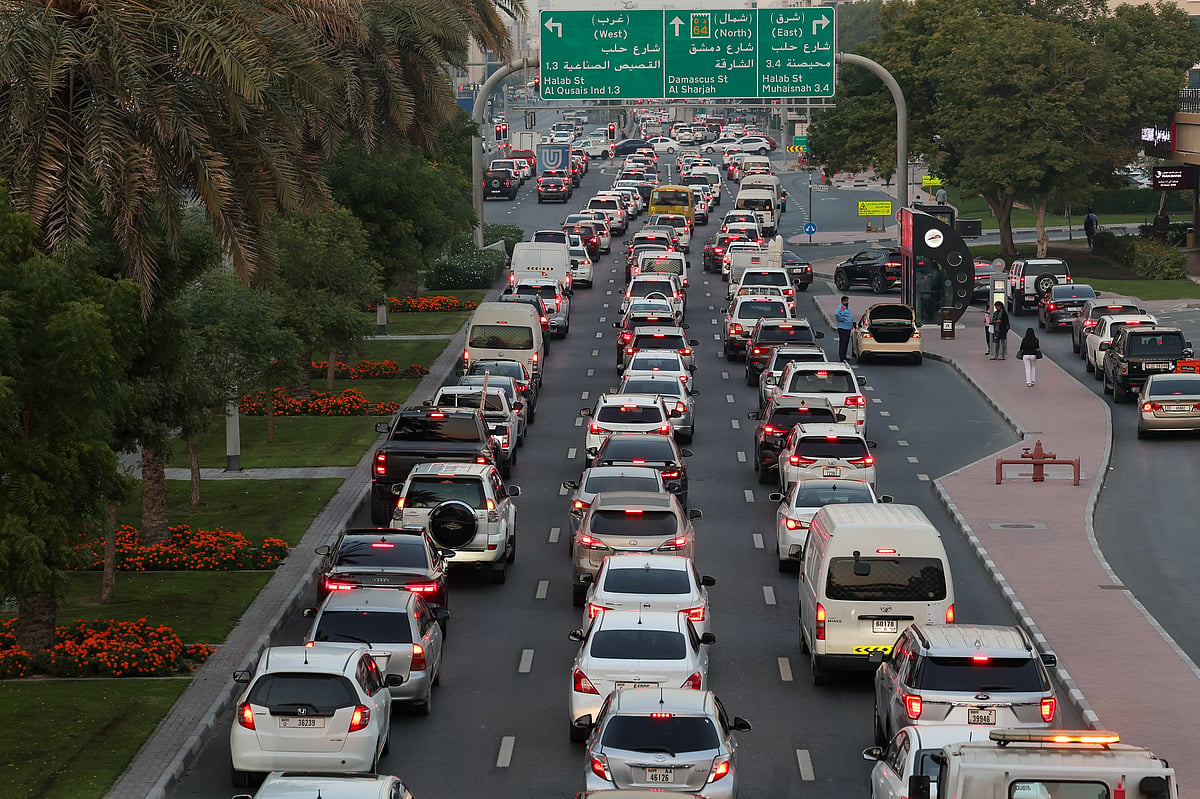
Dubai-Sharjah traffic
Virendra Saklani/Gulf News
Dubai: You are driving along a busy UAE highway when traffic suddenly slows to a crawl. There is no accident ahead. No broken-down vehicle is blocking a lane. No roadworks are causing a bottleneck. So why has traffic suddenly stopped?
The answer could be a phantom traffic jam.
“This is known as phantom traffic, which is a sudden slowdown or stop on a road that happens without any obvious cause like an accident or roadwork,” Thomas Edelmann, founder and Managing Director of RoadSafetyUAE, told Gulf News.
On some of the UAE’s busiest roads, where thousands of vehicles are travelling close together, a tiny change in one driver’s behaviour can quickly spread through the traffic.
How does a phantom traffic jam start?
Phantom traffic jams are more likely when there are lots of cars packed closely together.
“A driver may lightly tap the brakes, perhaps because they have moved too close to the vehicle ahead. The driver behind sees the brake lights and takes a moment to react, braking slightly harder. The next driver does the same, and the effect continues down the line,” Edelmann, said.
Eventually, drivers further back may be forced to slow dramatically or even come to a complete stop. “The important point is that nothing major had to happen to cause the jam. A small disturbance in free-flowing traffic can be enough to create a chain reaction,” Edelmann, said.
And it does not necessarily remain in one lane.
“Other motorists going in the lane next to the car that brakes might also brake because they might think something is wrong or wonder what is going on. In some cases, it can involve multiple lanes,” he said.
Phantom traffic jams are more likely to develop when roads are carrying a large number of vehicles. In such congested conditions, even a minor change in speed, such as a driver braking suddenly or leaving too little space ahead, can trigger a chain reaction, with each following vehicle slowing down more than the last until traffic comes to a standstill.
Thomas Edelmann Founder and Managing Director of RoadSafetyUAE
Why heavy traffic can turn into a phantom jam
The first step in understanding phantom traffic jams is traffic density. When there are more vehicles on the road, cars have less space between them, leaving less room for small changes in speed to be absorbed.
This matters on busy UAE roads, where traffic congestion is common. A 2025 study found that 91 per cent of Dubai residents and 90 per cent of Sharjah residents typically experience traffic jams. Dubai also recorded 3.5 million cars in 2024, a 10 per cent increase, according to data from Dubai's Roads and Transport Authority (RTA).
Can phantom traffic jams occur even when there are fewer cars on the road?
A 2008 experiment in Japan demonstrated how a phantom jam can form even when there is no obvious cause.
Researchers asked drivers to travel around a circular track at a constant 30km/h while maintaining a safe distance from one another. There were no accidents, lane changes, roadworks or obstacles. Yet within about a minute, a traffic jam formed.
One driver travelling slightly slower or making a small braking adjustment created a disturbance. The driver behind reacted by slowing down, the next driver slowed down further, and the effect continued through the line until vehicles at the back were forced to slow dramatically or stop.
The experiment showed how a small change in an otherwise smooth flow of traffic can become a much larger problem when vehicles are travelling close together.
UAE roads: Is following distance the problem?
According to Mustafa Aldah, founder of RoadHeroAcademy and a road safety expert, the same phenomenon occurs frequently on UAE roads.
One of the biggest contributing factors, he said, is drivers failing to leave enough space between their vehicle and the one ahead.
“If everybody left a safe distance, that gap would be enough to absorb a slowdown without anyone needing to brake. The wave never forms, and the phantom jam disappears before it starts,” Aldah, explained.
When drivers follow too closely, there is little room to absorb even a small change in speed. “The only response available is the brake pedal, and that’s what passes the problem back to everyone behind,” he said.
Dubai Police recommends maintaining a safe following distance of at least three seconds from the vehicle ahead. “As long as that gap is missing, I think this phenomenon will keep appearing occasionally,” he said.
If everyone left a safe distance between their vehicles, that gap would be enough to absorb a slowdown without anyone having to brake. The wave would never form, and the phantom jam could disappear before it even starts. But when most drivers do not know what a safe following distance actually looks like, that space simply isn't there. The only response left is to hit the brakes and that is what passes the problem back to every driver behind them.
Dr. Mustafa Aldah founder of RoadHeroAcademy
Can drivers prevent phantom traffic jams?
There may not be a way to eliminate phantom traffic jams completely, particularly when roads become extremely crowded. Drivers can reduce the chances of creating or amplifying them.
Aldah said the key is to leave enough space to see beyond the vehicle directly in front and anticipate what is happening further ahead.
He explained this using a simple A4 sheet of paper. Hold the paper vertically next to your nose and it blocks your view. Move it further away and you can see more of the space around it.
“Driving is exactly the same. If you are too close to the car ahead, you cannot see what is in front of them. If there is something in the road that they cannot avoid, you will get entangled as well,” he said.
His advice is to stay at least two seconds behind the vehicle ahead and “read” the traffic further down the road. “You can almost always tell when something is wrong before it becomes unavoidable,” he said.
Traffic congestion itself is unlikely to disappear but for UAE motorists, the message is simple - leave a safe gap, brake and accelerate smoothly, and resist constantly changing lanes.
Sign up for the Daily Briefing
Get the latest news and updates straight to your inbox
Network Links
GN StoreAbout Gulf NewsTerms & ConditionsReach by GNSitemapContact usPrivacy PolicyGN FocusHave your sayWork with usAdvertise with usGulf News epaperPrinting Services
Download our app
© Al Nisr Publishing LLC 2026. All rights reserved.